
巨噬细胞介导的异体吞噬有助于在不敏感的啮齿动物宿主东方田鼠体内破坏人类血吸虫。
Macrophage-mediated trogocytosis contributes to destroying human schistosomes in a non-susceptible rodent host, Microtus fortis.
作者信息
Shen Jia, Zhao Siyu, Peng Mei, Li Yanguo, Zhang Lichao, Li Xiaoping, Hu Yunyi, Wu Mingrou, Xiang Suoyu, Wu Xiaoying, Liu Jiahua, Zhang Beibei, Chen Zebin, Lin Datao, Liu Huanyao, Tang Wenyan, Chen Jun, Sun Xi, Liao Qi, Hide Geoff, Zhou Zhijun, Lun Zhao-Rong, Wu Zhongdao
机构信息
Department of Parasitology, Zhongshan School of Medicine, Sun Yat-Sen University, Guangzhou, Guangdong, China.
Key Laboratory of Tropical Disease Control of the Ministry of Education, Sun Yat-sen University, Guangzhou, Guangdong, China.
出版信息
Cell Discov. 2023 Oct 5;9(1):101. doi: 10.1038/s41421-023-00603-6.
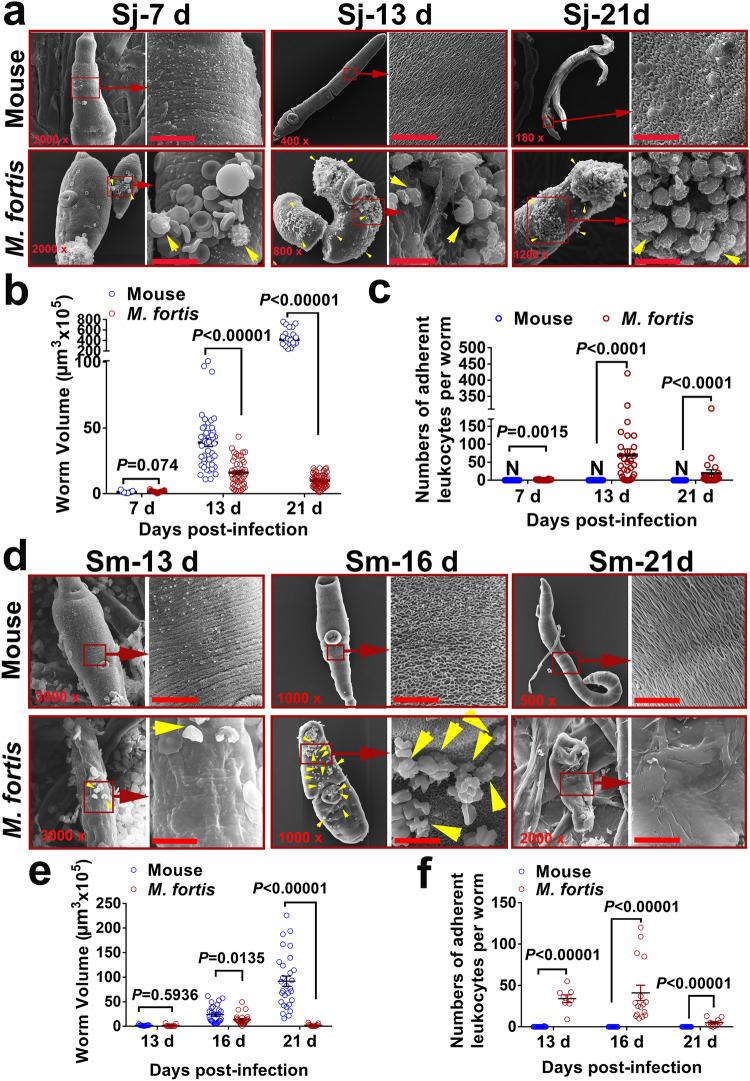
Schistosoma parasites, causing schistosomiasis, exhibit typical host specificity in host preference. Many mammals, including humans, are susceptible to infection, while the widely distributed rodent, Microtus fortis, exhibits natural anti-schistosome characteristics. The mechanisms of host susceptibility remain poorly understood. Comparison of schistosome infection in M. fortis with the infection in laboratory mice (highly sensitive to infection) offers a good model system to investigate these mechanisms and to gain an insight into host specificity. In this study, we showed that large numbers of leukocytes attach to the surface of human schistosomes in M. fortis but not in mice. Single-cell RNA-sequencing analyses revealed that macrophages might be involved in the cell adhesion, and we further demonstrated that M. fortis macrophages could be mediated to attach and kill schistosomula with dependence on Complement component 3 (C3) and Complement receptor 3 (CR3). Importantly, we provided direct evidence that M. fortis macrophages could destroy schistosomula by trogocytosis, a previously undescribed mode for killing helminths. This process was regulated by Ca/NFAT signaling. These findings not only elucidate a novel anti-schistosome mechanism in M. fortis but also provide a better understanding of host parasite interactions, host specificity and the potential generation of novel strategies for schistosomiasis control.
引起血吸虫病的血吸虫寄生虫在宿主偏好方面表现出典型的宿主特异性。许多哺乳动物,包括人类,都易受感染,而广泛分布的啮齿动物东方田鼠则表现出天然的抗血吸虫特性。宿主易感性的机制仍知之甚少。将东方田鼠的血吸虫感染与实验室小鼠(对感染高度敏感)的感染进行比较,为研究这些机制和深入了解宿主特异性提供了一个良好的模型系统。在本研究中,我们发现大量白细胞附着在东方田鼠体内的人体血吸虫表面,而在小鼠体内则没有。单细胞RNA测序分析表明巨噬细胞可能参与细胞黏附,并且我们进一步证明东方田鼠巨噬细胞可以在依赖补体成分3(C3)和补体受体3(CR3)的情况下介导附着并杀死血吸虫幼虫。重要的是,我们提供了直接证据,证明东方田鼠巨噬细胞可以通过反吞噬作用破坏血吸虫幼虫,这是一种以前未描述的杀死蠕虫的方式。这个过程受Ca/NFAT信号通路调控。这些发现不仅阐明了东方田鼠体内一种新的抗血吸虫机制,还为更好地理解宿主-寄生虫相互作用、宿主特异性以及血吸虫病控制新策略的潜在产生提供了依据。



 Zotero 插件