
系统免疫炎症指数与代谢综合征及其组分的关系:来自 2011-2016 年全国健康与营养调查的结果。
Association between systemic immune-inflammation index and metabolic syndrome and its components: results from the National Health and Nutrition Examination Survey 2011-2016.
机构信息
Department of Nuclear Medicine, Southwest Hospital, Third Military Medical University (Army Medical University), Chongqing, China.
Department of Basic Medicine, Third Military Medical University (Army Medical University), Chongqing, China.
出版信息
J Transl Med. 2023 Oct 4;21(1):691. doi: 10.1186/s12967-023-04491-y.
BACKGROUND
Metabolic syndrome (MetS), a worldwide public health problem, affects human health and quality of life in a dramatic manner. A growing evidence base suggests that MetS is strongly associated with levels of systemic immune inflammation. The present study aimed to investigate the possible relationship between the systemic immune-inflammation index (SII), a novel inflammatory marker, and MetS to provide data support for effective MetS prevention by reducing the systemic inflammatory response.
METHODS
We included adult participants with complete SII and MetS information from the 2011-2016 National Health and Nutrition Examination Survey (NHANES). MetS was defined as using the criteria developed by the Adult Treatment Program III of the National Cholesterol Education Program. The formula for SII was as follows: SII = platelet counts × neutrophil counts/ lymphocyte counts. Weighted linear regression was used to assess differences in variables across SII quartile groups after the SII score was divided into 4 quartiles. The independent interaction between SII and MetS was investigated using weighted multivariate logistic regression analysis and subgroup analysis, and the relationship between SII levels and 5 particular MetS items was further explored in depth.
RESULTS
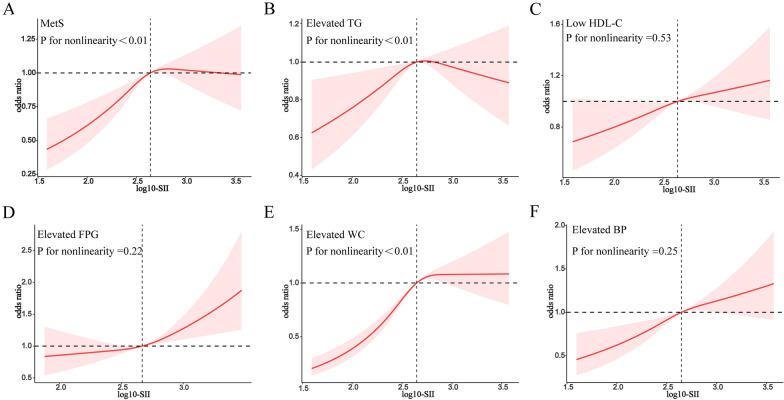
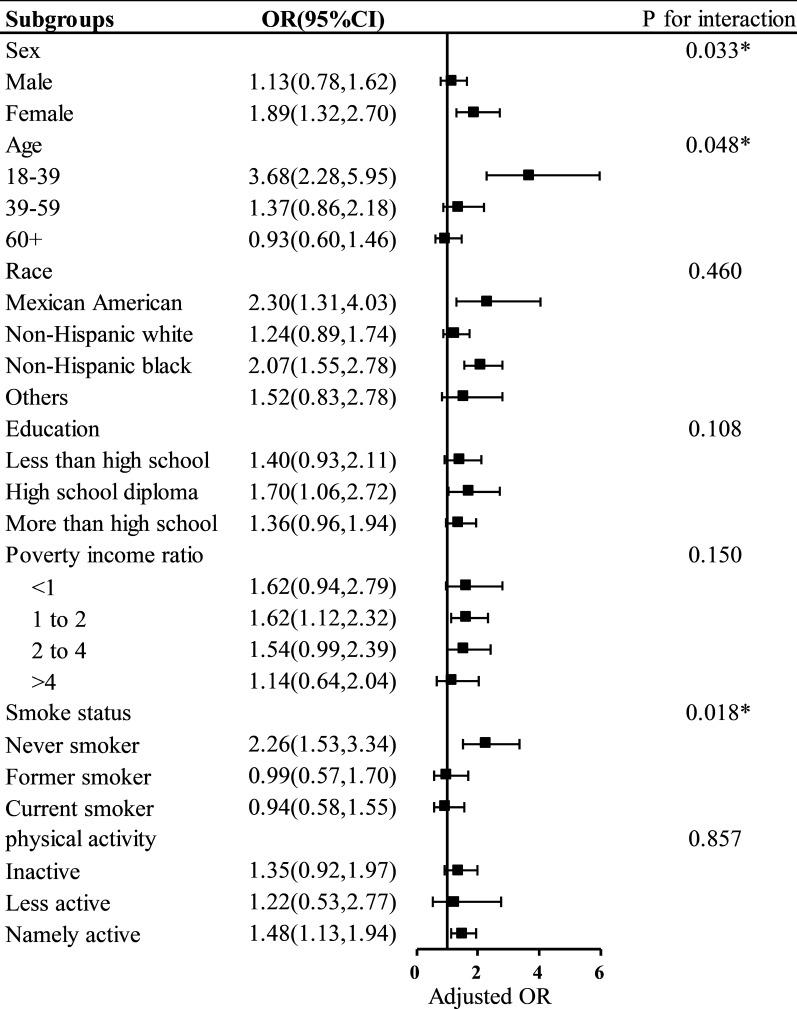
A total of 12,402 participants, 3,489 of whom were diagnosed with MetS, were included in this study. After correcting for covariates, the results of a logistic regression of multistage weighted complex sampling data revealed that participants with higher SII scores had a higher chance of developing MetS (odds ratio (OR) = 1.33, 95% confidence interval (CI): 1.14-1.55) and that SII levels could be used as an independent risk factor to predict that likelihood of MetS onset. In the Q1-Q4 SII quartile group, the risk of developing MetS was 1.33 times higher in the Q4 group, which had the highest level of systemic immune inflammation than in the Q1 group. After adjusting for all confounding factors, SII scores were found to have a negative correlation with high-density lipoprotein cholesterol (OR = 1.29; 95% CI, 0.99-1.67, P = 0.056) and a significant positive correlation with waist circumference (OR = 2.17; 95% CI, 1.65-2.87, P < 0.001) and blood pressure (BP) (OR = 1.65; 95% CI, 1.20-2.27, P = 0.003). Gender, age, and smoking status were shown to alter the positive association between SII and MetS in subgroup analyses and interaction tests (p for interaction < 0.05). Additionally, we demonstrated a nonlinear correlation between SII and MetS. The findings of the restricted cubic spline indicated that there was an inverted U-shaped association between SII and MetS.
CONCLUSIONS
Our findings imply that increased SII levels are related to MetS, and SII may be a simple and cost-effective method to identify individuals with MetS. Therefore, protective measures such as early investigation and anti-inflammatory interventions are necessary to reduce the overall incidence of MetS.
背景
代谢综合征(MetS)是一个全球性的公共卫生问题,对人类健康和生活质量有显著影响。越来越多的证据表明,MetS 与全身性免疫炎症水平密切相关。本研究旨在探讨全身性免疫炎症指数(SII)与 MetS 之间可能的关系,为通过降低全身性炎症反应来有效预防 MetS 提供数据支持。
方法
我们纳入了来自 2011-2016 年全国健康与营养调查(NHANES)的具有完整 SII 和 MetS 信息的成年参与者。MetS 按照国家胆固醇教育计划成人治疗方案 III 的标准定义。SII 的公式如下:SII=血小板计数×中性粒细胞计数/淋巴细胞计数。将 SII 评分分为 4 个四分位数后,采用加权线性回归评估各变量在 SII 四分位数组之间的差异。采用加权多变量 logistic 回归分析和亚组分析研究 SII 与 MetS 之间的独立交互作用,并进一步深入探讨 SII 水平与 5 个特定 MetS 项目之间的关系。
结果
共纳入 12402 名参与者,其中 3489 名被诊断为 MetS。经协变量校正后,多阶段加权复杂抽样数据的 logistic 回归结果显示,SII 评分较高的参与者发生 MetS 的几率更高(比值比(OR)=1.33,95%置信区间(CI):1.14-1.55),且 SII 水平可作为独立的危险因素预测 MetS 发病的可能性。在 Q1-Q4 SII 四分位组中,与 Q1 组相比,SII 水平最高的 Q4 组发生 MetS 的风险高 1.33 倍。在调整所有混杂因素后,SII 评分与高密度脂蛋白胆固醇呈负相关(OR=1.29;95%CI,0.99-1.67,P=0.056),与腰围(OR=2.17;95%CI,1.65-2.87,P<0.001)和血压(BP)(OR=1.65;95%CI,1.20-2.27,P=0.003)呈显著正相关。性别、年龄和吸烟状况在亚组分析和交互检验中改变了 SII 与 MetS 之间的正相关关系(交互检验 P<0.05)。此外,我们还发现 SII 与 MetS 之间存在非线性关系。限制立方样条分析的结果表明,SII 与 MetS 之间存在倒 U 型关联。
结论
我们的研究结果表明,SII 水平升高与 MetS 相关,SII 可能是一种简单且经济有效的方法来识别 MetS 患者。因此,有必要采取早期调查和抗炎干预等保护措施,以降低 MetS 的总体发病率。

 Zotero 插件