
质子泵抑制剂与痴呆:一项全国性基于人群的研究。
Proton pump inhibitors and dementia: A nationwide population-based study.
机构信息
Danish Dementia Research Centre, Department of Neurology, Copenhagen University Hospital - Rigshospitalet, Copenhagen, Denmark.
Department of Clinical Medicine, University of Copenhagen, Copenhagen, Denmark.
出版信息
Alzheimers Dement. 2024 Feb;20(2):837-845. doi: 10.1002/alz.13477. Epub 2023 Oct 5.
INTRODUCTION
Proton pump inhibitors (PPIs) may increase dementia risk. However, it is currently unknown whether timing of exposure or age at dementia diagnosis influence the risk.
METHODS
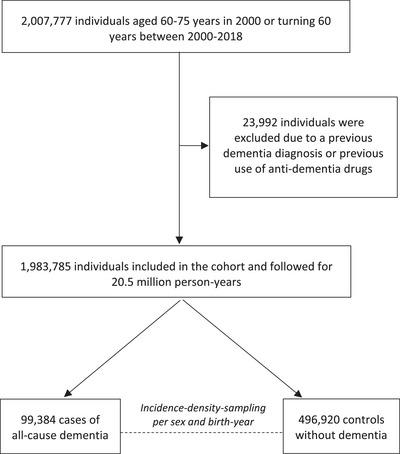
We assessed associations between cumulative PPI use and dementia at different ages in a nationwide Danish cohort of 1,983,785 individuals aged 60 to 75 years between 2000 and 2018.
RESULTS
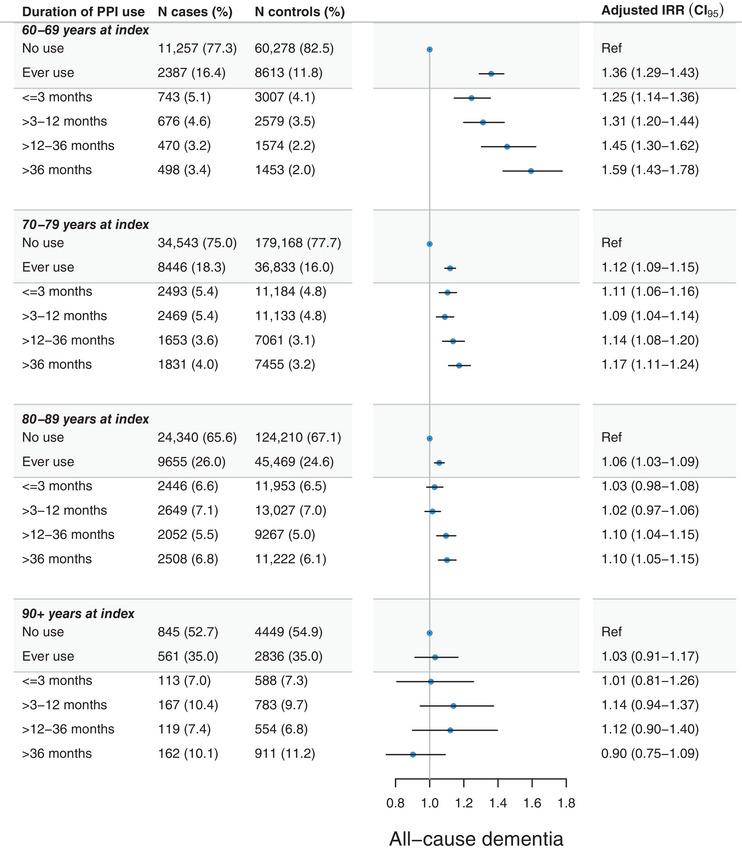
During follow-up, there were 99,384 all-cause dementia incidences. Incidence rate ratio (IRR) of dementia with PPI ever-use compared with never-use was 1.36 (95% CI, 1.29 to 1.43) for age 60 to 69 years at diagnosis, 1.12 (1.09 to 1.15) for 70 to 79 years, 1.06 (1.03 to 1.09) for 80 to 89 years, and 1.03 (0.91 to 1.17) for 90+ years. Longer treatment duration yielded increasing IRRs. For cases below 90 years, increased dementia rate was observed regardless of treatment initiation up to >15 years before diagnosis.
DISCUSSION
Regardless of timing of treatment initiation, PPI use was associated with increased dementia rate before age 90 years. Dementia rates increased with younger age at diagnosis.
HIGHLIGHTS
After following 1,983,785 individuals for a median of 10 years, 99,384 developed dementia PPIs were used by 21.2% of cases and 18.9% of controls PPI use was associated with increased dementia rate regardless of time of treatment onset Magnitude of associations increased with younger age at diagnosis PPI use was not associated with dementia occurring after age 90 years.
简介
质子泵抑制剂 (PPI) 可能会增加痴呆症的风险。然而,目前尚不清楚暴露时间或痴呆症诊断时的年龄是否会影响这种风险。
方法
我们在一项针对丹麦全国范围内年龄在 60 至 75 岁之间的 1983785 人的队列研究中,评估了在不同年龄时累积使用 PPI 与痴呆症之间的相关性。
结果
在随访期间,共有 99384 例全因痴呆症发病。与从未使用 PPI 相比,诊断时年龄为 60 至 69 岁、70 至 79 岁、80 至 89 岁和 90 岁以上的 PPI 使用者患痴呆症的发生率比值(IRR)分别为 1.36(95%CI,1.29 至 1.43)、1.12(1.09 至 1.15)、1.06(1.03 至 1.09)和 1.03(0.91 至 1.17)。治疗时间越长,IRR 越高。对于年龄低于 90 岁的病例,无论治疗开始时间如何,在诊断前 15 年以上,痴呆症的发生率都有所增加。
讨论
无论治疗开始时间如何,PPI 使用与 90 岁以下人群的痴呆症发生率增加有关。痴呆症的发生率随着诊断时年龄的降低而增加。
重点
在对 1983785 人进行中位数为 10 年的随访后,99384 人发展为痴呆症。病例中有 21.2%使用了 PPI,对照组中有 18.9%使用了 PPI。无论治疗开始时间如何,PPI 使用都与痴呆症发生率增加相关。这种相关性的幅度随着诊断时年龄的降低而增加。PPI 使用与 90 岁以后发生的痴呆症无关。

 Zotero 插件