
自愿和强制处方药物监测计划实施后,开处阿片类药物用于疼痛的人群中阿片类激动剂治疗起始的变化:时间序列分析。
Changes in opioid agonist treatment initiation among people prescribed opioids for pain following voluntary and mandatory prescription drug monitoring program implementation: A time series analysis.
机构信息
Monash Addiction Research Centre, Eastern Health Clinical School, Monash University, Melbourne, Australia.
Centre for Medicine Use and Safety, Faculty of Pharmacy and Pharmaceutical Sciences, Monash University, Melbourne, Australia.
出版信息
Drug Alcohol Rev. 2023 Nov;42(7):1639-1646. doi: 10.1111/dar.13754. Epub 2023 Oct 5.
INTRODUCTION
Prescription drug monitoring programs (PDMP) are increasingly used to identify people prescribed high-dose opioids. However, little is known about whether PDMPs impact opioid agonist treatment (OAT) uptake, the gold standard for opioid use disorder. This study examined the impact of PDMP implementation on OAT initiation among people prescribed opioids, in Victoria, Australia.
METHODS
De-identified electronic records from all 464 Victorian general practices included in the POLAR database were used. OAT initiation was defined as a new OAT prescription between 1 April 2017 and 31 December 2020, with no OAT prescriptions in the year prior. Interrupted time series analyses were used to compare outcomes before (April 2017 to March 2019) and after (April 2019 to December 2020) PDMP implementation. Binary logistic regression was used to examine differences in patients' characteristics associated with OAT initiation prior to and after PDMP implementation.
RESULTS
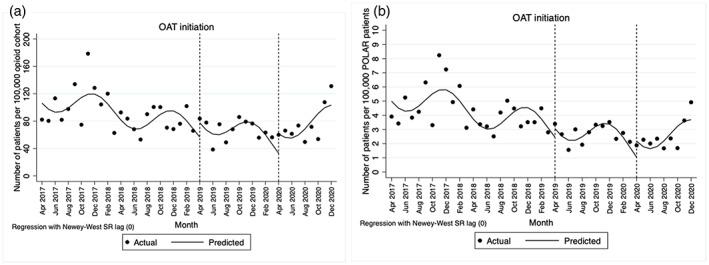
In total, 1610 people initiated OAT, 946 before and 664 after PDMP implementation. No significant immediate (step) or longer-term (slope) changes in the rates of OAT initiation were identified following PDMP implementation, after adjusting for seasonality. A high opioid dose (>100 mg oral morphine equivalent) in the 6-months prior to OAT initiation was the only significant characteristic associated with reduced odds of OAT initiation post-PDMP implementation (odds ratio 0.29; 0.23-0.37).
DISCUSSION AND CONCLUSIONS
PDMP implementation did not have a significant impact on OAT initiation among people prescribed opioids. Findings suggest additional clinical initiatives that support OAT initiation are required to ensure PDMPs meet their intended target of reducing opioid-related harms.
引言
处方药物监测计划(PDMP)越来越多地用于识别开处高剂量阿片类药物的人群。然而,对于 PDMP 是否会影响阿片类药物激动剂治疗(OAT)的采用(阿片类药物使用障碍的金标准)知之甚少。本研究在澳大利亚维多利亚州,调查了 PDMP 的实施对开处阿片类药物人群中 OAT 起始的影响。
方法
使用包含在 POLAR 数据库中的所有 464 家维多利亚州全科诊所的去识别电子记录。OAT 起始定义为 2017 年 4 月 1 日至 2020 年 12 月 31 日期间的新 OAT 处方,且在之前的一年中没有 OAT 处方。中断时间序列分析用于比较 PDMP 实施前后(2017 年 4 月至 2019 年 3 月;2019 年 4 月至 2020 年 12 月)的结果。二项逻辑回归用于检查 PDMP 实施前后与 OAT 起始相关的患者特征的差异。
结果
共有 1610 人开始接受 OAT 治疗,946 人在 PDMP 实施前,664 人在 PDMP 实施后。调整季节性因素后,PDMP 实施后,OAT 起始率没有明显的即时(步长)或长期(斜率)变化。OAT 起始前 6 个月内的高阿片类药物剂量(>100mg 口服吗啡当量)是与 PDMP 实施后 OAT 起始可能性降低相关的唯一显著特征(比值比 0.29;0.23-0.37)。
讨论与结论
PDMP 的实施对开处阿片类药物人群的 OAT 起始没有显著影响。研究结果表明,需要采取额外的临床措施来支持 OAT 的起始,以确保 PDMP 能够达到减少阿片类相关危害的预期目标。
 Zotero 插件