
中国汉族人群髓鞘少突胶质细胞糖蛋白抗体相关性疾病的临床特征和长期随访结局。
Clinical characteristics and long-term follow-up outcomes of myelin oligodendrocyte glycoprotein antibody-associated disease in Han Chinese participants.
机构信息
Department of Neurology, Liuzhou People's Hospital, Liuzhou, China.
Department of Neurology, First Affiliated Hospital of Guangxi Medical University, Nanning, China.
出版信息
Medicine (Baltimore). 2023 Oct 6;102(40):e35391. doi: 10.1097/MD.0000000000035391.
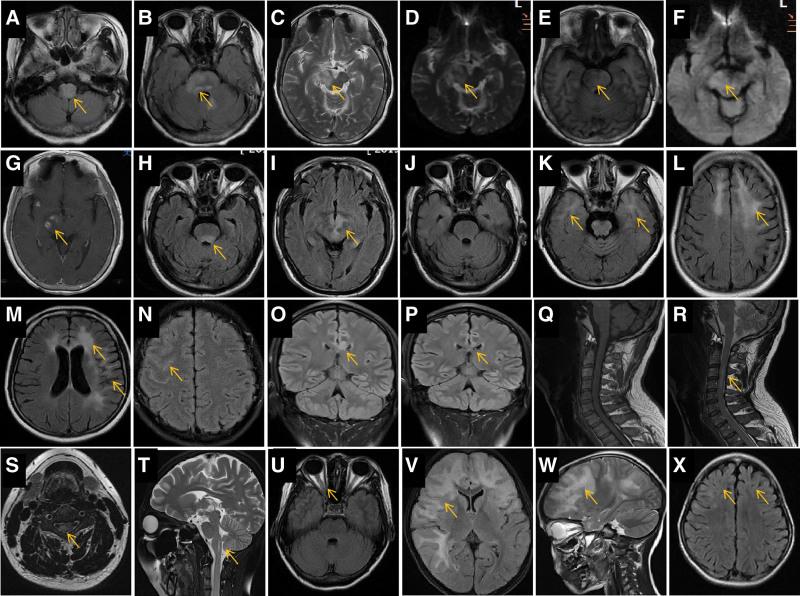
Myelin oligodendrocyte glycoprotein (MOG) antibody-associated disease (MOGAD) is an immune-mediated inflammatory demyelinating disease of the central nervous system. This study aimed to delineate the clinical manifestations, imaging features, and long-term outcomes in Chinese patients with MOGAD and analyze the recurrence-associated factors. The phenotypic and neuroimaging characteristics of 15 Han Chinese patients with MOGAD were retrospectively analyzed. Demyelinating attacks, MOG antibodies in the cerebrospinal fluid/serum, response to immunotherapy, follow-up outcomes, and recurrence-associated factors were recorded. The median age at disease onset was 34 years (range, 4-65 years). The most common initial presentations included vision loss (10/15, 66.7%) and seizures (5/15, 33.3%). Serum MOG-Ab titers in 14/15 cases were higher than those in the cerebrospinal fluid and were detected in 3/6 relapsed patients. Brain magnetic resonance imaging during acute attacks showed lesions in 10/15 patients (66.7%), mostly in the cortex/subcortical white matter (5/15, 33.3%). Recurrence occurred in 6/15 patients (40.0%); in 4 patients, recurrence occurred shortly after immunotherapy discontinuation. Residual neurological deficits were present in 5/15 patients (33.3%), including visual impairment, incapacitation, cognitive impairment, and speech reduction. Optic neuritis was the most common clinical manifestation of MOGAD. magnetic resonance imaging findings were heterogeneous and the cerebral cortex/subcortical white matter was the most susceptible brain region. Although patients in the acute phase responded well to methylprednisolone pulse therapy, the long-term recurrence rate was high. Consistently detected serum MOG antibodies and inappropriate maintenance immunotherapy may be associated with recurrence, and residual neurological deficits should not be ignored.
髓鞘少突胶质细胞糖蛋白 (MOG) 抗体相关性疾病 (MOGAD) 是一种中枢神经系统免疫介导的炎症性脱髓鞘疾病。本研究旨在描述中国 MOGAD 患者的临床表现、影像学特征和长期预后,并分析复发相关因素。回顾性分析 15 例汉族 MOGAD 患者的表型和神经影像学特征。记录脱髓鞘发作、脑脊液/血清中 MOG 抗体、免疫治疗反应、随访结果和复发相关因素。发病年龄中位数为 34 岁(范围 4-65 岁)。最常见的首发表现包括视力丧失(10/15,66.7%)和癫痫发作(5/15,33.3%)。14/15 例血清 MOG-Ab 滴度高于脑脊液,3/6 例复发患者检测到 MOG-Ab。急性发作期脑磁共振成像显示 10/15 例患者(66.7%)有病灶,多位于皮质/皮质下白质(5/15,33.3%)。15 例患者中有 6 例(40.0%)复发;4 例患者在免疫治疗停药后不久复发。15 例患者中有 5 例(33.3%)存在遗留神经功能缺损,包括视力损害、残疾、认知障碍和言语减少。视神经炎是 MOGAD 最常见的临床表现。磁共振成像表现呈异质性,大脑皮质/皮质下白质是最易受累的脑区。虽然急性期患者对甲基强的松龙脉冲治疗反应良好,但长期复发率较高。持续检测到血清 MOG 抗体和不适当的维持性免疫治疗可能与复发有关,不应忽视遗留的神经功能缺损。
 Zotero 插件