
美国人群中瘦体重与内脏脂肪量之比与骨密度的关联:一项横断面研究。
Association between lean body mass to visceral fat mass ratio and bone mineral density in United States population: a cross-sectional study.
作者信息
Li Longti, Zhong Huiqin, Shao Ya, Zhou Xu, Hua Yu, Chen Maoqian
机构信息
Department of Nursing, TaiHe Hospital, Hubei University of Medicine, Shiyan, China.
Department of Gastroenterology, TaiHe Hospital, Hubei University of Medicine, Shiyan, China.
出版信息
Arch Public Health. 2023 Oct 6;81(1):180. doi: 10.1186/s13690-023-01190-4.
BACKGROUND
Studies have explored the correlation between body composition and bone mineral density (BMD), but there has yet to be a consensus. Thus, the present study aims to comprehensively investigate the association between lean body mass, adipose tissue, and BMD.
METHODS
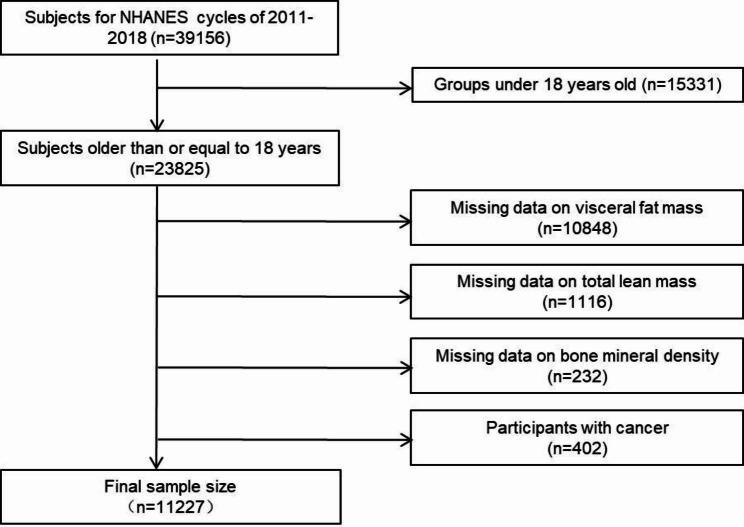
We conducted a cross-sectional study using data from the National Health and Nutrition Examination Survey (NHANES) (2011-2018) with 11,227 subjects. Multiple linear regression, smoothed curve fitting, threshold, and saturation effect analysis were used to explore the association between lean body mass, visceral fat mass, and BMD. Also, we used the lean body mass to visceral fat mass ratio (Log LM/VFM) as a proxy variable to analyze its association with BMD alone.
RESULTS
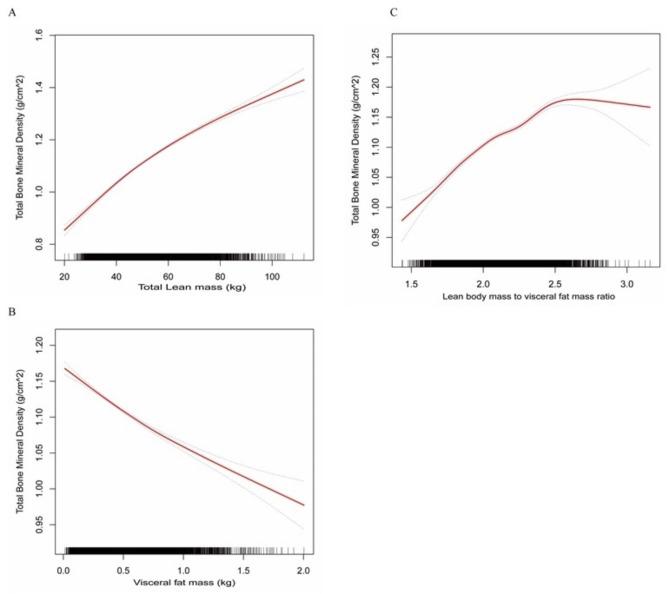
After adjusting for potential confounding factors, the results showed a positive correlation between lean mass and total BMD (for continuous: β = 0.078, P < 0.001; for quartile: β = 0.138, P < 0.001), while visceral fat mass was negatively correlated (for continuous: β = -0.027, P < 0.001; for quartile: β = -0.065, P < 0.001). A positive correlation was observed when the alternative variable Log LM/VFM was analyzed separately for its association with BMD (for continuous: β = 0.034, P < 0.001; for quartile: β = 0.084, P < 0.001). In addition, subgroup analyses for gender, age, body mass index, hypertension, and diabetes showed that all subgroups except the diabetes subgroup showed a substantial degree of robustness (P < 0.05). The smoothed curve fitting showed a nonlinear relationship between Log LM/VFM and BMD, and there was a threshold effect with a critical value of 2.60.
CONCLUSION
Maintaining a proper ratio of lean body mass and visceral fat mass is beneficial for increasing BMD.
背景
已有研究探讨了身体成分与骨密度(BMD)之间的相关性,但尚未达成共识。因此,本研究旨在全面调查瘦体重、脂肪组织与骨密度之间的关联。
方法
我们使用来自美国国家健康与营养检查调查(NHANES)(2011 - 2018年)的数据进行了一项横断面研究,共有11227名受试者。采用多元线性回归、平滑曲线拟合、阈值和饱和效应分析来探讨瘦体重、内脏脂肪量与骨密度之间的关联。此外,我们使用瘦体重与内脏脂肪量之比(Log LM/VFM)作为替代变量单独分析其与骨密度的关联。
结果
在调整潜在混杂因素后,结果显示瘦体重与总骨密度呈正相关(连续变量:β = 0.078,P < 0.001;四分位数变量:β = 0.138,P < 0.001),而内脏脂肪量呈负相关(连续变量:β = -0.027,P < 0.001;四分位数变量:β = -0.065,P < 0.001)。当单独分析替代变量Log LM/VFM与骨密度的关联时,观察到正相关(连续变量:β = 0.034,P < 0.001;四分位数变量:β = 0.084,P < 0.001)。此外,按性别、年龄、体重指数、高血压和糖尿病进行的亚组分析表明,除糖尿病亚组外,所有亚组均显示出较高的稳健性(P < 0.05)。平滑曲线拟合显示Log LM/VFM与骨密度之间存在非线性关系,并且存在阈值效应,临界值为2.60。
结论
维持瘦体重与内脏脂肪量的适当比例有利于增加骨密度。
 Zotero 插件