
对使用自我采集样本检测出人乳头瘤病毒(HPV)呈阳性的女性进行分子分类的选择方案。
Molecular triaging options for women testing HPV positive with self-collected samples.
作者信息
Taghavi Katayoun, Zhao Fanghui, Downham Laura, Baena Armando, Basu Partha
机构信息
Early Detection, Prevention and Infections Branch, International Agency For Research On Cancer (IARC), Lyon, France.
Department of Cancer Epidemiology, National Cancer Center/Cancer Hospital, Chinese Academy of Medical Sciences, Beijing, China.
出版信息
Front Oncol. 2023 Sep 22;13:1243888. doi: 10.3389/fonc.2023.1243888. eCollection 2023.
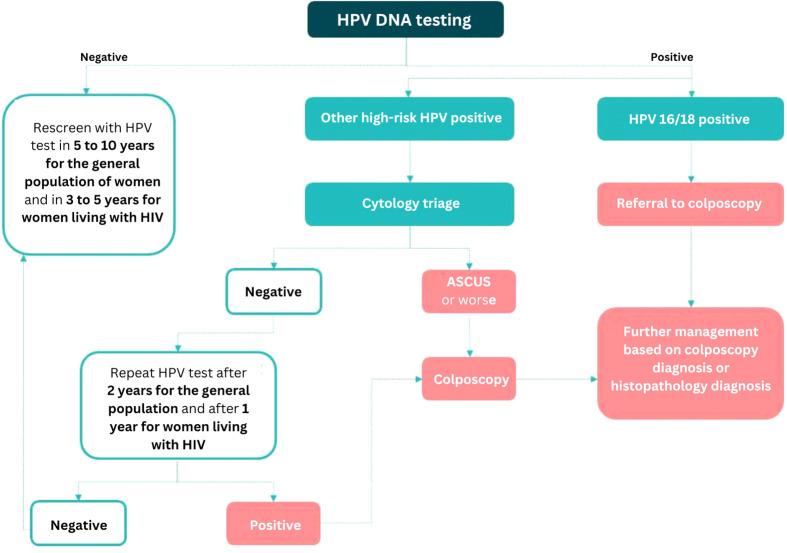
We review developments in molecular triaging options for women who test positive for high-risk human papillomavirus (hrHPV) on self-collected samples in the context of cervical cancer elimination. The World Health Organization (WHO) recommends hrHPV screening as the primary test for cervical screening due to its high sensitivity compared to other screening tests. However, when hrHPV testing is used alone for treatment decisions, a proportion of women of childbearing age receive unnecessary treatments. This provides the incentive to optimize screening regimes to minimize the risk of overtreatment in women of reproductive age. Molecular biomarkers can potentially enhance the accuracy and efficiency of screening and triage. HrHPV testing is currently the only screening test that allows triage with molecular methods using the same sample. Additionally, offering self-collected hrHPV tests to women has been reported to increase screening coverage. This creates an opportunity to focus health resources on linking screen-positive women to diagnosis and treatment. Adding an additional test to the screening algorithm (a triage test) may improve the test's positive predictive value (PPV) and offer a better balance of benefits and risks for women. Conventional triage methods like cytology and visual inspection with acetic acid (VIA) cannot be performed on self-collected samples and require additional clinic visits and subjective interpretations. Molecular triaging using methods like partial and extended genotyping, methylation tests, detection of E6/E7 proteins, and hrHPV viral load in the same sample as the hrHPV test may improve the prediction of cervical intraepithelial neoplasia grade 2 or worse (CIN2+) and invasive cancer, offering more precise, efficient, and cost-effective screening regimes. More research is needed to determine if self-collected samples are effective and cost-efficient for diverse populations and in comparison to other triage methods. The implementation of molecular triaging could improve screening accuracy and reduce the need for multiple clinical visits. These important factors play a crucial role in achieving the global goal of eliminating cervical cancer as a public health problem.
在宫颈癌消除的背景下,我们回顾了在自我采集样本中高危型人乳头瘤病毒(hrHPV)检测呈阳性的女性的分子分流选项的发展情况。世界卫生组织(WHO)建议将hrHPV筛查作为宫颈癌筛查的主要检测方法,因为与其他筛查检测相比,它具有更高的灵敏度。然而,当单独使用hrHPV检测来做出治疗决策时,一部分育龄妇女会接受不必要的治疗。这促使人们优化筛查方案,以尽量减少育龄妇女过度治疗的风险。分子生物标志物有可能提高筛查和分流的准确性和效率。目前,hrHPV检测是唯一一种能够使用相同样本通过分子方法进行分流的筛查检测。此外,据报道,向女性提供自我采集的hrHPV检测可提高筛查覆盖率。这为将卫生资源集中于将筛查呈阳性的女性与诊断和治疗相联系创造了机会。在筛查算法中增加一项额外检测(分流检测)可能会提高检测的阳性预测值(PPV),并为女性提供更好的利益和风险平衡。像细胞学检查和醋酸目视检查(VIA)等传统分流方法无法在自我采集的样本上进行,需要额外的门诊就诊和主观解读。在与hrHPV检测相同的样本中使用部分和扩展基因分型、甲基化检测、E6/E7蛋白检测以及hrHPV病毒载量等方法进行分子分流,可能会改善对2级或更高级别宫颈上皮内瘤变(CIN2+)和浸润性癌的预测,提供更精确、高效且具有成本效益的筛查方案。需要更多研究来确定自我采集的样本对于不同人群是否有效且具有成本效益,以及与其他分流方法相比情况如何。分子分流的实施可以提高筛查准确性并减少多次门诊就诊的需求。这些重要因素在实现将宫颈癌作为公共卫生问题消除的全球目标中起着至关重要的作用。
 Zotero 插件