
脑室灌洗与脑室外引流治疗脑室出血的随机临床试验
Intraventricular Lavage vs External Ventricular Drainage for Intraventricular Hemorrhage: A Randomized Clinical Trial.
机构信息
Department of Neurosurgery, Aarhus University Hospital, Aarhus, Denmark.
Department of Clinical Medicine, Aarhus University, Aarhus, Denmark.
出版信息
JAMA Netw Open. 2023 Oct 2;6(10):e2335247. doi: 10.1001/jamanetworkopen.2023.35247.
IMPORTANCE
Intraventricular lavage has been proposed as a minimally invasive method to evacuate intraventricular hemorrhage. There is little evidence to support its use.
OBJECTIVE
To evaluate the safety and potential efficacy of intraventricular lavage treatment of intraventricular hemorrhage.
DESIGN, SETTING, AND PARTICIPANTS: This single-blinded, controlled, investigator-initiated 1:1 randomized clinical trial was conducted at Aarhus University Hospital and Odense University Hospital in Denmark from January 13, 2022, to November 24, 2022. Follow-up duration was 90 days. The trial was set to include 58 patients with intraventricular hemorrhage. Prespecified interim analysis was performed for the first 20 participants. Data were analyzed from February to April 2023.
INTERVENTIONS
Participants were randomized to receive either intraventricular lavage or standard drainage.
MAIN OUTCOMES AND MEASURES
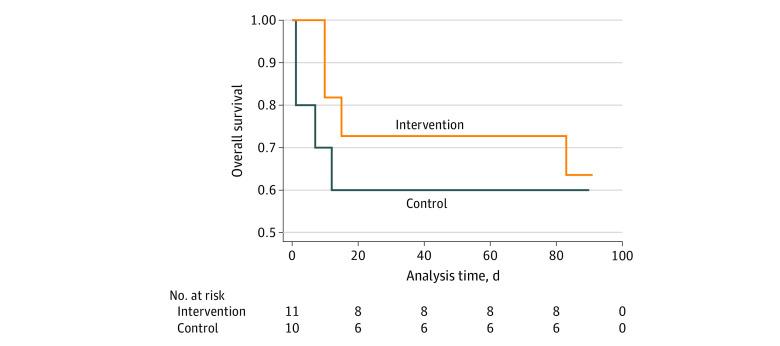
The main outcome was risk of catheter occlusions. Additional safety outcomes were catheter-related infections and procedure time, length of stay at the intensive care unit, duration of treatment, and 30-day mortality. The main outcome of the prespecified interim analysis was risk of severe adverse events. Efficacy outcomes were hematoma clearance, functional outcome, overall survival, and shunt dependency.
RESULTS
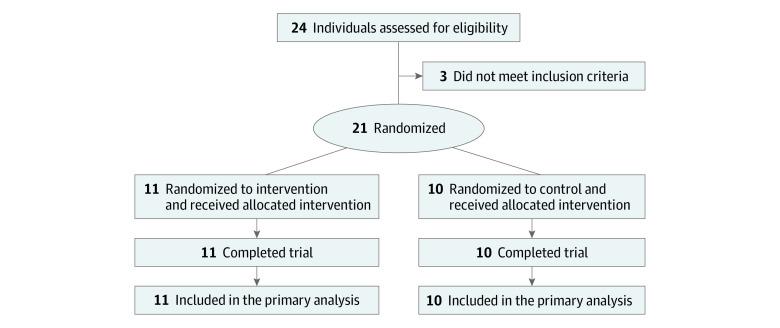
A total of 21 participants (median [IQR] age, 67 [59-82] years; 14 [66%] male) were enrolled, with 11 participants randomized to intraventricular lavage and 10 participants randomized to standard drainage; 20 participants (95%) had secondary intraventricular hemorrhage. The median (IQR) Graeb score was 9 (5-11), and the median (IQR) Glasgow Coma Scale score was 6.5 (4-8). The study was terminated early due to a significantly increased risk of severe adverse events associated with intraventricular lavage at interim analysis (risk difference for control vs intervention, 0.43; 95% CI, 0.06-0.81; P = .04; incidence rate ratio for control vs intervention, 6.0; 95% CI, 1.38-26.1; P = .01). The rate of catheter occlusion was higher for intraventricular lavage compared with drainage (6 of 16 patients [38%] vs 2 of 13 patients [7%]; hazard ratio, 4.4 [95% CI, 0.6-31.2]; P = .14), which met the prespecified α = .20 level. Median (IQR) procedure time for catheter placement was 53.5 (33-75) minutes for intraventricular lavage vs 12 (4-20) minutes for control (P < .001).
CONCLUSIONS AND RELEVANCE
This randomized clinical trial of intraventricular lavage vs standard drainage found that intraventricular lavage was encumbered with a significantly increased number of severe adverse events. Caution is recommended when using the device to ensure patient safety.
TRIAL REGISTRATION
ClinicalTrials.gov Identifier: NCT05204849.
重要性
脑室灌洗被提议作为一种微创方法来清除脑室内出血。几乎没有证据支持其使用。
目的
评估脑室灌洗治疗脑室内出血的安全性和潜在疗效。
设计、地点和参与者:这是一项由研究者发起的、单盲、对照、1:1 随机临床试验,于 2022 年 1 月 13 日至 11 月 24 日在丹麦奥胡斯大学医院和欧登塞大学医院进行。随访时间为 90 天。试验计划纳入 58 例脑室内出血患者。对前 20 名参与者进行了预设的中期分析。数据分析于 2023 年 2 月至 4 月进行。
干预措施
参与者被随机分配接受脑室灌洗或标准引流。
主要和次要结局
主要结局是导管阻塞的风险。其他安全性结局包括导管相关感染和手术时间、重症监护病房住院时间、治疗持续时间以及 30 天死亡率。预设中期分析的主要结局是严重不良事件的风险。疗效结局是血肿清除、功能结局、总生存率和分流依赖性。
结果
共纳入 21 名参与者(中位数[IQR]年龄,67[59-82]岁;14[66%]为男性),其中 11 名参与者随机分配至脑室灌洗组,10 名参与者随机分配至标准引流组;20 名参与者(95%)有继发性脑室内出血。Graeb 评分中位数(IQR)为 9(5-11),格拉斯哥昏迷量表评分中位数(IQR)为 6.5(4-8)。由于中期分析显示脑室灌洗与严重不良事件风险显著增加,研究提前终止(对照组与干预组的风险差异为 0.43;95%CI,0.06-0.81;P=0.04;对照组与干预组的发病率比为 6.0;95%CI,1.38-26.1;P=0.01)。与引流组相比,脑室灌洗组的导管阻塞发生率更高(16 名患者中有 6 名[38%] vs 13 名患者中有 2 名[7%];危险比,4.4[95%CI,0.6-31.2];P=0.14),达到了预设的 α=0.20 水平。脑室灌洗组的导管放置手术时间中位数(IQR)为 53.5(33-75)分钟,对照组为 12(4-20)分钟(P<0.001)。
结论和相关性
这项与标准引流相比的脑室灌洗随机临床试验发现,脑室灌洗组发生严重不良事件的风险显著增加。使用该设备时应谨慎,以确保患者安全。
试验注册
ClinicalTrials.gov 标识符:NCT05204849。
 Zotero 插件