
哮喘的全球负担及其对特定亚组的影响:鼻息肉、过敏性鼻炎、重度哮喘、嗜酸性粒细胞性哮喘。
Global Burden of Asthma, and Its Impact on Specific Subgroups: Nasal Polyps, Allergic Rhinitis, Severe Asthma, Eosinophilic Asthma.
作者信息
Rabe Adrian Paul J, Loke Wei Jie, Gurjar Khushboo, Brackley Allison, Lucero-Prisno Iii Don Eliseo
机构信息
BioPharmaceutical Medical, Respiratory & Immunology, AstraZeneca, Cambridge, UK.
Imperial College, London, UK.
出版信息
J Asthma Allergy. 2023 Oct 6;16:1097-1113. doi: 10.2147/JAA.S418145. eCollection 2023.
BACKGROUND
The complex nature of asthma has resulted in a poor understanding of its epidemiology, particularly in low-and middle-income countries (LMIC). Clinical subgroups, such as patients with severe asthma, eosinophilic asthma, allergic rhinitis, or nasal polyps, experience additional barriers to care.
METHODS
Prevalence estimates for asthma and key clinical subgroups were extracted from the Global Burden of Diseases, Injuries, and Risk Factors Study 2019 and from a targeted literature review conducted through PubMed in October of 2021. National estimates were calculated and the roles of potential explanatory factors were explored through qualitative analysis.
RESULTS
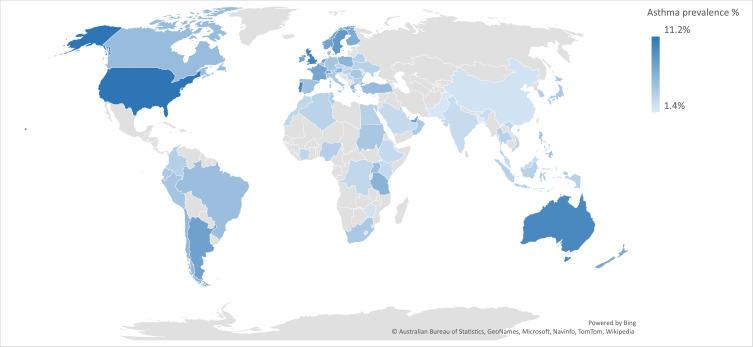
In total, 162 publications from 69 countries were included. Across continents, asthma prevalence values ranged from 3.44% (Asia), 3.67% (Africa), 4.90% (South America), 5.69% (Europe), 8.29% (North America), to 8.33% (Oceania). Globally, of those with asthma, 26.70% had severe asthma, 30.99% had eosinophilic asthma, 48.95% had allergic rhinitis, and 7.0% to 25.40% had nasal polyps. Countries with higher air quality, income status, and healthcare access and quality reported a higher asthma prevalence.
CONCLUSION
Asthma prevalence values were low in LMICs, potentially indicating health system deficiencies resulting in low diagnosis and reporting. The prevalence of eosinophilic asthma and severe asthma phenotypes was high in many countries, although the prevalence estimates of all asthma subgroups were quite variable.
背景
哮喘的复杂性导致对其流行病学的了解不足,在低收入和中等收入国家(LMIC)尤为如此。临床亚组,如重度哮喘、嗜酸性粒细胞性哮喘、过敏性鼻炎或鼻息肉患者,在获得医疗服务方面面临更多障碍。
方法
从《2019年全球疾病、伤害及危险因素负担研究》以及2021年10月通过PubMed进行的针对性文献综述中提取哮喘及关键临床亚组的患病率估计值。计算各国的估计值,并通过定性分析探讨潜在解释因素的作用。
结果
总共纳入了来自69个国家的162篇出版物。各大洲的哮喘患病率从3.44%(亚洲)、3.67%(非洲)、4.90%(南美洲)、5.69%(欧洲)、8.29%(北美洲)到8.33%(大洋洲)不等。在全球范围内,哮喘患者中,26.70%患有重度哮喘,30.99%患有嗜酸性粒细胞性哮喘,48.95%患有过敏性鼻炎,7.0%至25.40%患有鼻息肉。空气质量、收入状况、医疗服务可及性和质量较高的国家报告的哮喘患病率较高。
结论
低收入和中等收入国家的哮喘患病率较低,这可能表明卫生系统存在缺陷,导致诊断和报告率较低。许多国家嗜酸性粒细胞性哮喘和重度哮喘表型的患病率较高,尽管所有哮喘亚组的患病率估计差异很大。

 Zotero 插件