
脂联素 rs1501299 和趋化素 rs17173608 基因多态性与 1 型糖尿病患儿的大血管病变及外周动脉疾病的关系。
Adiponectin rs1501299 and chemerin rs17173608 gene polymorphism in children with type 1 diabetes mellitus: relation with macroangiopathy and peripheral artery disease.
机构信息
Pediatrics Department, Faculty of Medicine, Ain Shams University, Cairo, Egypt.
Radiology Department, Faculty of Medicine, Ain Shams University, Cairo, Egypt.
出版信息
J Endocrinol Invest. 2024 Apr;47(4):983-994. doi: 10.1007/s40618-023-02215-z. Epub 2023 Oct 13.
AIM
Although macrovascular complications represent the leading cause of mortality in type 1 diabetes mellitus (T1DM), the prevalence of subtle macrovascular affection including peripheral artery disease (PAD) among children with T1DM and its genetic predictors remains to be unraveled. Increasing evidence suggests a link between adiponectin rs1501299 and chemerin rs17173608 gene polymorphism and atherogenesis, and insulin resistance. Hence, this study assess the prevalence of these variants among children with T1DM in comparison to healthy controls and their association with macrovascular complications, namely PAD and hyperlipidemia.
METHODS
Fifty children with T1DM and 50 matched controls underwent a thorough assessment including adiponectin rs1501299 and chemerin rs17173608 gene polymorphisms, fasting lipids, glycated hemoglobin (HbA1c), and ankle-brachial index (ABI). Cochran-Armitage trend test was used to decide the risk allele and evaluate the association between the candidate variant and PAD using a case-control design.
RESULTS
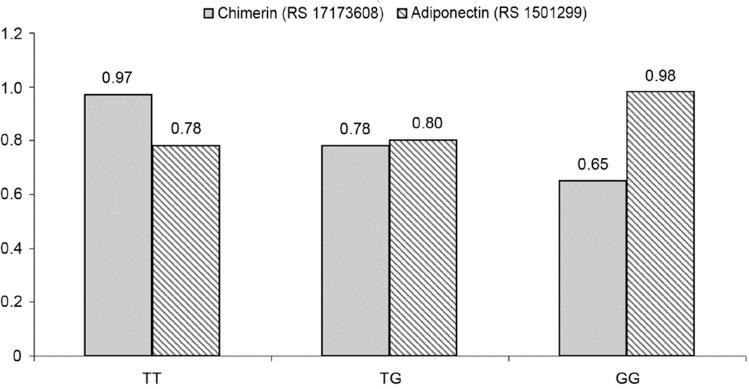
Children with T1DM were found to have significantly higher ABI (p = 0.011) than controls. Chemerin gene polymorphism was detected in 41 children with T1DM (82.0%), while adiponectin gene polymorphism was detected in 19 children (38.0%). Children with T1DM having GG chemerin variant and those having TT adiponectin variant had significantly higher cholesterol with significantly lower HDL-C and ABI than those having the other two variants (p < 0.005). Children with T1DM having abnormal ABI had significantly higher chemerin G (p = 0.017) and adiponectin T (p = 0.022) alleles than those with normal ABI. Cholesterol and ABI were independently associated with chemerin and adiponectin gene polymorphism by multivariable regression analysis.
CONCLUSION
Children with T1DM having chemerin and adiponectin gene polymorphisms have significantly higher cholesterol and ABI than those without these polymorphisms and controls.
TRIAL REGISTRATION
The Research Ethics Committee of Ain Shams University, approval number R 31/2021.
目的
尽管大血管并发症是 1 型糖尿病(T1DM)患者死亡的主要原因,但 T1DM 患儿中包括外周动脉疾病(PAD)在内的微妙大血管病变的患病率及其遗传预测因素仍有待阐明。越来越多的证据表明脂联素 rs1501299 和趋化素 rs17173608 基因多态性与动脉粥样硬化和胰岛素抵抗之间存在关联。因此,本研究评估了这些变体在 T1DM 患儿中的流行率,并与健康对照组进行了比较,同时还评估了它们与大血管并发症(即 PAD 和血脂异常)的关联。
方法
50 名 T1DM 患儿和 50 名匹配的对照组接受了全面评估,包括脂联素 rs1501299 和趋化素 rs17173608 基因多态性、空腹血脂、糖化血红蛋白(HbA1c)和踝臂指数(ABI)。采用 Cochran-Armitage 趋势检验来确定风险等位基因,并使用病例对照设计评估候选变异与 PAD 之间的关联。
结果
与对照组相比,T1DM 患儿的 ABI 显著升高(p=0.011)。在 41 名 T1DM 患儿(82.0%)中检测到趋化素基因突变,在 19 名患儿(38.0%)中检测到脂联素基因突变。T1DM 患儿中 GG 型趋化素变异体和 TT 型脂联素变异体的胆固醇显著升高,HDL-C 和 ABI 显著降低,而其他两种变异体则较低(p<0.005)。ABI 异常的 T1DM 患儿的趋化素 G(p=0.017)和脂联素 T(p=0.022)等位基因显著高于 ABI 正常的患儿。多变量回归分析显示,胆固醇和 ABI 与趋化素和脂联素基因多态性独立相关。
结论
与无这些多态性的 T1DM 患儿和对照组相比,T1DM 患儿中存在脂联素和趋化素基因突变的患儿胆固醇和 ABI 显著升高。
试验注册
艾因夏姆斯大学研究伦理委员会,注册号 R 31/2021。
 Zotero 插件