
胰岛素抵抗和中心性肥胖决定肝脂肪变性,并解释脂肪性肝病患者的心血管风险。
Insulin resistance and central obesity determine hepatic steatosis and explain cardiovascular risk in steatotic liver disease.
机构信息
Division of Gastroenterology and Hepatology, Department of Internal Medicine III, Medical University of Vienna, Vienna, Austria.
Department of Internal Medicine, General Hospital Oberndorf, Teaching Hospital of the Paracelsus Medical University Salzburg, Salzburg, Austria.
出版信息
Front Endocrinol (Lausanne). 2023 Sep 29;14:1244405. doi: 10.3389/fendo.2023.1244405. eCollection 2023.
BACKGROUND
Metabolic dysfunction-associated steatotic liver disease (MASLD) has recently been proposed to replace non-alcoholic fatty liver disease and focus on patients with progressive disease due to the presence of metabolic dysfunction. However, it is unclear whether the new definition actually identifies patients with hepatic steatosis at increased cardiovascular risk.
METHODS
A total of 4,286 asymptomatic subjects from the SAKKOPI study aged 45-80 years undergoing screening colonoscopy were analyzed. Steatosis was diagnosed by abdominal ultrasound. MASLD was diagnosed according to the recent expert consensus. Insulin resistance was assessed by homeostasis model assessment-insulin resistance score (HOMA-IR) (cutoff: ≥2.5), subclinical inflammation was estimated by ferritin/CRP/uric acid, and cardiovascular risk was assessed using SCORE2/ASCVD.
RESULTS
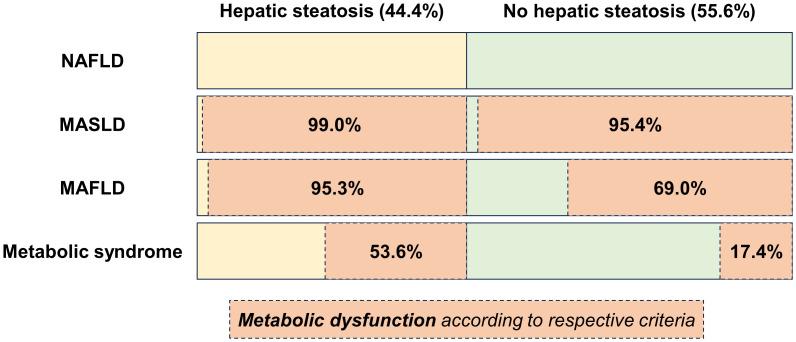
Mean age was 59.4 ± 8.5 years, 51.6% were male; mean BMI was 27.0 ± 4.5 kg/m², 9.2% had type 2 diabetes mellitus. In total, 1,903 (44.4%) were diagnosed with hepatic steatosis and were characterized by more severe metabolic dysfunction including insulin resistance (47.1% vs. 12.2%, < 0.001) and central obesity (waist circumference ≥102/88 cm, 71.8% vs. 37.1%, < 0.001). This translated into higher (subclinical) inflammation (ferritin 153 vs. 95 mg/dL, < 0.001, uric acid 6.3 mg/dL vs. 5.2 mg/dL, < 0.001) and 10-year cardiovascular risk (SCORE2 7.8 points vs. 5.1 points, < 0.001, ASCVD 17.9 points vs. 10.8 points, < 0.001). 99.0% of subjects with steatosis met the MASLD definition, 95.4% met the MAFLD definition, and 53.6% met the definition of metabolic syndrome, while 95.4% of subjects without steatosis also met the MASLD criteria for metabolic dysfunction compared to 69.0% and 17.4% who met the MAFLD and metabolic syndrome criteria, respectively. Forward stepwise regression indicated that waist circumference, HOMA-IR, and triglycerides were most relevant in explaining the presence of hepatic steatosis across all subgroups of increasing metabolic dysfunction. At the same time, hepatic steatosis was not associated with cardiovascular risk in the overall cohort (SCORE2: = 0.060, 95% CI: -0.193-0.314, and = 0.642) and in patients with metabolic dysfunction after adjusting for age, sex, and these three metabolic dysfunction components.
CONCLUSION
Although hepatic steatosis is associated with increased central obesity and insulin resistance, metabolic dysfunction rather than hepatic steatosis explains cardiovascular risk in these patients.
背景
代谢功能障碍相关脂肪性肝病(MASLD)最近被提议取代非酒精性脂肪性肝病,并关注因代谢功能障碍而出现进展性疾病的患者。然而,新定义是否能真正识别出心血管风险增加的肝脂肪变性患者尚不清楚。
方法
对年龄在 45-80 岁、接受筛查性结肠镜检查的 SAKKOPI 研究中的 4286 名无症状受试者进行了分析。通过腹部超声诊断脂肪变性。根据最近的专家共识诊断 MASLD。使用稳态模型评估胰岛素抵抗评分(HOMA-IR)(切点:≥2.5)评估胰岛素抵抗,用铁蛋白/CRP/尿酸估计亚临床炎症,使用 SCORE2/ASCVD 评估心血管风险。
结果
平均年龄为 59.4±8.5 岁,51.6%为男性;平均 BMI 为 27.0±4.5kg/m²,9.2%患有 2 型糖尿病。共有 1903 人(44.4%)被诊断为肝脂肪变性,其代谢功能障碍更为严重,包括胰岛素抵抗(47.1% vs. 12.2%,<0.001)和中心性肥胖(腰围≥102/88cm,71.8% vs. 37.1%,<0.001)。这转化为更高的(亚临床)炎症(铁蛋白 153 毫克/分升 vs. 95 毫克/分升,<0.001,尿酸 6.3 毫克/分升 vs. 5.2 毫克/分升,<0.001)和 10 年心血管风险(SCORE2 7.8 分 vs. 5.1 分,<0.001,ASCVD 17.9 分 vs. 10.8 分,<0.001)。99.0%的脂肪变性患者符合 MASLD 定义,95.4%符合 MAFLD 定义,53.6%符合代谢综合征定义,而 95.4%无脂肪变性患者也符合 MASLD 代谢功能障碍标准,而符合 MAFLD 和代谢综合征标准的分别为 69.0%和 17.4%。逐步向前回归表明,腰围、HOMA-IR 和甘油三酯在解释所有代谢功能障碍程度增加的亚组中,与肝脂肪变性的相关性最大。同时,肝脂肪变性与整个队列的心血管风险无关(SCORE2:=0.060,95%CI:-0.193-0.314,=0.642),在调整年龄、性别和这三个代谢功能障碍成分后,在代谢功能障碍患者中也与心血管风险无关。
结论
尽管肝脂肪变性与中心性肥胖和胰岛素抵抗增加有关,但代谢功能障碍而不是肝脂肪变性解释了这些患者的心血管风险。
 Zotero 插件