
静脉铁补充改善了运动骨骼肌的能量代谢,而对射血分数降低的心力衰竭男性患者的氧化应激或炎症没有影响。
Intravenous iron supplementation improves energy metabolism of exercising skeletal muscles without effect on either oxidative stress or inflammation in male patients with heart failure with reduced ejection fraction.
机构信息
Institute of Heart Diseases, Wroclaw Medical University, Wroclaw, Poland.
Institute of Heart Diseases, University Hospital, Wroclaw, Poland.
出版信息
Cardiol J. 2024;31(2):300-308. doi: 10.5603/cj.97253. Epub 2023 Oct 19.
BACKGROUND
Skeletal muscle dysfunction is a feature of heart failure (HF). Iron deficiency (ID) is prevalent in patients with HF associated with exercise intolerance and poor quality of life. Intravenous iron in iron deficient patients with HF has attenuated HF symptoms, however the pathomechanisms remain unclear. The aim of study was to assess whether intravenous iron supplementation as compared to placebo improves energy metabolism of skeletal muscles in patients with HF.
METHODS
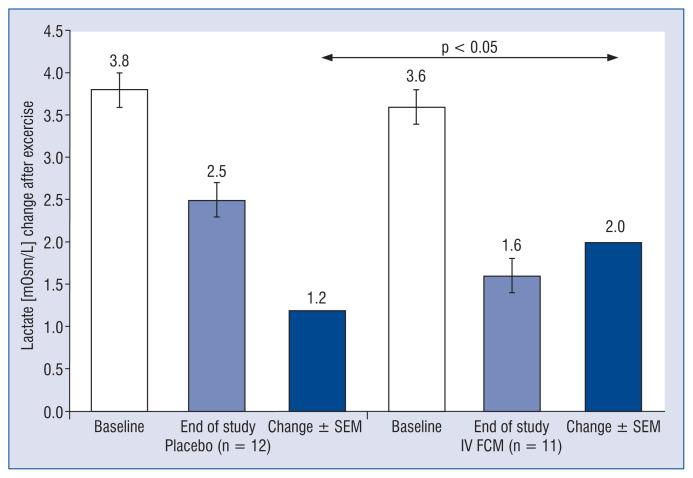
Men with heart failure with reduced ejection fraction (HFrEF) and ID were randomised in 1:1 ratio to either intravenous ferric carboxymaltose (IV FCM) or placebo. In vivo reduction of lactates by exercising skeletal muscles of forearm was analyzed. A change in lactate production between week 0 and 24 was considered as a primary endpoint of the study.
RESULTS
There were two study arms: the placebo and the IV FCM (12 and 11 male patients with HFrEF). At baseline, there were no differences between these two study arms. IV FCM therapy as compared to placebo reduced the exertional production of lactates in exercising skeletal muscles. These effects were accompanied by a significant increase in both serum ferritin and transferrin saturation in the IV FCM arm which was not demonstrated in the placebo arm.
CONCLUSIONS
Intravenous iron supplementation in iron deficient men with HFrEF improves the functioning of skeletal muscles via an improvement in energy metabolism in exercising skeletal muscles, limiting the contribution of anaerobic reactions generating ATP as reflected by a lower in vivo lactate production in exercising muscles in patients with repleted iron stores.
背景
骨骼肌功能障碍是心力衰竭(HF)的特征。铁缺乏症(ID)在与运动不耐受和生活质量差相关的 HF 患者中很常见。HF 伴 ID 患者静脉内补铁可减轻 HF 症状,但发病机制尚不清楚。本研究旨在评估与安慰剂相比,静脉内补铁是否能改善 HF 患者骨骼肌的能量代谢。
方法
采用 1:1 比例将射血分数降低的心力衰竭(HFrEF)伴 ID 的男性患者随机分为静脉铁羧基麦芽糖铁(IV FCM)组或安慰剂组。分析前臂运动骨骼肌中乳酰盐的体内减少情况。将第 0 周和第 24 周之间的乳酰盐生成变化作为研究的主要终点。
结果
该研究有两个研究组:安慰剂组和 IV FCM 组(各有 12 名和 11 名 HFrEF 男性患者)。在基线时,这两个研究组之间没有差异。与安慰剂相比,IV FCM 治疗可减少运动骨骼肌中乳酰盐的产生。这些作用伴随着 IV FCM 组的血清铁蛋白和转铁蛋白饱和度显著增加,而安慰剂组则没有这种现象。
结论
在 HFrEF 伴铁缺乏的男性患者中补充静脉铁可通过改善运动骨骼肌的能量代谢来改善骨骼肌的功能,限制产生 ATP 的无氧反应的贡献,如体内运动肌肉中乳酰盐生成减少所反映的那样,从而使铁储存得到补充的患者。
 Zotero 插件