
肿瘤微环境作为舌癌治疗的潜在免疫治疗靶点
Tumour Microenvironment as a Potential Immune Therapeutic Target for Tongue Cancer Management.
作者信息
Janardhanan Mahija, Smitha N V, Rajalakshmi G, George Antony, Koyakutty Manzoor, Iyer Subramania
机构信息
Department of Oral and Maxillofacial Pathology, Amrita Vishwa Vidyapeetham, Amrita School of Dentistry, Kochi, Kerala, India.
Department of Pathology, Amrita Vishwa Vidyapeetham, Amrita Institute of Medical Sciences Kochi, Kerala, India.
出版信息
J Oral Maxillofac Pathol. 2023 Apr-Jun;27(2):382-389. doi: 10.4103/jomfp.jomfp_134_23. Epub 2023 Jul 13.
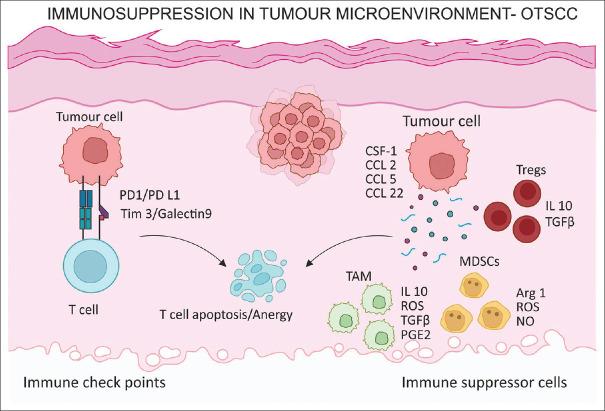
Immunotherapy is a promising approach in the management of human cancers and has been proven to provide a durable response in many cancers. It is helpful as an adjuvant therapy for cancers and at present is considered as a fourth pillar supporting surgery, chemotherapy and radiotherapy. In the treatment of oral cancer, immunotherapy is approved in late-stage diseases where surgical resection cannot be carried out or fails, leading to recurrences and metastasis. Evidences suggest that when given as a first-line treatment, it can elicit an immune response that shrinks tumours, which could provide long-term benefit for patients. But unlike the traditional approach which follows the uniform protocol for all oral cancer patients, effective immunotherapy requires a more site-specific personalized approach. The aim of this paper is to review the various immune evasive mechanisms adopted by tumour cells and their relevance as potential targets for immunotherapy in oral tongue squamous cell carcinoma.
免疫疗法是人类癌症治疗中一种很有前景的方法,并且已被证明在许多癌症中能产生持久的反应。它作为癌症的辅助疗法很有帮助,目前被视为支持手术、化疗和放疗的第四大支柱。在口腔癌的治疗中,免疫疗法被批准用于无法进行手术切除或手术失败导致复发和转移的晚期疾病。有证据表明,作为一线治疗使用时,它可以引发免疫反应使肿瘤缩小,这可能为患者带来长期益处。但与针对所有口腔癌患者采用统一方案的传统方法不同,有效的免疫疗法需要更具部位特异性的个性化方法。本文的目的是综述肿瘤细胞采用的各种免疫逃逸机制及其作为口腔舌鳞状细胞癌免疫治疗潜在靶点的相关性。

 Zotero 插件