
采用 Tyrer-Cuzick 算法和 18 个单核苷酸多态性(SNP)多基因风险评分预测欧洲低乳腺癌发病率人群的乳腺癌风险。
Breast cancer risk prediction using Tyrer-Cuzick algorithm with an 18-SNPs polygenic risk score in a European population with below-average breast cancer incidence.
机构信息
Department of Surgical Oncology, Institute of Oncology Ljubljana, Zaloška cesta 2, 1000, Ljubljana, Slovenia; Medical Faculty, University of Ljubljana, Vrazov trg 2, 1000, Ljubljana, Slovenia.
Department of Molecular Diagnostics, Institute of Oncology Ljubljana, Zaloška cesta 2, 1000, Ljubljana, Slovenia.
出版信息
Breast. 2023 Dec;72:103590. doi: 10.1016/j.breast.2023.103590. Epub 2023 Oct 12.
GOALS
To determine whether an 18 single nucleotide polymorphisms (SNPs) polygenic risk score (PRS18) improves breast cancer (BC) risk prediction for women at above-average risk of BC, aged 40-49, in a Central European population with BC incidence below EU average.
METHODS
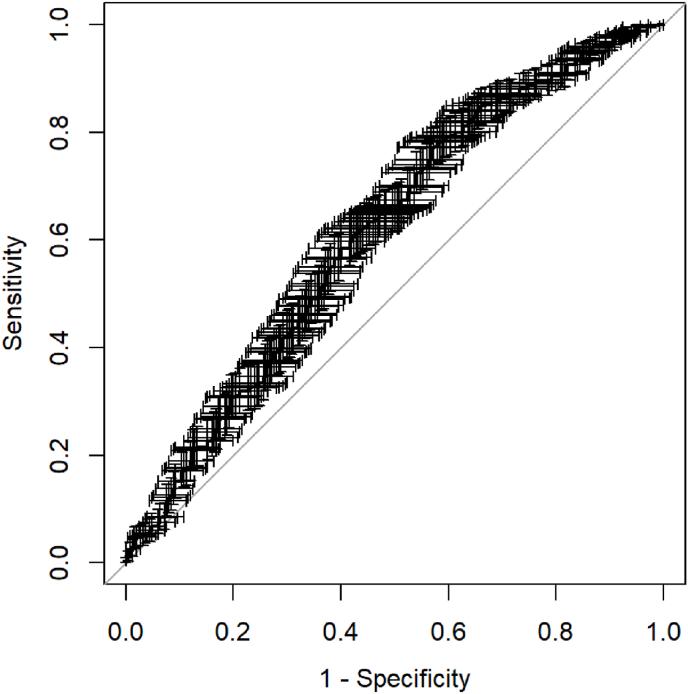
502 women aged 40-49 years at the time of BC diagnosis completed a questionnaire on BC risk factors (as per Tyrer-Cuzick algorithm) with data known at age 40 and before BC diagnosis. Blood samples were collected for DNA isolation. 250 DNA samples from healthy women aged 50 served as a control cohort. 18 BC-associated SNPs were genotyped in both groups and PRS18 was calculated. The predictive power of PRS18 to detect BC was evaluated using a ROC curve. 10-year BC risk was calculated using the Tyrer-Cuzick algorithm adapted to the Slovenian incidence rate (S-IBIS): first based on questionnaire-based risk factors and, second, including PRS18.
RESULTS
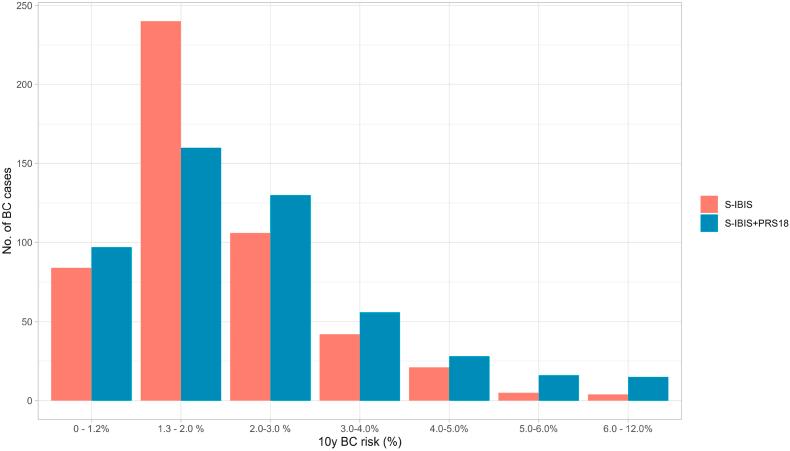
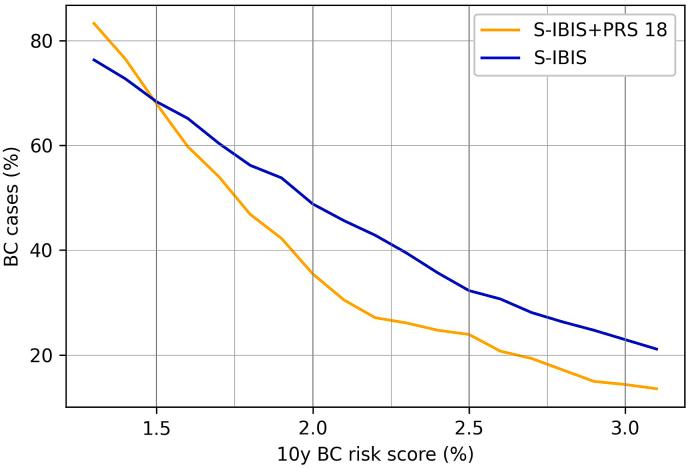
The AUC for PRS18 was 0.613 (95 % CI 0.570-0.657). 83.3 % of women were classified at above-average risk for BC with S-IBIS without PRS18 and 80.7 % when PRS18 was included.
CONCLUSION
BC risk prediction models and SNPs panels should not be automatically used in clinical practice in different populations without prior population-based validation. In our population the addition of an 18SNPs PRS to questionnaire-based risk factors in the Tyrer-Cuzick algorithm in general did not improve BC risk stratification, however, some improvements were observed at higher BC risk scores and could be valuable in distinguishing women at intermediate and high risk of BC.
目的
确定在欧洲中部乳腺癌发病率低于欧盟平均水平的人群中,对于年龄在 40-49 岁、乳腺癌发病风险高于平均水平的女性,18 个单核苷酸多态性(SNP)多基因风险评分(PRS18)是否能提高乳腺癌(BC)风险预测能力。
方法
502 名年龄在 40-49 岁的女性在诊断为乳腺癌时完成了一份关于乳腺癌危险因素的问卷(根据 Tyrer-Cuzick 算法),并在 40 岁时和乳腺癌诊断前提供了数据。采集血液样本进行 DNA 分离。250 名年龄在 50 岁的健康女性的血液样本作为对照队列。对两组人群中的 18 个与 BC 相关的 SNP 进行基因分型,并计算 PRS18。使用 ROC 曲线评估 PRS18 检测 BC 的预测能力。使用 Tyrer-Cuzick 算法计算 10 年 BC 风险,该算法适用于斯洛文尼亚的发病率(S-IBIS):首先基于问卷风险因素,其次包括 PRS18。
结果
PRS18 的 AUC 为 0.613(95%CI 0.570-0.657)。在没有 PRS18 的情况下,S-IBIS 对 83.3%的女性进行了高于平均水平的 BC 风险分类,而在纳入 PRS18 后,这一比例为 80.7%。
结论
在不同人群中,在没有基于人群的验证的情况下,BC 风险预测模型和 SNP 面板不应该自动用于临床实践。在我们的人群中,一般来说,在 Tyrer-Cuzick 算法中基于问卷的危险因素中加入 18 个 SNP 的 PRS 并没有改善 BC 风险分层,但在更高的 BC 风险评分中观察到了一些改善,这可能有助于区分 BC 中、高危女性。

 Zotero 插件