
摩洛哥农村市场后院鸡中主要传染病的流行情况。
Prevalence of major infectious diseases in backyard chickens from rural markets in Morocco.
作者信息
Fagrach Asma, Arbani Oumaima, Karroute Oumaima, El-Ftouhy Fatima Zahra, Kichou Faouzi, Bouslikhane Mohammed, Fellahi Siham
机构信息
Department of Pathology and Veterinary Public Health, Institut Agronomique et Vétérinaire Hassan II, BP 6202, Rabat, Morocco.
Laboratory of Biochemistry, Environment and Agri-food, Faculty of Science and Technology Mohammedia, University Hassan II, Casablanca, Morocco.
出版信息
Vet World. 2023 Sep;16(9):1897-1906. doi: 10.14202/vetworld.2023.1897-1906. Epub 2023 Sep 21.
BACKGROUND AND AIM
Raising backyard chickens is a common practice in Morocco, mainly in rural or periurban areas. Constraints due to devastating avian diseases have been recognized as a major limiting factor in backyard poultry production. Consequently, these flocks could potentially be implicated as reservoirs for poultry diseases. However, there is a considerable lack of information on disease prevalence in this production system, and the risk represented by these small flocks remains under debate. This study aimed to estimate the seroprevalence and identify related risk factors of a range of bacterial and viral pathogens of outstanding importance for the economy and public health in backyard poultry in Morocco.
MATERIALS AND METHODS
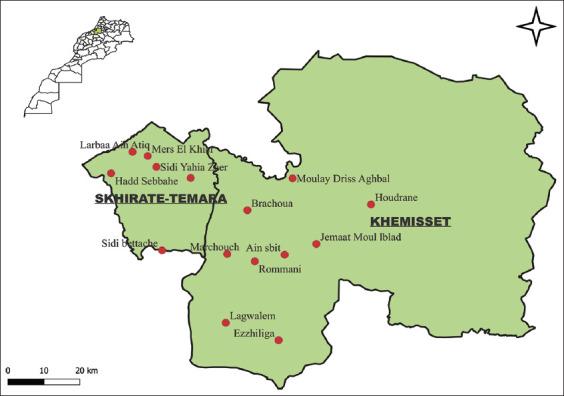
A total of 712 sera samples and 258 cloacal swabs were collected from 712 backyard chickens from 15 rural markets in the Khemisset and Skhirat-Temara provinces. None of the sampled chickens received any vaccination. Sera samples were screened for antibodies against Newcastle disease virus (NDV) and low pathogenic avian influenza H9N2 subtype (LPAI H9N2) using a hemagglutination-inhibition test, against bursal infectious disease virus (IBDV) and infectious bronchitis virus (IBV) using enzyme-linked immunosorbent assay, and against (MG) and (MS) using a rapid serum agglutination test. Swab samples were compiled into 86 pools and submitted for molecular detection using real-time reverse-transcription-polymerase chain reaction (RT-PCR).
RESULTS
The seroprevalences in backyard chickens for NDV, LPAI H9N2, IBDV, IBV, MG, and MS were 52.1% (371/712), 63.5% (452/712), 84.7% (603/712), 82.2% (585/712), 58% (413/712), and 74.8% (533/712), respectively. Based on the RT-PCR results, 2.3% (2/86), 62.8% (54/86), 2.3% (2/86), 63.9% (55/86), 40.7% (35/86), and 29.1% (25/86) of the pools were positive for NDV, H9N2 LPAI, IBDV, IBV, MG, and MS, respectively. Multiple coinfections (H9N2-IBV-MG), (H9N2-IBV-MS), or (IBV-MG-MS) were observed in 15.1%, 8.5%, and 8.5% of the tested samples, respectively.
CONCLUSION
The results show that backyard chicken flocks and rural markets have the potential to serve as reservoirs or amplifiers for poultry pathogens and could pose a risk to the commercial poultry sector. This highlights the need for a comprehensive and adapted vaccination plan for backyard chickens, and extension of efforts to increase flock owners' awareness of avian diseases and incite the implementation of biosecurity measures at the farm level.
背景与目的
在摩洛哥,尤其是农村或城市周边地区,饲养后院鸡是一种常见做法。毁灭性禽类疾病造成的限制已被视为后院家禽生产的主要制约因素。因此,这些鸡群有可能成为家禽疾病的储存宿主。然而,关于该生产系统中疾病流行情况的信息相当匮乏,这些小群体所代表的风险仍存在争议。本研究旨在估计摩洛哥后院家禽中一系列对经济和公共卫生具有重要意义的细菌和病毒病原体的血清阳性率,并确定相关风险因素。
材料与方法
从凯米塞特省和斯希拉特 - 泰马拉省的15个农村市场的712只后院鸡中采集了712份血清样本和258份泄殖腔拭子。所有采样鸡均未接种任何疫苗。血清样本采用血凝抑制试验检测新城疫病毒(NDV)和低致病性禽流感H9N2亚型(LPAI H9N2)抗体,采用酶联免疫吸附试验检测传染性法氏囊病病毒(IBDV)和传染性支气管炎病毒(IBV)抗体,采用快速血清凝集试验检测支原体(MG)和滑液支原体(MS)抗体。拭子样本被合并为86组,并采用实时逆转录 - 聚合酶链反应(RT-PCR)进行分子检测。
结果
后院鸡中NDV、LPAI H9N2、IBDV、IBV、MG和MS的血清阳性率分别为52.1%(371/712)、63.5%(452/712)、84.7%(603/712)、82.2%(585/712)、58%(413/712)和74.8%(533/712)。基于RT-PCR结果,NDV、H9N2 LPAI、IBDV、IBV、MG和MS的组阳性率分别为2.3%(2/86)、62.8%(54/86)、2.3%(2/86)、63.9%(55/86)、40.7%(35/86)和29.1%(25/86)。在15.1%、8.5%和8.5%的测试样本中分别观察到多重感染(H9N2 - IBV - MG)、(H9N2 - IBV - MS)或(IBV - MG - MS)。
结论
结果表明,后院鸡群和农村市场有可能成为家禽病原体的储存宿主或扩增宿主,并可能对商业家禽业构成风险。这突出了为后院鸡制定全面且适用的疫苗接种计划的必要性,并加大力度提高鸡群所有者对禽类疾病的认识,促使他们在农场层面实施生物安全措施。
 Zotero 插件