
在三个乳腺影像中心的多个不同样本中进行遗传性癌症检测。
Hereditary cancer testing in a diverse sample across three breast imaging centers.
机构信息
Natera, Inc., 13011 McCallen Pass, Austin, TX, 78753, USA.
The Breast Health Institute of Houston, Houston, TX, 77054, USA.
出版信息
Breast Cancer Res Treat. 2024 Jan;203(2):365-372. doi: 10.1007/s10549-023-07137-1. Epub 2023 Oct 20.
PURPOSE
Up to 10% of all breast cancers (BC) are attributed to inherited pathogenic variants (PV) in BC susceptibility genes; however, most carriers of PVs remain unidentified. Here, we sought to determine the yield of hereditary cancer gene PVs among diverse women attending breast imaging centers, who could benefit from enhanced surveillance and/or risk reduction interventions.
METHODS
This cross-sectional retrospective cohort study included consecutive women, unselected for personal or family cancer history, who were offered genetic testing for hereditary cancer genes at the time of breast imaging at three centers (November 2020-March 2022).
RESULTS
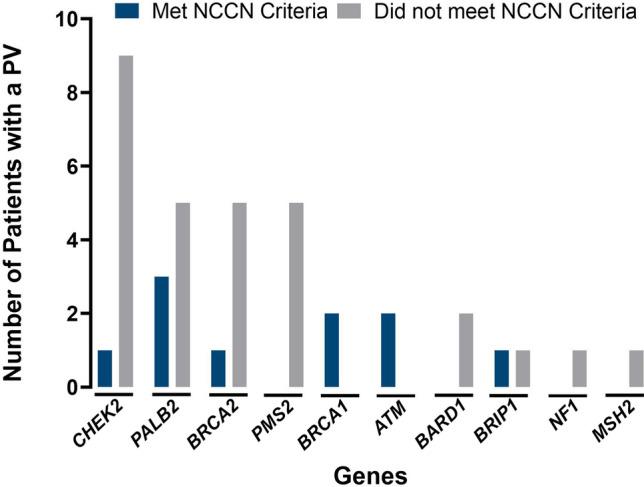
Among 1943 patients (median age: 66 years), self-reported race/ethnicity was White (34.5%), Hispanic (27.7%), African American (17.9%), Asian (4.5%), Ashkenazi Jewish (0.6%), Other (3.5%), and missing (13.0%). Thirty-nine patients (2%) were identified as carriers of a PV in an autosomal dominant clinically actionable hereditary breast and ovarian cancer (HBOC)-related or Lynch syndrome gene, most frequently, BRCA2 (6/39; 15.4%), PALB2 (8/39; 20.5%), CHEK2 (10/39; 25.6%), and PMS2 (5/39; 12.8%). Of the 34 PVs with known race/ethnicity, 47% were detected among non-White patients. Overall, 354/1,943 (18.2%) of patients met NCCN guidelines for HBOC gene testing and only 15/39 (38.5%) patients with an autosomal dominant clinically actionable PV met guidelines.
CONCLUSION
This population health approach extended the reach of genetic cancer risk assessment in a diverse population and highlighted the limits of a guideline-based approach. This may help address inequity in access to risk-appropriate screening and cancer prevention.
目的
多达 10%的乳腺癌(BC)归因于 BC 易感性基因中的遗传致病性变异(PV);然而,大多数 PV 携带者仍未被发现。在这里,我们旨在确定在参加乳腺影像中心的不同女性中遗传性癌症基因 PV 的检出率,这些女性可能受益于增强的监测和/或降低风险干预。
方法
这是一项横断面回顾性队列研究,纳入了在三个中心进行乳腺影像学检查时(2020 年 11 月至 2022 年 3 月)提供遗传性癌症基因检测的连续女性,她们未经个人或家族癌症史选择。
结果
在 1943 名患者中(中位年龄:66 岁),自我报告的种族/民族为白人(34.5%)、西班牙裔(27.7%)、非裔美国人(17.9%)、亚洲人(4.5%)、阿什肯纳兹犹太人(0.6%)、其他(3.5%)和缺失(13.0%)。39 名患者(2%)被确定为常染色体显性遗传的可操作遗传性乳腺癌和卵巢癌(HBOC)相关或林奇综合征基因的 PV 携带者,最常见的是 BRCA2(6/39;15.4%)、PALB2(8/39;20.5%)、CHEK2(10/39;25.6%)和 PMS2(5/39;12.8%)。在已知种族/民族的 34 个 PV 中,47% 存在于非白人患者中。总体而言,1943 名患者中有 354 名(18.2%)符合 NCCN 指南的 HBOC 基因检测标准,而 39 名携带常染色体显性遗传的可操作 PV 的患者中只有 15 名(38.5%)符合指南。
结论
这种基于人群的方法扩展了遗传癌症风险评估在不同人群中的应用,并强调了基于指南的方法的局限性。这可能有助于解决获得风险适当的筛查和癌症预防的机会不平等问题。

 Zotero 插件