
入住 ICU 后并发脓毒症相关性脑病患者前 24 小时 PaCO2 与全因死亡率的相关性:一项回顾性研究。
Association between the first 24 hours PaCO2 and all-cause mortality of patients suffering from sepsis-associated encephalopathy after ICU admission: A retrospective study.
机构信息
Department of Neurology, Puai Hospital of Tongji Medical College, Huazhong University of Science and Technology, Wuhan, Hubei, China.
Wuhan Fourth Hospital, Wuhan, Hubei, China.
出版信息
PLoS One. 2023 Oct 24;18(10):e0293256. doi: 10.1371/journal.pone.0293256. eCollection 2023.
OBJECTIVE
The relationship between the levels of the first 24-h PaCO2 and the prognosis of sepsis-associated encephalopathy (SAE) remains unclear, and the first 24-h optimal target for PaCO2 is currently inconclusive. This study was performed to investigate the correlation between PaCO2 and all-cause mortality for SAE patients, establish a reference range of the initial 24-hour PaCO2 for clinicians in critical care, and explain the possible pathophysiological mechanisms of abnormal PaCO2 levels as a higher mortality risk factor for SAE.
METHODS
The baseline information and clinical data of patients were extracted from the fourth edition Medical Information Mart for Intensive Care database (MIMIC-IV 2.0). Multivariate logistic regressions were performed to assess the relationship between PaCO2 and all-cause mortality of SAE. Additionally, restricted cubic splines, Kaplan-Meier Survival analyses, propensity score matching (PSM) analyses, and subgroup analyses were conducted.
RESULTS
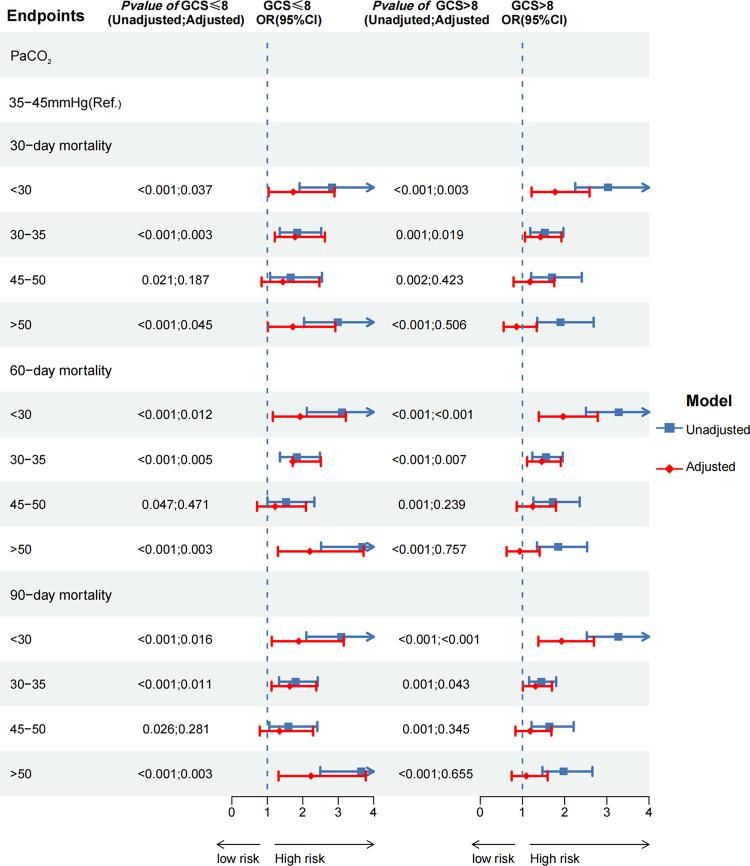
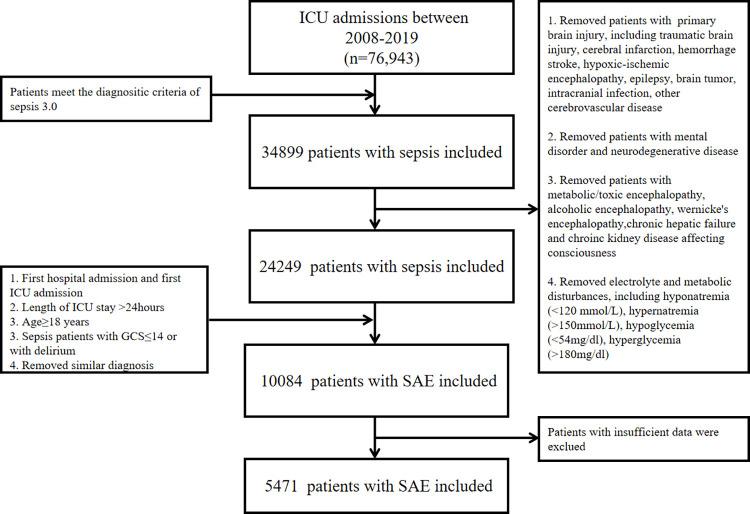
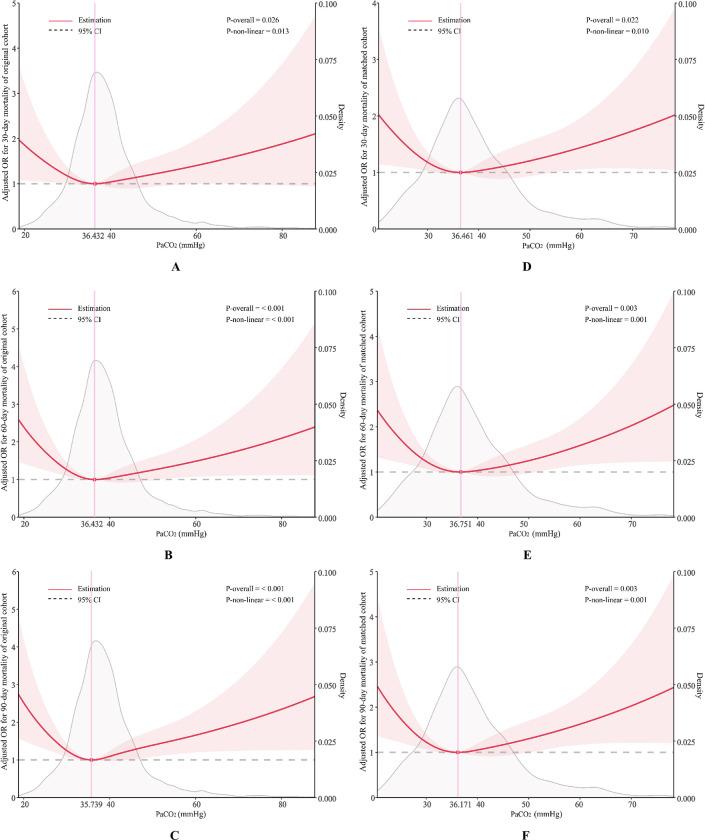
A total of 5471 patients were included in our cohort. In the original and matched cohort, multivariate logistic regression analysis showed that normocapnia and mild hypercapnia may be associated with a more favorable prognosis of SAE patients, and survival analysis supported the findings. In addition, a U-shaped association emerged when examining the initial 24-hour PaCO2 levels in relation to 30-day, 60-day, and 90-day mortality using restricted cubic splines, with an average cut-off value of 36.3mmHg (P for nonlinearity<0.05). Below the cut-off value, higher PaCO2 was associated with lower all-cause mortality, while above the cut-off value, higher PaCO2 was associated with higher all-cause mortality. Subsequent subgroup analyses revealed similar results for the subcohort of GCS≤8 compared to the original cohort. Additionally, when examining the subcohort of GCS>8, a L-shaped relationship between PaCO2 and the three clinical endpoints emerged, in contrast to the previously observed U-shaped pattern. The findings from the subcohort of GCS>8 suggested that patients experiencing hypocapnia had a more unfavorable prognosis, which aligns with the results obtained from corresponding multivariate logistic regression analyses.
CONCLUSION
The retrospective study revealed the association between the first 24-h PaCO2 and all-cause mortality risk (30-day, 60-day, and 90-day) for patients with SAE in ICU. The range (35mmHg-50mmHg) of PaCO2 may be the optimal target for patients with SAE in clinical practice.
目的
第 24 小时内 PaCO2 水平与脓毒症相关脑病(SAE)预后之间的关系尚不清楚,目前也不确定 PaCO2 的 24 小时最佳目标值。本研究旨在探讨 PaCO2 与 SAE 患者全因死亡率之间的相关性,为危重症患者建立初始 24 小时 PaCO2 的参考范围,并解释异常 PaCO2 水平作为 SAE 更高死亡率风险因素的可能病理生理机制。
方法
从第四版医疗信息监护数据库(MIMIC-IV 2.0)中提取患者的基线信息和临床数据。使用多变量逻辑回归评估 PaCO2 与 SAE 全因死亡率之间的关系。此外,还进行了限制性立方样条、Kaplan-Meier 生存分析、倾向评分匹配(PSM)分析和亚组分析。
结果
共纳入 5471 例患者。在原始和匹配队列中,多变量逻辑回归分析显示,正常碳酸血症和轻度高碳酸血症可能与 SAE 患者更有利的预后相关,生存分析也支持这一发现。此外,通过限制性立方样条分析,在第 24 小时 PaCO2 水平与 30 天、60 天和 90 天死亡率之间的关系时,呈现出 U 形关联,平均截断值为 36.3mmHg(P<0.05)。在截断值以下,较高的 PaCO2 与较低的全因死亡率相关,而在截断值以上,较高的 PaCO2 与较高的全因死亡率相关。随后的亚组分析显示,在 GCS≤8 的亚组中,结果与原始队列相似。此外,当检查 GCS>8 的亚组时,与之前观察到的 U 形模式相比,出现了 PaCO2 与三个临床终点之间的 L 形关系。来自 GCS>8 亚组的结果表明,发生低碳酸血症的患者预后更差,这与相应的多变量逻辑回归分析结果一致。
结论
本回顾性研究揭示了 ICU 中 SAE 患者第 24 小时 PaCO2 与全因死亡率风险(30 天、60 天和 90 天)之间的关联。PaCO2 范围(35mmHg-50mmHg)可能是 SAE 患者临床实践中的最佳目标值。


 Zotero 插件