
NCRD:一个用于检测抗生素耐药基因的非冗余综合数据库。
NCRD: A non-redundant comprehensive database for detecting antibiotic resistance genes.
作者信息
Mao Yujie, Liu Xiaohui, Zhang Na, Wang Zhi, Han Maozhen
机构信息
Key Laboratory for Environment and Disaster Monitoring and Evaluation of Hubei, Innovation Academy for Precision Measurement Science and Technology, Chinese Academy of Sciences, Wuhan 430077, China.
School of Life Sciences, Anhui Medical University, Hefei, Anhui 230032, China.
出版信息
iScience. 2023 Oct 5;26(11):108141. doi: 10.1016/j.isci.2023.108141. eCollection 2023 Nov 17.
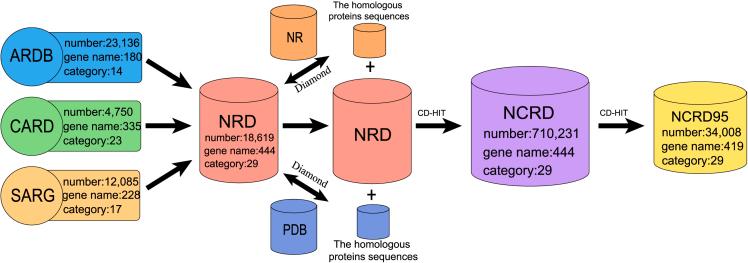
Antibiotic resistance genes (ARGs) are emerging pollutants present in various environments. Identifying ARGs has become a growing concern in recent years. Several databases, including the Antibiotic Resistance Genes Database (ARDB), Comprehensive Antibiotic Resistance Database (CARD), and Structured Antibiotic Resistance Genes (SARG), have been applied to detect ARGs. However, these databases have limitations, which hinder the comprehensive profiling of ARGs in environmental samples. To address these issues, we constructed a non-redundant antibiotic resistance genes database (NRD) by consolidating sequences from ARDB, CARD, and SARG. We identified the homologous proteins of NRD from Non-redundant Protein Database (NR) and the Protein DataBank Database (PDB) and clustered them to establish a non-redundant comprehensive antibiotic resistance genes database (NCRD) with similarities of 100% (NCRD100) and 95% (NCRD95). To demonstrate the advantages of NCRD, we compared it with other databases by using metagenome datasets. Results revealed its strong ability in detecting potential ARGs.
抗生素抗性基因(ARGs)是存在于各种环境中的新兴污染物。近年来,识别ARGs已成为一个日益受到关注的问题。包括抗生素抗性基因数据库(ARDB)、综合抗生素抗性数据库(CARD)和结构化抗生素抗性基因数据库(SARG)在内的几个数据库已被用于检测ARGs。然而,这些数据库存在局限性,阻碍了对环境样本中ARGs的全面分析。为了解决这些问题,我们通过整合ARDB、CARD和SARG的序列构建了一个非冗余抗生素抗性基因数据库(NRD)。我们从非冗余蛋白质数据库(NR)和蛋白质数据库(PDB)中识别出NRD的同源蛋白,并将它们聚类,以建立相似性为100%(NCRD100)和95%(NCRD95)的非冗余综合抗生素抗性基因数据库(NCRD)。为了证明NCRD的优势,我们通过使用宏基因组数据集将其与其他数据库进行了比较。结果显示了它在检测潜在ARGs方面的强大能力。



 Zotero 插件