
转基因生物还是非转基因生物?CRISPR 难题。
GMOs or non-GMOs? The CRISPR Conundrum.
作者信息
Ahmad Aftab, Jamil Amer, Munawar Nayla
机构信息
Center for Advanced Studies in Agriculture and Food Security (CASAFS), University of Agriculture Faisalabad, Faisalabad, Pakistan.
Department of Biochemistry, University of Agriculture, Faisalabad, Pakistan.
出版信息
Front Plant Sci. 2023 Oct 9;14:1232938. doi: 10.3389/fpls.2023.1232938. eCollection 2023.
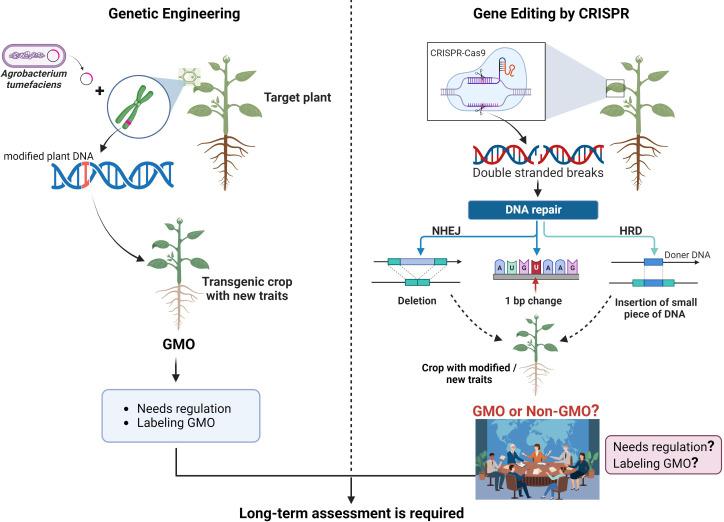
CRISPR-Cas9, the "genetic scissors", is being presaged as a revolutionary technology, having tremendous potential to create designer crops by introducing precise and targeted modifications in the genome to achieve global food security in the face of climate change and increasing population. Traditional genetic engineering relies on random and unpredictable insertion of isolated genes or foreign DNA elements into the plant genome. However, CRISPR-Cas based gene editing does not necessarily involve inserting a foreign DNA element into the plant genome from different species but introducing new traits by precisely altering the existing genes. CRISPR edited crops are touching markets, however, the world community is divided over whether these crops should be considered genetically modified (GM) or non-GM. Classification of CRISPR edited crops, especially transgene free crops as traditional GM crops, will significantly affect their future and public acceptance in some regions. Therefore, the future of the CRISPR edited crops is depending upon their regulation as GM or non-GMs, and their public perception. Here we briefly discuss how CRISPR edited crops are different from traditional genetically modified crops. In addition, we discuss different CRISPR reagents and their delivery tools to produce transgene-free CRISPR edited crops. Moreover, we also summarize the regulatory classification of CRISPR modifications and how different countries are regulating CRISPR edited crops. We summarize that the controversy of CRISPR-edited plants as GM or non-GM will continue until a universal, transparent, and scalable regulatory framework for CRISPR-edited plants will be introduced worldwide, with increased public awareness by involving all stakeholders.
CRISPR-Cas9,即“基因剪刀”,被誉为一项革命性技术,在应对气候变化和人口增长以实现全球粮食安全方面,通过对基因组进行精确且有针对性的修饰来培育定制作物具有巨大潜力。传统基因工程依赖于将分离的基因或外源DNA元件随机且不可预测地插入植物基因组。然而,基于CRISPR-Cas的基因编辑不一定涉及将外源DNA元件从不同物种插入植物基因组,而是通过精确改变现有基因来引入新性状。CRISPR编辑的作物正在进入市场,然而,国际社会对于这些作物应被视为转基因(GM)作物还是非转基因作物存在分歧。将CRISPR编辑的作物,尤其是无转基因作物归类为传统转基因作物,将在某些地区显著影响其未来发展和公众接受度。因此,CRISPR编辑作物的未来取决于它们作为转基因作物或非转基因作物的监管情况以及公众认知。在此,我们简要讨论CRISPR编辑作物与传统转基因作物的不同之处。此外,我们还讨论了不同的CRISPR试剂及其递送工具,以生产无转基因的CRISPR编辑作物。此外,我们还总结了CRISPR修饰的监管分类以及不同国家对CRISPR编辑作物的监管方式。我们总结认为,CRISPR编辑植物作为转基因作物或非转基因作物的争议将持续存在,直到在全球范围内引入一个通用、透明且可扩展的CRISPR编辑植物监管框架,并通过让所有利益相关者参与来提高公众意识。
 Zotero 插件