
探索(L.)库尔茨叶和树皮的治疗潜力,重点关注其抗氧化、抗血栓形成、抗菌、抗炎、镇痛和止泻特性。
Exploring therapeutic potential of (L.) Kurz leaf and bark focusing on antioxidant, antithrombotic, antimicrobial, anti-inflammatory, analgesic, and antidiarrheal properties.
作者信息
Rahman Md Mahfuzur, Soma Mahfuza Afroz, Sultana Nahid, Hossain Md Jamal, Sufian Md Abu, Rahman M Oliur, Rashid Mohammad A
机构信息
Medicinal and Aromatic Plant Research Division, BCSIR Chattogram Laboratories Bangladesh Council of Scientific and Industrial Research Chattogram Bangladesh.
Department of Pharmacy University of Asia Pacific Dhaka Bangladesh.
出版信息
Health Sci Rep. 2023 Oct 25;6(10):e1654. doi: 10.1002/hsr2.1654. eCollection 2023 Oct.
BACKGROUND AND AIMS
The study aimed to evaluate the pharmacological properties of methanolic extracts of leaves and barks of (L.) Kurz (family: Lythraceae) focusing on antioxidant, thrombolytic, anti-inflammatory, antibacterial, analgesic, and antidiarrheal effects.
METHODS
1,1-Diphenyl-2-picrylhydrazyl (DPPH) free radical scavenging assay, clot lysis, disc diffusion, and membrane stabilizing methods were employed to assess in vitro antioxidant, thrombolytic, antibacterial, and anti-inflammatory properties of the leaf and bark methanolic extracts (ME) of and different organic solvents, that is, petroleum ether (PE), dichloromethane (DCM), chloroform (CL), and aqueous (AQ) fractions. In addition, central and peripheral analgesic and antidiarrheal activities of both crude extracts were evaluated at two doses (200 and 400 mg/kg of body weight [bw]).
RESULTS
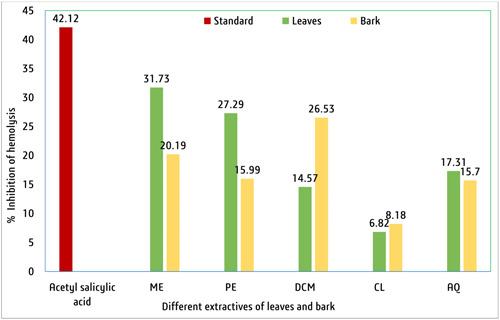
All the extracts and fractions showed promising antioxidant properties by scavenging DDPH free radicals with IC of 6.11-20.79 μg/mL. AQ fraction (41.24%) of leaves and ME (44.90%) of bark exerted notable in vitro thrombolytic activity. The CL fraction of leaves and AQ fraction of the bark showed 43.16% and 45.37% inhibition of RBC hemolysis, respectively, compared to the inhibition of RBC hemolysis by aspirin in a hypotonic-induced membrane stabilizing assay. Besides, both extracts were observed to provide significant ( < 0.001) central and peripheral analgesic responses at both doses of 200 and 400 mg/kg bw. Furthermore, both doses of bark extract ( < 0.001) and the 400 mg/kg bw of leaf extract ( < 0.05) were observed to possess statistically significant antidiarrheal activity. Additionally, in an acute toxicity investigation, both extracts had a median lethal dose (LD) greater than 5000 mg/kg bw, indicating their safety level.
CONCLUSION
The current study proves the ethnomedicinal uses of ; however, further studies are required for phytochemical screening to isolate the responsible bioactive compounds and discover the lead molecules from the plant species.
背景与目的
本研究旨在评估千屈菜科千屈菜属(L.)库尔茨植物叶和树皮甲醇提取物的药理特性,重点关注其抗氧化、溶栓、抗炎、抗菌、镇痛和止泻作用。
方法
采用1,1 - 二苯基 - 2 - 苦基肼(DPPH)自由基清除试验、血凝块溶解试验、纸片扩散法和膜稳定法,评估千屈菜属植物叶和树皮甲醇提取物(ME)以及不同有机溶剂提取物,即石油醚(PE)、二氯甲烷(DCM)、氯仿(CL)和水相(AQ)部分的体外抗氧化、溶栓、抗菌和抗炎特性。此外,在两个剂量(200和400mg/kg体重[bw])下评估了两种粗提物的中枢和外周镇痛及止泻活性。
结果
所有提取物和部分通过清除DDPH自由基均表现出良好的抗氧化性能,IC50为6.11 - 20.79μg/mL。叶的水相部分(41.24%)和树皮的甲醇提取物(44.90%)表现出显著的体外溶栓活性。在低渗诱导的膜稳定试验中,与阿司匹林对红细胞溶血的抑制作用相比,叶的氯仿部分和树皮的水相部分分别对红细胞溶血有43.16%和45.37%的抑制作用。此外,在200和400mg/kg bw两个剂量下,两种提取物均表现出显著的(P < 0.001)中枢和外周镇痛反应。此外,树皮提取物的两个剂量(P < 0.001)和叶提取物400mg/kg bw剂量(P < 0.05)均具有统计学显著的止泻活性。此外,在急性毒性研究中,两种提取物的半数致死剂量(LD50)均大于5000mg/kg bw,表明其安全水平。
结论
本研究证实了千屈菜的民族药用价值;然而,需要进一步进行植物化学筛选,以分离出起作用的生物活性化合物,并从该植物物种中发现先导分子。


 Zotero 插件