
一项关于牙科漂白方案使用后复合材料磨损情况的体外研究。
An In Vitro Study regarding the Wear of Composite Materials Following the Use of Dental Bleaching Protocols.
作者信息
Popescu Alexandru Dan, Ţuculină Mihaela Jana, Gheorghiță Lelia Mihaela, Osman Andrei, Nicolicescu Claudiu, Bugălă Smaranda Adelina, Ionescu Mihaela, Abdul-Razzak Jaqueline, Diaconu Oana Andreea, Dimitriu Bogdan
机构信息
Department of Endodontics, Faculty of Dental Medicine, University of Medicine and Pharmacy of Craiova, 200349 Craiova, Romania.
Department of Anatomy and Embriology, Faculty of Dental Medicine, University of Medicine and Pharmacy of Craiova, 200349 Craiova, Romania.
出版信息
J Funct Biomater. 2023 Oct 21;14(10):532. doi: 10.3390/jfb14100532.
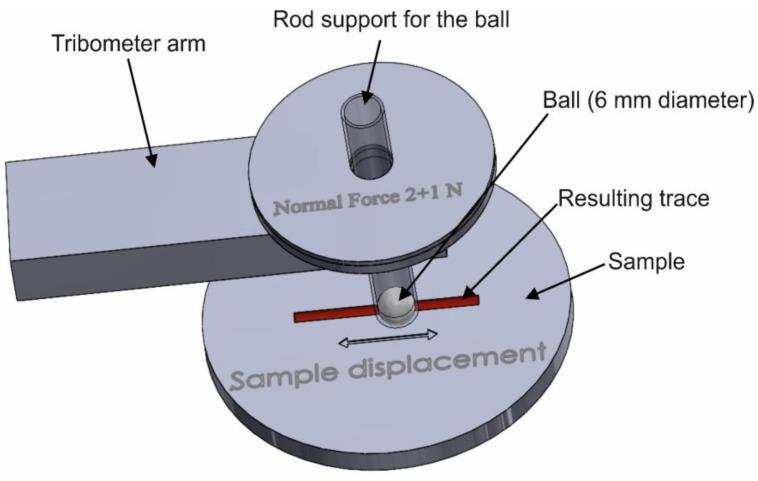
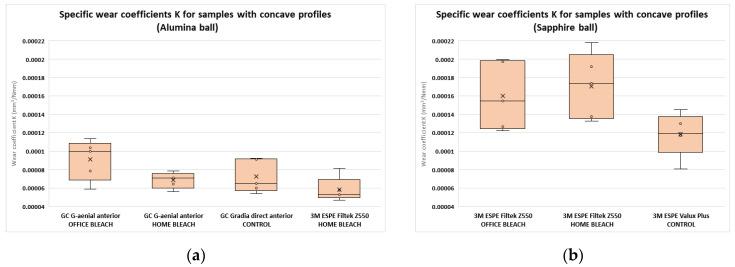
Composite materials used in dental restorations are considered resistant, long-lasting and aesthetic. As the wear of restorations is an important element in long-term use, the aim of this study was to evaluate the surface condition of nanohybrid and microfilled composite resins, after being subjected to the erosive action of dental bleaching protocols. This paper reflects a comparative study between one nanofilled composite and three microfilled composites used in restorations. For each composite, three sets of samples (under the form of composite discs) were created: a control group, an "office bleach" group with discs bleached with 40% hydrogen peroxide gel, and a "home bleach" group with discs bleached with 16% carbamide peroxide gel. Wear was numerically determined as the trace and the coefficients of friction obtained using a tribometer, the ball-on-disk test method, and two balls: alumina and sapphire. For all composite groups, there were statistically significant differences between the wear corresponding to the control and bleaching groups, for both testing balls. Regarding the composite type, the largest traces were recorded for GC Gradia direct anterior, for all groups, using the alumina ball. In contrast, for the sapphire ball, 3M ESPE Filtek Z550 was characterized by the largest traces. With respect to the friction coefficients, the "office bleach" group recorded the largest values, no matter the composite or the ball type used. The 3M ESPE Valux Plus composite recorded the largest friction coefficients for the alumina ball, and 3M ESPE Filtek Z550 for the sapphire ball. Overall, the "office bleach" group was characterized by higher composite wear, compared to the "home bleach" protocol or control group. Nanofilled composite resins showed superior wear resistance to microfilled resins after undergoing a bleaching protocol.
用于牙齿修复的复合材料被认为具有耐用性、持久性和美观性。由于修复体的磨损是长期使用中的一个重要因素,本研究的目的是评估纳米混合复合树脂和微填料复合树脂在经受牙齿漂白方案的侵蚀作用后的表面状况。本文反映了一种用于修复的纳米填料复合材料和三种微填料复合材料之间的对比研究。对于每种复合材料,创建了三组样品(复合圆盘形式):一个对照组、一个用40%过氧化氢凝胶漂白圆盘的“诊室漂白”组和一个用16%过氧化脲凝胶漂白圆盘的“家庭漂白”组。磨损通过使用摩擦计、球盘试验方法以及氧化铝和蓝宝石两种球来数值确定痕迹和摩擦系数。对于所有复合组,两种测试球在对照组和漂白组对应的磨损之间均存在统计学上的显著差异。关于复合材料类型,使用氧化铝球时,所有组中GC Gradia direct anterior记录的痕迹最大。相比之下,对于蓝宝石球,3M ESPE Filtek Z550的痕迹最大。关于摩擦系数,无论使用何种复合材料或球类型,“诊室漂白”组记录的值最大。3M ESPE Valux Plus复合材料在使用氧化铝球时记录的摩擦系数最大,3M ESPE Filtek Z550在使用蓝宝石球时摩擦系数最大。总体而言,与“家庭漂白”方案或对照组相比,“诊室漂白”组的复合材料磨损更高。经过漂白方案后,纳米填料复合树脂显示出比微填料树脂更好的耐磨性。



 Zotero 插件