
族群差异与早发性多病共存及与医疗服务使用、长期处方、生命损失年数和死亡率的关联:一项基于英国临床实践研究数据链聚类的横断面研究。
Ethnic differences in early onset multimorbidity and associations with health service use, long-term prescribing, years of life lost, and mortality: A cross-sectional study using clustering in the UK Clinical Practice Research Datalink.
机构信息
Wolfson Institute of Population Health, Queen Mary University of London, London, United Kingdom.
William Harvey Research Institute, Queen Mary University of London, London, United Kingdom.
出版信息
PLoS Med. 2023 Oct 27;20(10):e1004300. doi: 10.1371/journal.pmed.1004300. eCollection 2023 Oct.
BACKGROUND
The population prevalence of multimorbidity (the existence of at least 2 or more long-term conditions [LTCs] in an individual) is increasing among young adults, particularly in minority ethnic groups and individuals living in socioeconomically deprived areas. In this study, we applied a data-driven approach to identify clusters of individuals who had an early onset multimorbidity in an ethnically and socioeconomically diverse population. We identified associations between clusters and a range of health outcomes.
METHODS AND FINDINGS
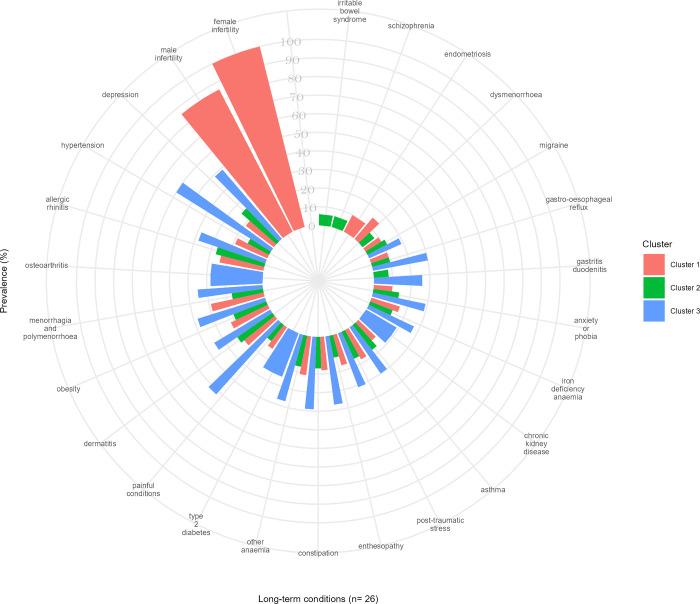
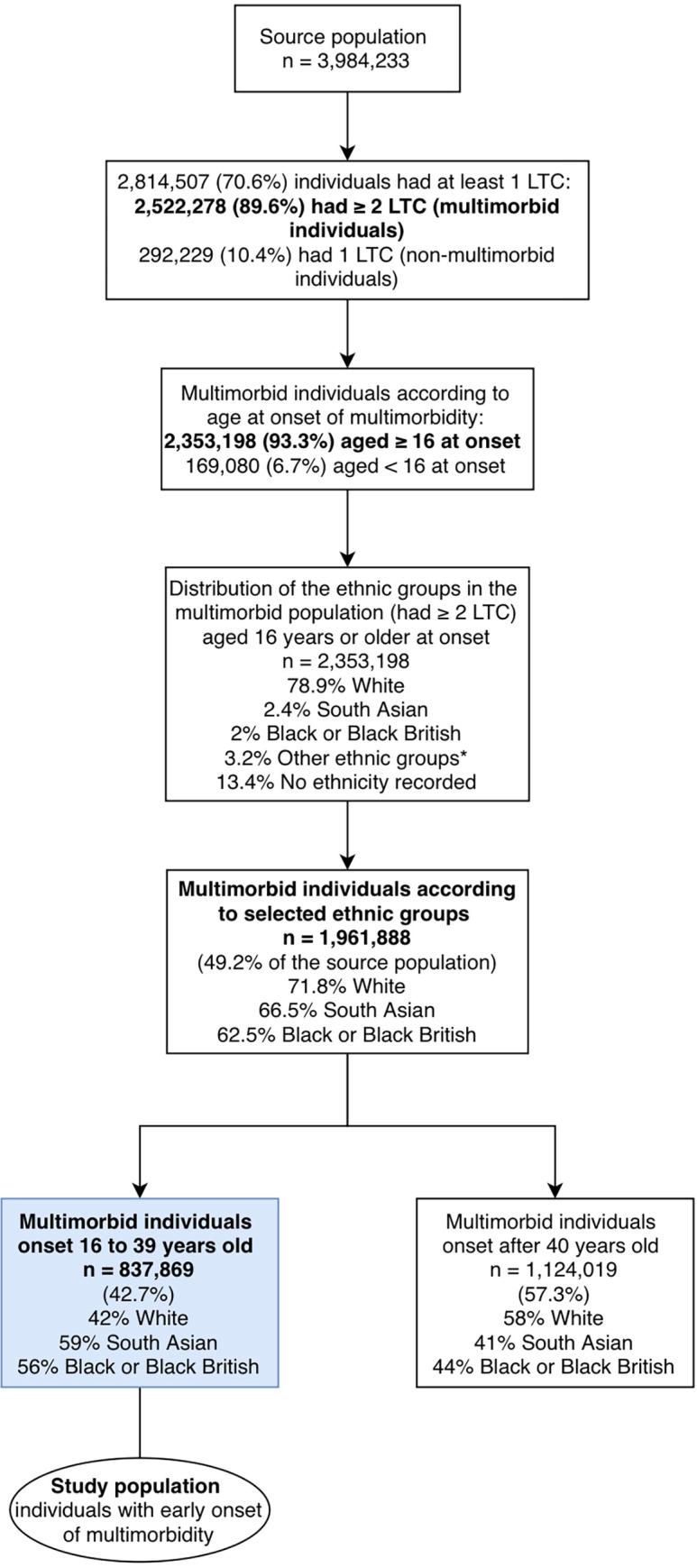
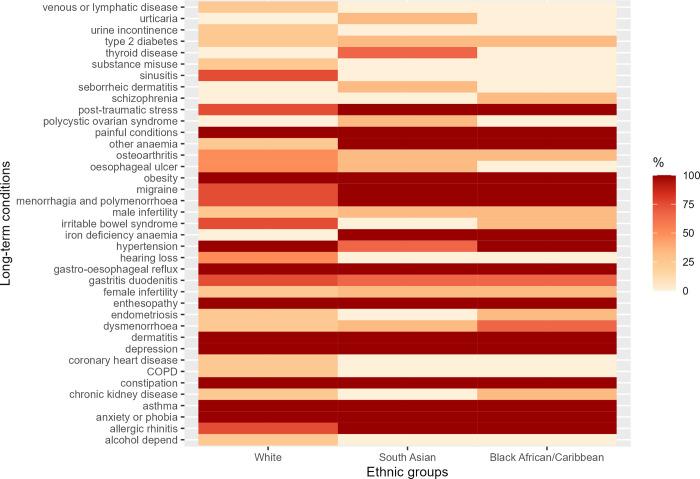
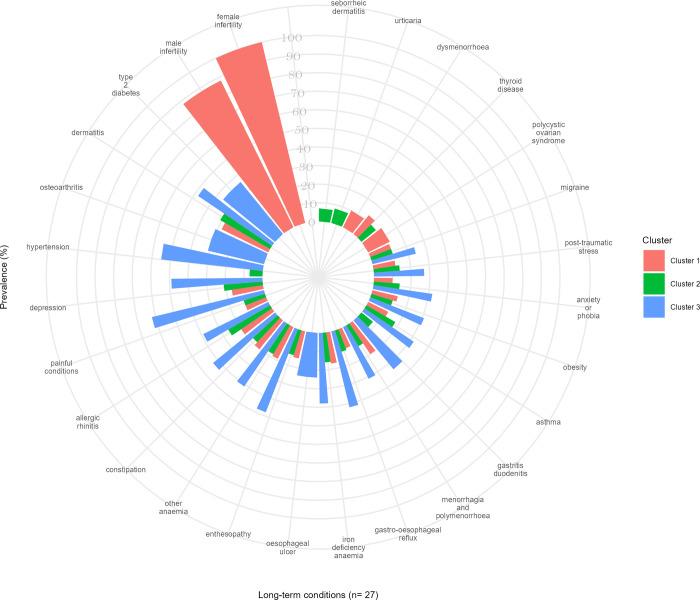
Using linked primary and secondary care data from the Clinical Practice Research Datalink GOLD (CPRD GOLD), we conducted a cross-sectional study of 837,869 individuals with early onset multimorbidity (aged between 16 and 39 years old when the second LTC was recorded) registered with an English general practice between 2010 and 2020. The study population included 777,906 people of White ethnicity (93%), 33,915 people of South Asian ethnicity (4%), and 26,048 people of Black African/Caribbean ethnicity (3%). A total of 204 LTCs were considered. Latent class analysis stratified by ethnicity identified 4 clusters of multimorbidity in White groups and 3 clusters in South Asian and Black groups. We found that early onset multimorbidity was more common among South Asian (59%, 33,915) and Black (56% 26,048) groups compared to the White population (42%, 777,906). Latent class analysis revealed physical and mental health conditions that were common across all ethnic groups (i.e., hypertension, depression, and painful conditions). However, each ethnic group also presented exclusive LTCs and different sociodemographic profiles: In White groups, the cluster with the highest rates/odds of the outcomes was predominantly male (54%, 44,150) and more socioeconomically deprived than the cluster with the lowest rates/odds of the outcomes. On the other hand, South Asian and Black groups were more socioeconomically deprived than White groups, with a consistent deprivation gradient across all multimorbidity clusters. At the end of the study, 4% (34,922) of the White early onset multimorbidity population had died compared to 2% of the South Asian and Black early onset multimorbidity populations (535 and 570, respectively); however, the latter groups died younger and lost more years of life. The 3 ethnic groups each displayed a cluster of individuals with increased rates of primary care consultations, hospitalisations, long-term prescribing, and odds of mortality. Study limitations include the exclusion of individuals with missing ethnicity information, the age of diagnosis not reflecting the actual age of onset, and the exclusion of people from Mixed, Chinese, and other ethnic groups due to insufficient power to investigate associations between multimorbidity and health-related outcomes in these groups.
CONCLUSIONS
These findings emphasise the need to identify, prevent, and manage multimorbidity early in the life course. Our work provides additional insights into the excess burden of early onset multimorbidity in those from socioeconomically deprived and diverse groups who are disproportionately and more severely affected by multimorbidity and highlights the need to ensure healthcare improvements are equitable.
背景
在年轻人群体中,特别是在少数族裔和生活在社会经济贫困地区的人群中,多种疾病(个体中存在至少 2 种或更多种长期疾病)的患病率正在增加。在这项研究中,我们应用了一种数据驱动的方法来识别在种族和社会经济多样化人群中早期发生多种疾病的个体聚类。我们确定了聚类与一系列健康结果之间的关联。
方法和发现
我们使用来自临床实践研究数据链接 GOLD(CPRD GOLD)的链接初级和二级护理数据,对 2010 年至 2020 年间在英国普通诊所登记的患有早期多种疾病(记录第二种长期疾病时年龄在 16 至 39 岁之间)的 837869 名个体进行了横断面研究。研究人群包括 777906 名白种人(93%)、33915 名南亚人(4%)和 26048 名黑非洲/加勒比人(3%)。共考虑了 204 种长期疾病。按种族分层的潜在类别分析确定了白人群体中的 4 个多种疾病聚类和南亚群体和黑人群体中的 3 个聚类。我们发现,南亚(59%,33915)和黑人群体(56%,26048)中早期发生多种疾病的情况比白人人群(42%,777906)更为常见。潜在类别分析揭示了所有族裔群体中常见的身心健康状况(即高血压、抑郁症和疼痛状况)。然而,每个族裔群体也存在独特的长期疾病和不同的社会人口学特征:在白人群体中,发生率/几率最高的结果的聚类主要是男性(54%,44150),比发生率/几率最低的结果的聚类更贫困。另一方面,南亚和黑人群体比白人更贫困,所有多种疾病聚类的贫困程度都呈梯度下降。在研究结束时,与白人群体的早期多种疾病人群相比,4%(34922)的白人早期多种疾病人群已经死亡,而南亚和黑人群体的早期多种疾病人群的死亡率分别为 2%(535 和 570);然而,后两组人群死亡年龄更小,失去了更多的寿命。这 3 个族裔群体各自显示出一组个体的初级保健咨询、住院、长期处方和死亡率的增加。研究的局限性包括排除了缺失种族信息的个体、诊断年龄并不能反映实际发病年龄以及由于没有足够的能力来调查这些群体中的多种疾病与健康相关结果之间的关联,因此排除了混合、中国和其他族裔群体的人。
结论
这些发现强调了需要在生命早期识别、预防和管理多种疾病。我们的工作为那些来自社会经济贫困和多样化群体的人提供了有关早期发生多种疾病的额外信息,这些人受到多种疾病的不成比例和更严重的影响,并且强调需要确保医疗保健的改善是公平的。


 Zotero 插件