
脑脊髓液循环肿瘤 DNA 基因分型与肺癌伴软脑膜转移患者生存分析。
Cerebrospinal fluid circulating tumour DNA genotyping and survival analysis in lung adenocarcinoma with leptomeningeal metastases.
机构信息
Department of Neurology, The Second Hospital of Hebei Medical University, 215 Heping West Road, Xinhua District, Shijiazhuang, Hebei Province, China.
The Key Laboratory of Neurology (Hebei Medical University), Ministry of Education, Shijiazhuang, China.
出版信息
J Neurooncol. 2023 Oct;165(1):149-160. doi: 10.1007/s11060-023-04471-8. Epub 2023 Oct 28.
PURPOSE
The prognosis of patients with leptomeningeal metastasis (LM) remains poor. Circulating tumour DNA (ctDNA) has been proven to be abundantly present in cerebrospinal fluid (CSF); hence, its clinical implication as a biomarker needs to be further verified.
METHODS
We conducted a retrospective study of 35 lung adenocarcinoma (LUAD) patients with LM, and matched CSF and plasma samples were collected from all patients. All paired samples underwent next-generation sequencing (NGS) of 139 lung cancer-associated genes. The clinical characteristics and genetic profiling of LM were analysed in association with survival prognosis.
RESULTS
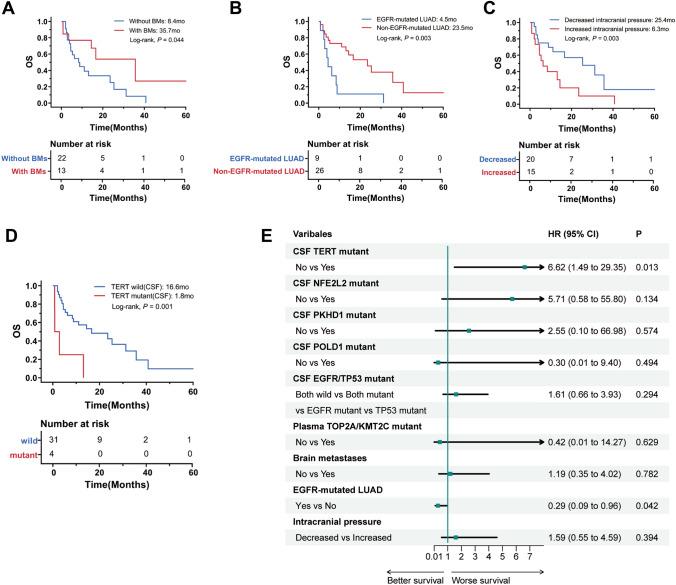
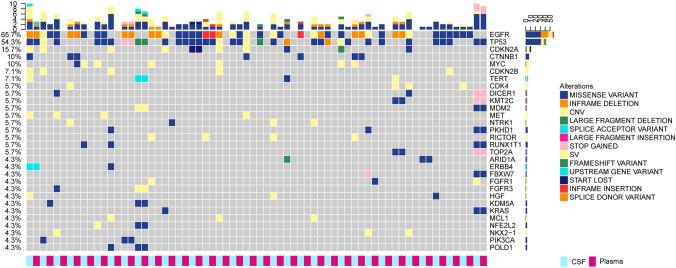
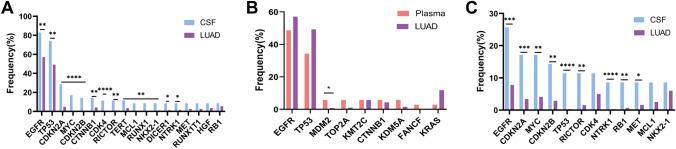
LM showed genetic heterogeneity, in which CSF had a higher detection rate of ctDNA (P = 0.003), a higher median mutation count (P < 0.0001), a higher frequency of driver mutations (P < 0.01), and more copy number variation (CNV) alterations (P < 0.001) than plasma. The mutation frequencies of the EGFR, TP53, CDKN2A, MYC and CDKN2B genes were easier to detect in CSF than in LUAD tissue (P < 0.05), possibly reflecting the underlying mechanism of LM metastasis. CSF ctDNA is helpful for analysing the mechanism of EGFR-TKI resistance. In cohort 1, which comprised patients who received 1/2 EGFR-TKIs before the diagnosis of LM, TP53 and CDKN2A were the most common EGFR-independent resistant mutations. In cohort 2, comprising those who progressed after osimertinib and developed LM, 7 patients (43.75%) had EGFR CNV detected in CSF but not plasma. Furthermore, patient characteristics and various genes were included for interactive survival analysis. Patients with EGFR-mutated LUAD (P = 0.042) had a higher median OS, and CSF ctDNA mutation with TERT (P = 0.013) indicated a lower median OS. Last, we reported an LM case in which CSF ctDNA dynamic changes were well correlated with clinical treatment.
CONCLUSIONS
CSF ctDNA could provide a more comprehensive genetic landscape of LM, indicating the potential metastasis-related and EGFR-TKI resistance mechanisms of LM patients. In addition, genotyping of CSF combined with clinical outcomes can predict the prognosis of LUAD patients with LM.
目的
软脑膜转移(LM)患者的预后仍然较差。已经证明循环肿瘤 DNA(ctDNA)在脑脊液(CSF)中大量存在;因此,需要进一步验证其作为生物标志物的临床意义。
方法
我们对 35 例 LM 的肺腺癌(LUAD)患者进行了回顾性研究,所有患者均采集了配对的 CSF 和血浆样本。所有配对样本均进行了 139 个肺癌相关基因的下一代测序(NGS)。分析了 LM 的临床特征和基因谱与生存预后的关系。
结果
LM 显示出遗传异质性,CSF 中 ctDNA 的检出率更高(P=0.003),中位突变数更高(P<0.0001),驱动突变频率更高(P<0.01),拷贝数变异(CNV)改变更多(P<0.001)。CSF 中 EGFR、TP53、CDKN2A、MYC 和 CDKN2B 基因突变的频率高于 LUAD 组织(P<0.05),这可能反映了 LM 转移的潜在机制。CSF ctDNA 有助于分析 EGFR-TKI 耐药的机制。在队列 1 中,包括在 LM 诊断前接受 1/2 代 EGFR-TKI 治疗的患者,TP53 和 CDKN2A 是最常见的 EGFR 非依赖性耐药突变。在队列 2 中,包括奥希替尼进展后发生 LM 的患者,7 例(43.75%)患者 CSF 中检测到 EGFR CNV,但血浆中未检测到。此外,还对患者特征和各种基因进行了交互生存分析。EGFR 突变型 LUAD 患者(P=0.042)的中位 OS 较高,CSF ctDNA 突变与 TERT(P=0.013)的中位 OS 较低。最后,我们报告了一个 LM 病例,CSF ctDNA 的动态变化与临床治疗密切相关。
结论
CSF ctDNA 可提供更全面的 LM 遗传图谱,提示 LM 患者潜在的转移相关和 EGFR-TKI 耐药机制。此外,CSF 基因分型结合临床结果可预测 LM 的 LUAD 患者的预后。

 Zotero 插件