
肌动蛋白依赖性细胞迁移的演变和多样性。
The evolution and diversity of actin-dependent cell migration.
机构信息
Department of Biology, University of Massachusetts, Amherst, MA 01003.
Department of Genetics, Cell Biology and Development, University of Minnesota, Minneapolis, MN 55455.
出版信息
Mol Biol Cell. 2023 Nov 1;34(12):pe6. doi: 10.1091/mbc.E22-08-0358.
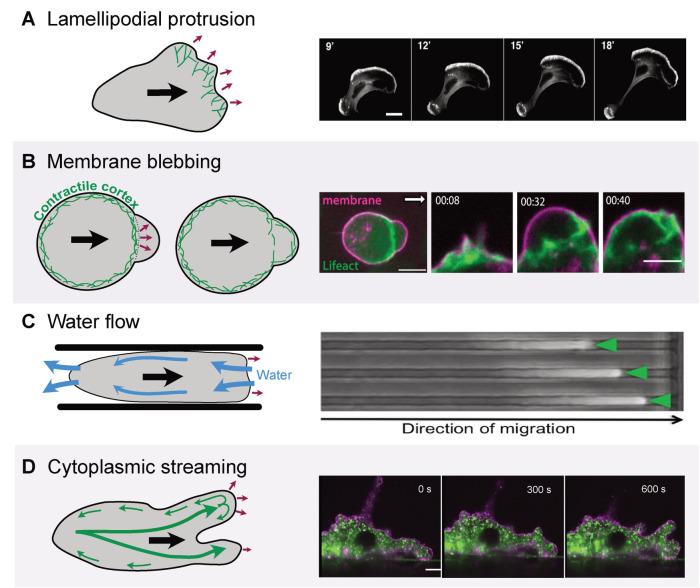
Many eukaryotic cells, including animal cells and unicellular amoebae, use dynamic-actin networks to crawl across solid surfaces. Recent discoveries of actin-dependent crawling in additional lineages have sparked interest in understanding how and when this type of motility evolved. Tracing the evolution of cell crawling requires understanding the molecular mechanisms underlying motility. Here we outline what is known about the diversity and evolution of the molecular mechanisms that drive cell motility, with a focus on actin-dependent crawling. Classic studies and recent work have revealed a surprising number of distinct mechanical modes of actin-dependent crawling used by different cell types and species to navigate different environments. The overlap in actin network regulators driving multiple types of actin-dependent crawling, along with cortical-actin networks that support the plasma membrane in these cells, suggest that actin motility and cortical actin networks might have a common evolutionary origin. The rapid development of additional evolutionarily diverse model systems, advanced imaging technologies, and CRISPR-based genetic tools, is opening the door to testing these and other new ideas about the evolution of actin-dependent cell crawling.
许多真核细胞,包括动物细胞和单细胞变形虫,利用动态肌动蛋白网络在固体表面上爬行。最近在其他谱系中发现了肌动蛋白依赖性爬行,这激发了人们对理解这种运动方式是如何以及何时进化而来的兴趣。追踪细胞爬行的进化需要了解运动的分子机制。在这里,我们概述了驱动细胞运动的分子机制的多样性和进化,重点是肌动蛋白依赖性爬行。经典研究和最近的工作揭示了不同细胞类型和物种在不同环境中导航时使用的肌动蛋白依赖性爬行的许多不同机械模式。驱动多种类型肌动蛋白依赖性爬行的肌动蛋白网络调节剂的重叠,以及支持这些细胞质膜的皮质肌动蛋白网络,表明肌动蛋白运动和皮质肌动蛋白网络可能具有共同的进化起源。越来越多的其他进化多样化的模式系统、先进的成像技术和基于 CRISPR 的遗传工具的快速发展,为测试这些和其他关于肌动蛋白依赖性细胞爬行进化的新想法打开了大门。

 Zotero 插件