
P21 重组蛋白在不同的人类母体-胎儿界面实验模型中调节 感染。
P21 recombinant protein modulates infection in different experimental models of the human maternal-fetal interface.
机构信息
Laboratory of Immunophysiology of Reproduction, Institute of Biomedical Sciences, Universidade Federal de Uberlândia, Uberlândia, MG, Brazil.
Department of Agricultural and Natural Science, Universidade do Estado de Minas Gerais, Ituiutaba, MG, Brazil.
出版信息
Front Immunol. 2023 Oct 16;14:1243480. doi: 10.3389/fimmu.2023.1243480. eCollection 2023.
INTRODUCTION
is the etiologic agent of toxoplasmosis, a disease that affects about one-third of the human population. Most infected individuals are asymptomatic, but severe cases can occur such as in congenital transmission, which can be aggravated in individuals infected with other pathogens, such as HIV-positive pregnant women. However, it is unknown whether infection by other pathogens, such as , the etiologic agent of Chagas disease, as well as one of its proteins, P21, could aggravate infection.
METHODS
In this sense, we aimed to investigate the impact of and recombinant P21 (rP21) on infection in BeWo cells and human placental explants.
RESULTS
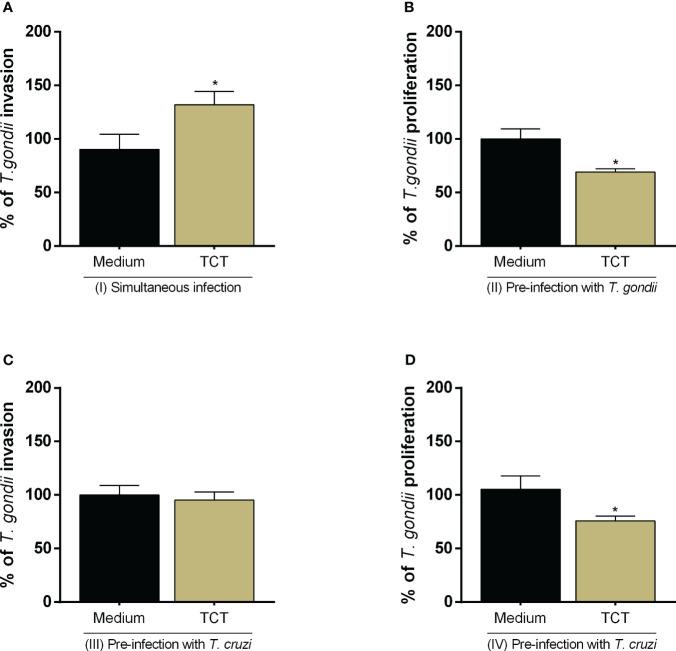
Our results showed that infection, as well as rP21, increases invasion and decreases intracellular proliferation of in BeWo cells. The increase in invasion promoted by rP21 is dependent on its binding to CXCR4 and the actin cytoskeleton polymerization, while the decrease in proliferation is due to an arrest in the S/M phase in the parasite cell cycle, as well as interleukin (IL)-6 upregulation and IL-8 downmodulation. On the other hand, in human placental villi, rP21 can either increase or decrease proliferation, whereas infection increases proliferation. This increase can be explained by the induction of an anti-inflammatory environment through an increase in IL-4 and a decrease in IL-6, IL-8, macrophage migration inhibitory factor (MIF), and tumor necrosis factor (TNF)-α production.
DISCUSSION
In conclusion, in situations of coinfection, the presence of may favor the congenital transmission of , highlighting the importance of neonatal screening for both diseases, as well as the importance of studies with P21 as a future therapeutic target for the treatment of Chagas disease, since it can also favor infection.
简介
弓形虫是弓形体病的病原体,这种疾病影响了大约三分之一的人类人口。大多数感染个体无症状,但严重病例可发生,如先天性传播,在感染其他病原体(如 HIV 阳性孕妇)的个体中可能加重。然而,目前尚不清楚其他病原体(如恰加斯病的病原体和其一种蛋白 P21)的感染是否会加重感染。
方法
在这方面,我们旨在研究感染对 BeWo 细胞和人胎盘外植体中感染的影响。
结果
我们的结果表明,感染以及 rP21 均可增加 BeWo 细胞中入侵并减少内增殖。rP21 促进的入侵依赖于其与 CXCR4 的结合和肌动蛋白细胞骨架聚合,而增殖减少是由于寄生虫细胞周期中的 S/M 期停滞,以及白细胞介素(IL)-6 的上调和 IL-8 的下调。另一方面,在人胎盘绒毛中,rP21 可增加或减少增殖,而感染则增加增殖。这种增加可以通过增加抗炎细胞因子 IL-4 和减少促炎细胞因子 IL-6、IL-8、巨噬细胞移动抑制因子(MIF)和肿瘤坏死因子(TNF)-α 的产生来解释。
讨论
总之,在合并感染的情况下,存在可能有利于先天性传播,突出了对这两种疾病进行新生儿筛查的重要性,以及以 P21 作为恰加斯病治疗的未来治疗靶点的研究的重要性,因为它也可能有利于感染。




 Zotero 插件