
真实世界中 OTX-101 滴眼液、环孢素滴眼液和利福平滴眼液在干眼症患者中的治疗模式:一项回顾性分析。
Real-world treatment patterns of OTX-101 ophthalmic solution, cyclosporine ophthalmic emulsion, and lifitegrast ophthalmic solution in patients with dry eye disease: a retrospective analysis.
机构信息
Kentucky Eye Institute, University of Pikeville Kentucky College of Optometry, Lexington, KY, USA.
VEB HealthCare, Morristown, NJ, USA.
出版信息
BMC Ophthalmol. 2023 Nov 2;23(1):443. doi: 10.1186/s12886-023-03174-y.
BACKGROUND
Dry eye disease (DED) is a disorder characterized by loss of tear film homeostasis that causes ocular surface inflammation and damage. The incidence of DED increases with age. Cyclosporine ophthalmic solution 0.09% (CEQUA; OTX-101), cyclosporine ophthalmic emulsion 0.05% (Restasis; CsA), and lifitegrast ophthalmic solution 5% (Xiidra; LFT) are anti-inflammatory agents indicated for DED. This analysis compared treatment patterns in patients with DED receiving OTX-101, CsA, or LFT.
METHODS
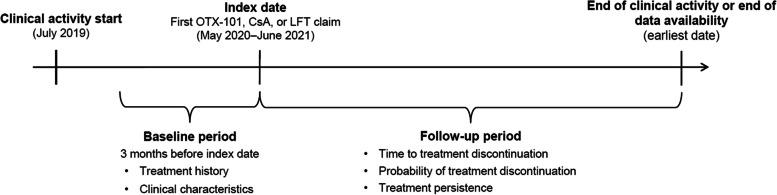
This real-world, retrospective, longitudinal cohort study utilized Symphony Health Integrated Dataverse claims from July 2019 to June 2021. The dataset included all patients with OTX-101 claims and patients with CsA or LFT claims randomly selected 2:1 to OTX-101. Patients were sorted into 3 cohorts based on index treatment. Index date was that of first treatment claim, and follow-up period was from index date to end of clinical activity or data availability. Time to treatment discontinuation (TTD), probability of discontinuation, and treatment persistence were assessed for OTX-101 vs. CsA, then OTX-101 vs. LFT. Subgroup analysis was performed based on age and prior DED treatment. Kaplan-Meier analysis and log-rank test were used to examine TTD. A logistic model evaluated association between index treatment and discontinuation. Unadjusted and adjusted odds ratios, 95% confidence intervals, and P-values were reported, with statistically significant associations based on P-values < 0.05.
RESULTS
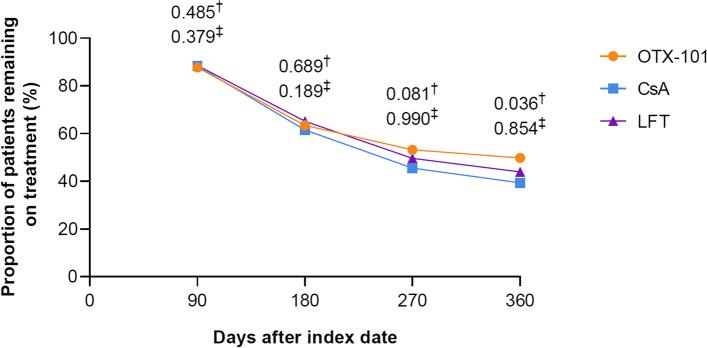
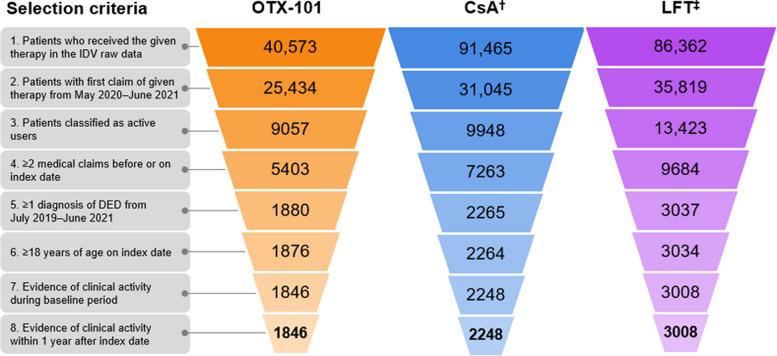
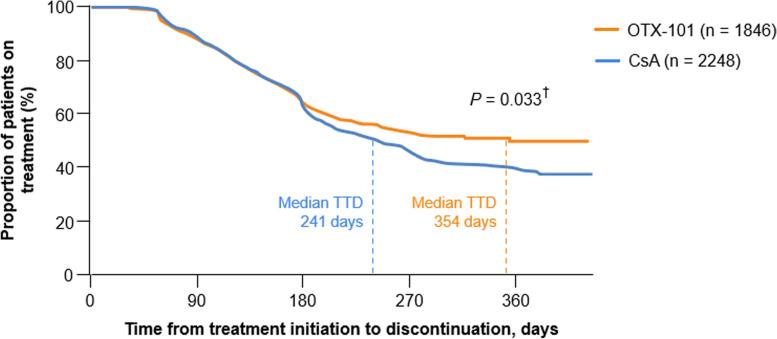
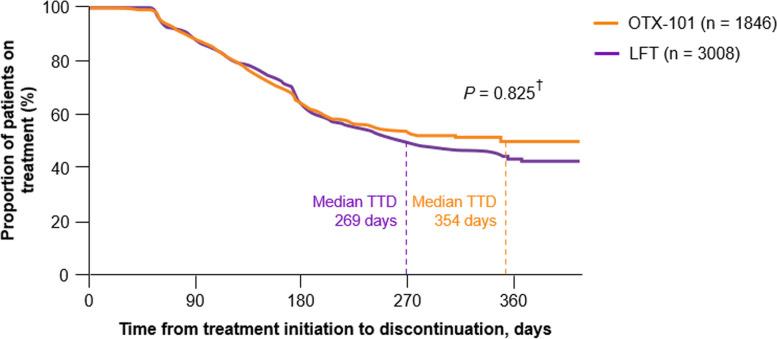
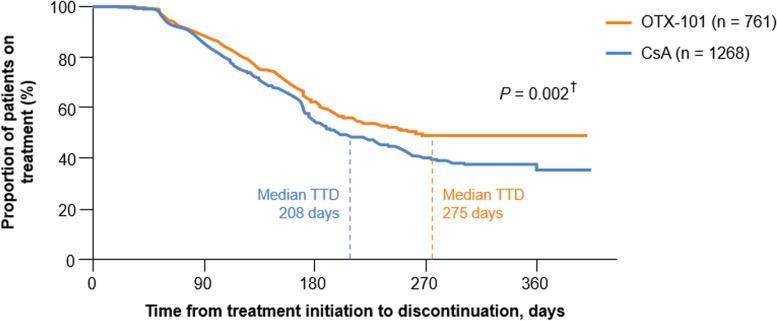
Overall, 7102 patients (OTX-101 n = 1846; CsA n = 2248; LFT n = 3008) were eligible. Median TTD was 354 days for patients receiving OTX-101 vs. 241 days for CsA and 269 days for LFT. Log-rank test indicated TTD was significantly longer for patients on OTX-101 vs. CsA (P = 0.033). Patients on CsA were 35% more likely to discontinue treatment than patients on OTX-101; OTX-101 and LFT groups had similar discontinuation rates. After 360 days, 49.8% of patients receiving OTX-101 remained on treatment vs. 39.4% of patients on CsA (P = 0.036) and 44.0% of patients on LFT (P = 0.854).
CONCLUSIONS
Patients receiving OTX-101 remained on treatment significantly longer and were significantly less likely to discontinue treatment than patients on CsA. Older patients remained on OTX-101 significantly longer than CsA. These findings highlight treatment pattern differences in patients with DED receiving these anti-inflammatory agents.
背景
干眼疾病(DED)是一种以泪膜稳态丧失为特征的疾病,会导致眼表面炎症和损伤。DED 的发病率随年龄增长而增加。环孢素眼用溶液 0.09%(CEQUA;OTX-101)、环孢素眼用乳剂 0.05%(Restasis;CsA)和利福平眼用溶液 5%(Xiidra;LFT)是用于 DED 的抗炎药。本分析比较了接受 OTX-101、CsA 或 LFT 治疗的 DED 患者的治疗模式。
方法
本真实世界、回顾性、纵向队列研究利用 Symphony Health Integrated Dataverse 2019 年 7 月至 2021 年 6 月的索赔数据。该数据集包括所有接受 OTX-101 索赔的患者和随机选择的接受 CsA 或 LFT 索赔的患者(2:1 比 OTX-101)。根据索引治疗将患者分为 3 组。索引日期为首次治疗索赔日期,随访期从索引日期到临床活动结束或数据可获得为止。评估 OTX-101 与 CsA、然后 OTX-101 与 LFT 的治疗停药时间(TTD)、停药概率和治疗持久性。基于年龄和既往 DED 治疗进行亚组分析。使用 Kaplan-Meier 分析和对数秩检验检查 TTD。使用逻辑模型评估索引治疗与停药之间的关联。报告未调整和调整后的优势比、95%置信区间和 P 值,并根据 P 值<0.05 报告具有统计学意义的关联。
结果
总体而言,7102 名患者(OTX-101 n=1846;CsA n=2248;LFT n=3008)符合条件。接受 OTX-101 治疗的患者的中位 TTD 为 354 天,而接受 CsA 治疗的患者为 241 天,接受 LFT 治疗的患者为 269 天。对数秩检验表明,接受 OTX-101 治疗的患者 TTD 明显长于接受 CsA 治疗的患者(P=0.033)。接受 CsA 治疗的患者停止治疗的可能性比接受 OTX-101 治疗的患者高 35%;OTX-101 和 LFT 组的停药率相似。在 360 天后,接受 OTX-101 治疗的患者中有 49.8%继续接受治疗,而接受 CsA 治疗的患者中有 39.4%(P=0.036)和接受 LFT 治疗的患者中有 44.0%(P=0.854)。
结论
接受 OTX-101 治疗的患者继续治疗的时间明显更长,停止治疗的可能性明显低于接受 CsA 治疗的患者。年龄较大的患者接受 OTX-101 治疗的时间明显长于 CsA。这些发现突出了接受这些抗炎药治疗的 DED 患者的治疗模式差异。

 Zotero 插件