
早期生活卫生相关因素与炎症性肠病风险:斯堪的纳维亚出生队列研究。
Early-Life Hygiene-Related Factors and Risk of Inflammatory Bowel Disease: A Scandinavian Birth Cohort Study.
机构信息
Department of Pediatrics, Institute of Clinical Sciences, Sahlgrenska Academy, University of Gothenburg, Gothenburg, Sweden.
Bioinformatics and Data Centre, Sahlgrenska Academy, University of Gothenburg, Gothenburg, Sweden.
出版信息
Inflamm Bowel Dis. 2024 Oct 3;30(10):1820-1830. doi: 10.1093/ibd/izad257.
BACKGROUND
We aimed to investigate whether early-life hygiene-related factors influenced the risk of inflammatory bowel disease (IBD) in a Scandinavian population and test the association's consistency across cohorts.
METHODS
This study followed 117 493 participants in the All Babies in Southeast Sweden study and the Norwegian Mother, Father, and Child Cohort Study. IBD diagnoses were defined by national registers. Comprehensive data on hygiene-related exposures, such as having pets, rural living, daycare attendance, and siblings, were retrieved from questionnaires administered from pregnancy until child's age of 36 months. A multivariable Cox regression model yielded adjusted hazard ratios (aHRs) for IBD accounting for socioeconomic status and perinatal factors. Cohort-specific estimates were pooled using a random-effects model.
RESULTS
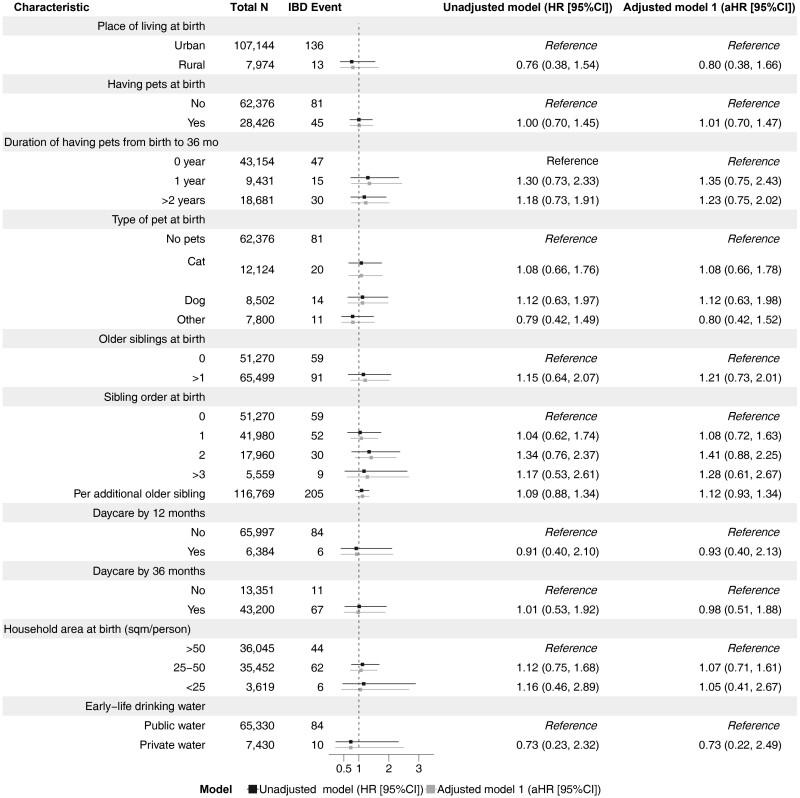
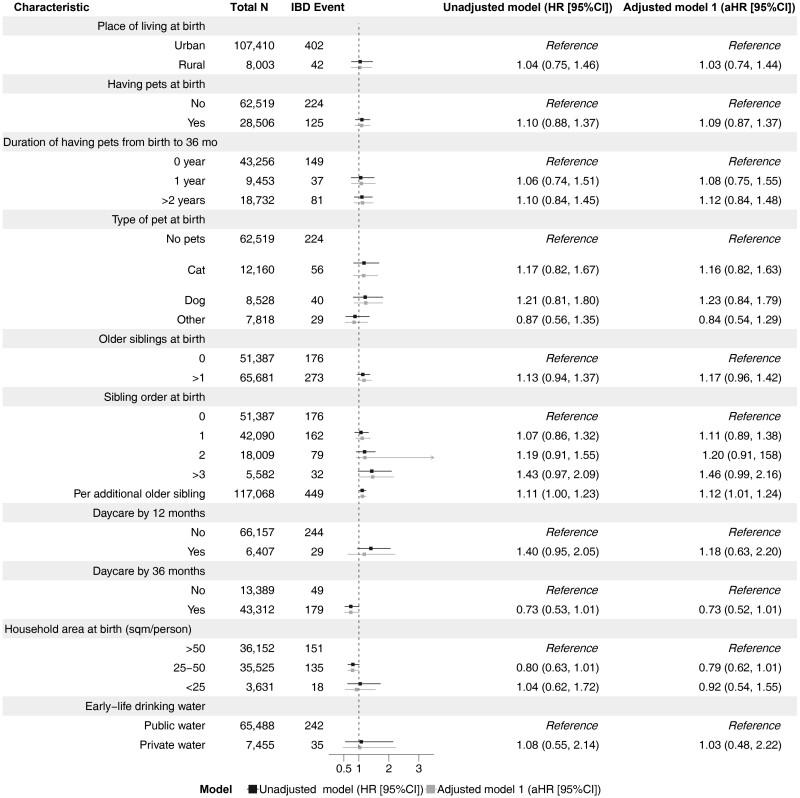
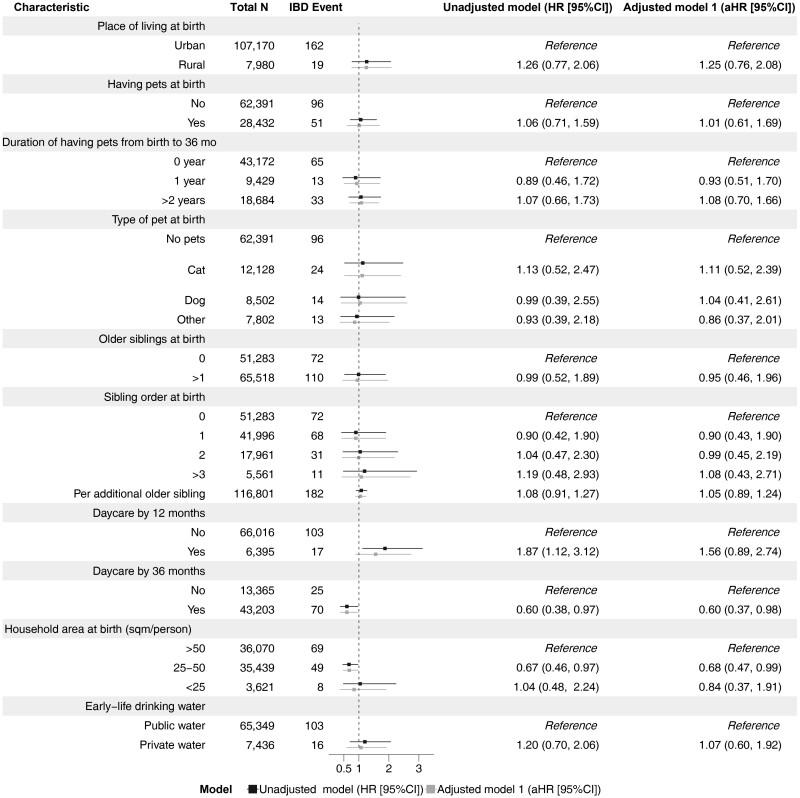
In over 2 024 299 person-years of follow-up 451 participants developed IBD. In pooled estimates children attending daycare up to 36 months of life vs not attending daycare were less likely to develop Crohn's disease (aHR, 0.60; 95% confidence interval [CI], 0.37- 0.98). Children having 1 or more siblings had a modestly increased risk of IBD (aHR, 1.17; 95% CI, 0.96-1.42; aHR for each sibling, 1.12; 95% CI, 1.01-1.24). The other hygiene factors were not significantly linked to later IBD. In the Norwegian Mother, Father, and Child Cohort Study cohort, bed sharing was associated with an increased risk of IBD, most notably for ulcerative colitis (aHR, 1.67; 95% CI, 1.01-2.78).
CONCLUSIONS
In this birth cohort study from 2 high-income Scandinavian countries, some early-life hygiene-related exposures were associated with IBD risk. The generalizability of these results to countries of other socioeconomic level is unknown.
背景
本研究旨在探究斯堪的纳维亚人群中,生命早期与卫生相关的因素是否会影响炎症性肠病(IBD)的发病风险,并检验这种关联在不同队列中的一致性。
方法
本研究纳入了瑞典东南部所有婴儿研究和挪威母婴队列研究中的 117493 名参与者。通过国家登记系统对 IBD 进行诊断。通过在妊娠至儿童 36 个月期间进行的问卷调查,获取与卫生相关的暴露(如养宠物、农村生活、日托和兄弟姐妹)的综合数据。多变量 Cox 回归模型得出了校正后的 IBD 发病风险比(aHR),并考虑了社会经济地位和围产期因素。使用随机效应模型对队列特异性估计值进行了汇总。
结果
在超过 2024299 人年的随访中,451 名参与者被诊断为 IBD。在汇总估计中,0-36 个月时上日托的儿童比不上日托的儿童患克罗恩病的风险较低(aHR,0.60;95%置信区间 [CI],0.37-0.98)。有 1 个或更多兄弟姐妹的儿童患 IBD 的风险略有增加(aHR,1.17;95% CI,0.96-1.42;每个兄弟姐妹的 aHR,1.12;95% CI,1.01-1.24)。其他卫生因素与之后的 IBD 无显著关联。在挪威母婴队列研究中,与父母同床睡与 IBD 风险增加相关,尤其是溃疡性结肠炎(aHR,1.67;95% CI,1.01-2.78)。
结论
在来自 2 个高收入斯堪的纳维亚国家的这项出生队列研究中,一些生命早期与卫生相关的暴露与 IBD 风险相关。这些结果在其他社会经济水平国家的普遍性尚不清楚。
 Zotero 插件