
使用 CCP4 套件中的 REFMAC5 进行中子晶体学精修。
Neutron crystallographic refinement with REFMAC5 from the CCP4 suite.
机构信息
Randall Centre for Cell and Molecular Biophysics, Faculty of Life Sciences and Medicine, King's College London, London SE1 9RT, United Kingdom.
Structural Studies, MRC Laboratory of Molecular Biology, Francis Crick Avenue, Cambridge CB2 0QH, United Kingdom.
出版信息
Acta Crystallogr D Struct Biol. 2023 Dec 1;79(Pt 12):1056-1070. doi: 10.1107/S2059798323008793. Epub 2023 Nov 3.
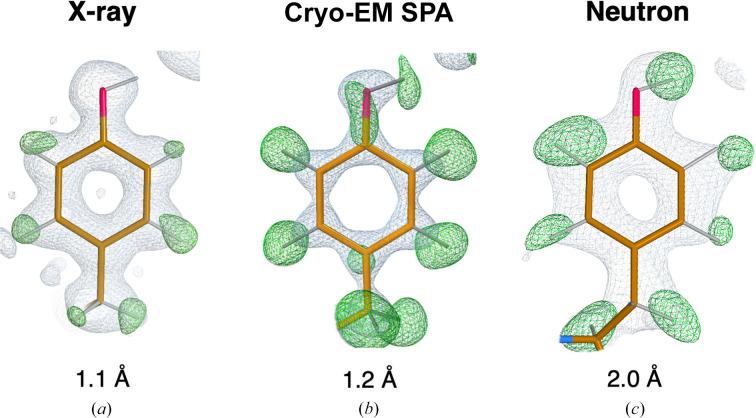
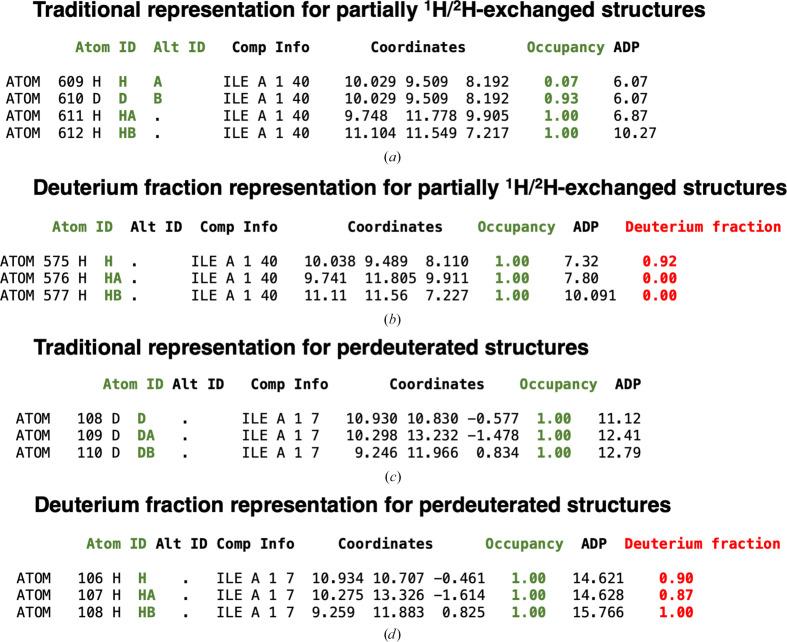
Hydrogen (H) atoms are abundant in macromolecules and often play critical roles in enzyme catalysis, ligand-recognition processes and protein-protein interactions. However, their direct visualization by diffraction techniques is challenging. Macromolecular X-ray crystallography affords the localization of only the most ordered H atoms at (sub-)atomic resolution (around 1.2 Å or higher). However, many H atoms of biochemical significance remain undetectable by this method. In contrast, neutron diffraction methods enable the visualization of most H atoms, typically in the form of deuterium (H) atoms, at much more common resolution values (better than 2.5 Å). Thus, neutron crystallography, although technically demanding, is often the method of choice when direct information on protonation states is sought. REFMAC5 from the Collaborative Computational Project No. 4 (CCP4) is a program for the refinement of macromolecular models against X-ray crystallographic and cryo-EM data. This contribution describes its extension to include the refinement of structural models obtained from neutron crystallographic data. Stereochemical restraints with accurate bond distances between H atoms and their parent atom nuclei are now part of the CCP4 Monomer Library, the source of prior chemical information used in the refinement. One new feature for neutron data analysis in REFMAC5 is refinement of the protium/deuterium (H/H) fraction. This parameter describes the relative H/H contribution to neutron scattering for hydrogen isotopes. The newly developed REFMAC5 algorithms were tested by performing the (re-)refinement of several entries available in the PDB and of one novel structure (FutA) using either (i) neutron data only or (ii) neutron data supplemented by external restraints to a reference X-ray crystallographic structure. Re-refinement with REFMAC5 afforded models characterized by R-factor values that are consistent with, and in some cases better than, the originally deposited values. The use of external reference structure restraints during refinement has been observed to be a valuable strategy, especially for structures at medium-low resolution.
氢(H)原子在生物大分子中大量存在,在酶催化、配体识别过程和蛋白质-蛋白质相互作用中常常起着关键作用。然而,利用衍射技术直接观察它们具有挑战性。大分子 X 射线晶体学只能定位(亚)原子分辨率下(约 1.2Å 或更高)最有序的 H 原子。然而,许多具有生物化学意义的 H 原子仍然无法用这种方法检测到。相比之下,中子衍射方法可以可视化大多数 H 原子,通常是以氘(H)原子的形式,分辨率通常更高(优于 2.5Å)。因此,尽管中子晶体学技术要求较高,但当需要直接获得质子化状态信息时,它通常是首选方法。REFMAC5 是协作计算项目 4(CCP4)的一个程序,用于针对 X 射线晶体学和 cryo-EM 数据对大分子模型进行精修。本贡献描述了它的扩展,以包括从中子晶体学数据中获得的结构模型的精修。现在,具有 H 原子与其母核之间准确键距离的立体化学限制是 CCP4 单体库的一部分,这是精修中使用的先前化学信息的来源。REFMAC5 中的一个新的中子数据分析功能是对氕/氘(H/H)分数进行精修。该参数描述了氢同位素对中子散射的 H/H 相对贡献。新开发的 REFMAC5 算法通过对 PDB 中可用的几个条目以及一个新结构(FutA)进行(重新)精修进行了测试,这些条目仅使用(i)中子数据或(ii)中子数据和外部约束补充参考 X 射线晶体结构。使用 REFMAC5 重新精修后,得到的模型的 R 因子值与原始值一致,在某些情况下甚至更好。在精修过程中使用外部参考结构约束已被证明是一种有效的策略,特别是对于中低分辨率的结构。

 Zotero 插件