
一款自助式跨诊断智能手机应用程序对患者赋权及心理健康的影响:随机对照试验
Effects of a Self-Guided Transdiagnostic Smartphone App on Patient Empowerment and Mental Health: Randomized Controlled Trial.
作者信息
Kerber André, Beintner Ina, Burchert Sebastian, Knaevelsrud Christine
机构信息
Department of Clinical-Psychological Intervention, Freie Universität Berlin, Berlin, Germany.
MindDoc Health GmbH, Munich, Germany.
出版信息
JMIR Ment Health. 2023 Nov 6;10:e45068. doi: 10.2196/45068.
BACKGROUND
Mental disorders impact both individuals and health systems. Symptoms and syndromes often remain undetected and untreated, resulting in chronification. Besides limited health care resources, within-person barriers such as the lack of trust in professionals, the fear of stigmatization, or the desire to cope with problems without professional help contribute to the treatment gap. Self-guided mental health apps may support treatment seeking by reducing within-person barriers and facilitating mental health literacy. Digital mental health interventions may also improve mental health related self-management skills and contribute to symptom reduction and the improvement of quality of life.
OBJECTIVE
This study aims to investigate the effects of a self-guided transdiagnostic app for mental health on help seeking, reduced stigma, mental health literacy, self-management skills, mental health symptoms, and quality of life using a randomized controlled design.
METHODS
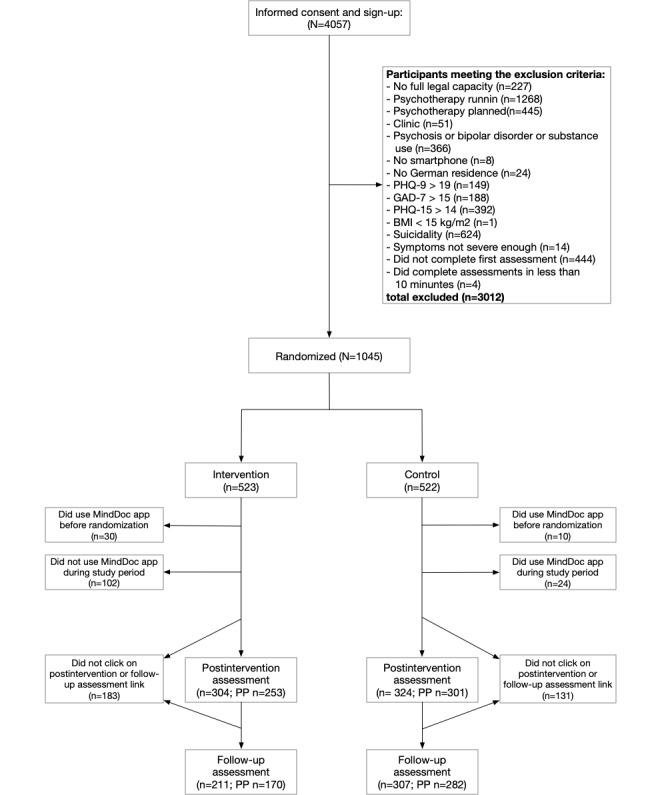
Overall, 1045 participants (recruited via open, blinded, and web-based recruitment) with mild to moderate depression or anxiety-, sleep-, eating-, or somatization-related psychopathology were randomized to receive either access to a self-guided transdiagnostic mental health app (MindDoc) in addition to care as usual or care as usual only. The core features of the app were regular self-monitoring, automated feedback, and psychological courses and exercises. The coprimary outcomes were mental health literacy, mental health-related patient empowerment and self-management skills (MHPSS), attitudes toward help seeking, and actual mental health service use. The secondary outcomes were psychopathological symptom burden and quality of life. Data were collected at baseline and 8 weeks and 6 months after randomization. Treatment effects were investigated using analyses of covariance, including baseline variables as predictors and applying multiple imputation.
RESULTS
We found small but robust between-group effects for MHPSS (Cohen d=0.29), symptoms burden (Cohen d=0.28), and quality of life (Cohen d=0.19) 8 weeks after randomization. The effects on MHPSS were maintained at follow-up. Follow-up assessments also showed robust effects on mental health literacy and preliminary evidence for the improvement of help seeking. Predictors of attrition were lower age and higher personality dysfunction. Among the non-attritors, predictors for deterioration were less outpatient treatment and higher initial symptom severity.
CONCLUSIONS
A self-guided transdiagnostic mental health app can contribute to lasting improvements in patient empowerment. Symptoms of common mental disorders and quality of life improved faster in the intervention group than in the control group. Therefore, such interventions may support individuals with symptoms of 1 or more internalizing disorders, develop health-centered coping skills, prevent chronification, and accelerate symptom improvement. Although the effects for individual users are small and predictors of attrition and deterioration need to be investigated further, the potential public health impact of a self-guided intervention can be large, given its high scalability.
TRIAL REGISTRATION
German Clinical Trials Register DRKS00022531; https://drks.de/search/de/trial/DRKS00022531.
背景
精神障碍对个人和卫生系统都会产生影响。症状和综合征常常未被发现和治疗,从而导致病情慢性化。除了卫生保健资源有限外,个人内在的障碍,如对专业人员缺乏信任、害怕被污名化,或希望在没有专业帮助的情况下应对问题,也导致了治疗差距。自我引导式心理健康应用程序可能通过减少个人内在障碍和促进心理健康素养来支持寻求治疗。数字心理健康干预还可能提高与心理健康相关的自我管理技能,并有助于减轻症状和改善生活质量。
目的
本研究旨在采用随机对照设计,调查一款自我引导式跨诊断心理健康应用程序对寻求帮助、减少污名化、心理健康素养、自我管理技能、心理健康症状和生活质量的影响。
方法
总共1045名参与者(通过公开、盲法和基于网络的招募方式招募),患有轻度至中度抑郁或与焦虑、睡眠、饮食或躯体化相关的精神病理学问题,被随机分配接受除常规护理外还可使用自我引导式跨诊断心理健康应用程序(MindDoc),或仅接受常规护理。该应用程序的核心功能包括定期自我监测、自动反馈以及心理课程和练习。共同主要结局为心理健康素养、与心理健康相关的患者赋权和自我管理技能(MHPSS)、对寻求帮助的态度以及实际使用心理健康服务的情况。次要结局为精神病理症状负担和生活质量。在基线、随机分组后8周和6个月收集数据。使用协方差分析研究治疗效果,将基线变量作为预测因素并应用多重插补法。
结果
我们发现随机分组8周后,MHPSS(科恩d值 = 0.29)、症状负担(科恩d值 = 0.28)和生活质量(科恩d值 = 0.19)在组间存在虽小但显著的效应。对MHPSS的效应在随访时得以维持。随访评估还显示对心理健康素养有显著效应,并有寻求帮助得到改善的初步证据。失访的预测因素为年龄较小和人格功能障碍程度较高。在未失访者中,病情恶化的预测因素为门诊治疗较少和初始症状严重程度较高。
结论
一款自我引导式跨诊断心理健康应用程序有助于患者赋权的持续改善。干预组常见精神障碍的症状和生活质量比对照组改善得更快。因此,此类干预可能支持有1种或更多内化障碍症状的个体,培养以健康为中心的应对技能,预防病情慢性化,并加速症状改善。尽管对个体用户的效应较小,且失访和病情恶化的预测因素需要进一步研究,但鉴于其高可扩展性,自我引导式干预对公共卫生的潜在影响可能很大。
试验注册
德国临床试验注册中心DRKS00022531;https://drks.de/search/de/trial/DRKS00022531 。
 Zotero 插件