
血清 hedgehog 信号蛋白在犬乳腺肿瘤中的生物标志物可用性。
Usability of serum hedgehog signalling proteins as biomarkers in canine mammary carcinomas.
机构信息
Department of Veterinary Clinical Sciences, College of Veterinary Medicine and Research Institute for Veterinary Science, Seoul National University, 1 Gwanak-Ro, Gwanak-Gu, Seoul, 08826, Republic of Korea.
Department of Veterinary Surgery, College of Veterinary Medicine, Chungbuk National University, Cheongju, Republic of Korea.
出版信息
BMC Vet Res. 2023 Nov 6;19(1):231. doi: 10.1186/s12917-023-03761-7.
BACKGROUND
The hedgehog signalling pathway has been implicated in tumourigenesis and progression of many tumour types. This pathway has recently emerged as a therapeutic target, and inhibitors of hedgehog signalling have gained considerable attention. In dogs, the roles of hedgehog signals in several types of tumours have been investigated, but their relationship with canine mammary gland tumours (MGTs) has not been established. This study aimed to evaluate the expression of sonic hedgehog (SHH) and glioma-associated oncogene 1 (GLI-1) in the serum and mammary tumour tissues of dogs.
RESULTS
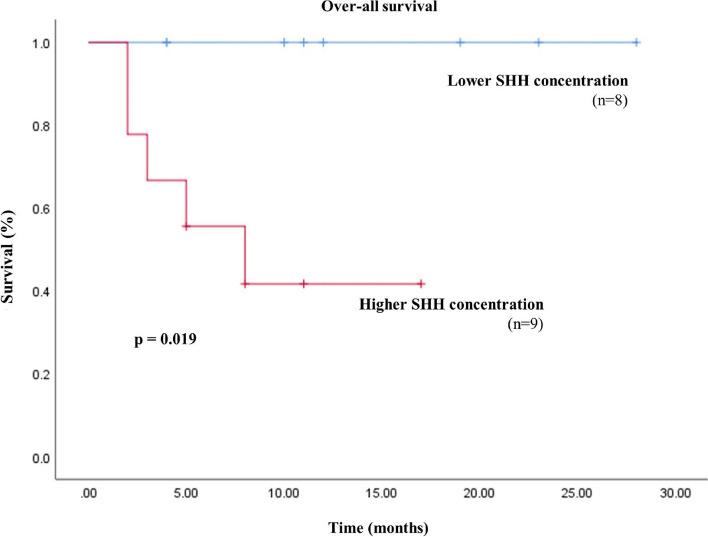
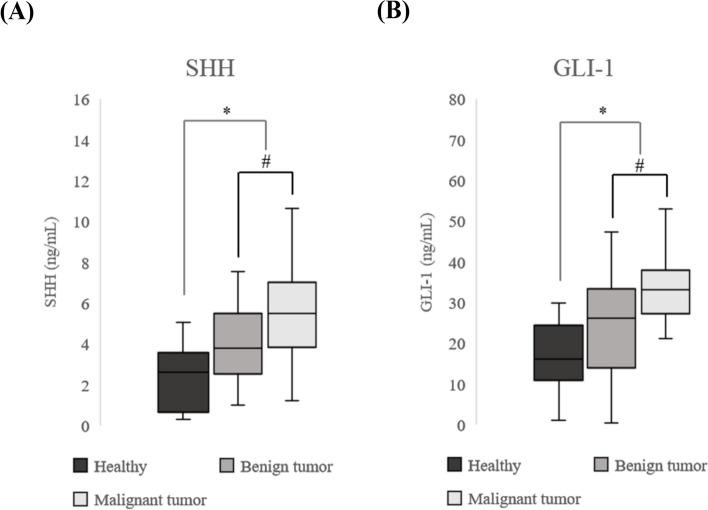
SHH and GLI-1 protein expression levels were significantly higher in MGT tissues than in normal mammary gland tissues, as well as in malignant MGT specimens than in benign MGT specimens. Serum levels of SHH and GLI-1 were higher in MGT patients than in healthy controls (p < .001 and .001, respectively). Serum SHH level showed a statistically significant relationship with metastatic status (p = .01), and serum GLI-1 level showed a statistically significant relationship with histologic grade (p = 0.048) and metastatic status (p = 0.007). Serum hedgehog signalling protein levels were not significantly associated with breed size, sex, tumour size, or histologic type.
CONCLUSIONS
Hedgehog signalling protein expression in canine MGT tissue and serum differed according to the histological classification (benign and malignant) and metastatic status, indicating a relationship between the hedgehog signalling pathway and canine MGT. Thus, the hedgehog signalling pathway may serve as a new biomarker and therapeutic target in canine MGT patients.
背景
刺猬信号通路已被牵涉到多种肿瘤类型的肿瘤发生和进展中。该通路最近已成为治疗靶点,刺猬信号抑制剂受到了广泛关注。在犬中,已经研究了刺猬信号在几种类型的肿瘤中的作用,但它们与犬乳腺肿瘤(MGT)的关系尚未建立。本研究旨在评估 sonic hedgehog(SHH)和 glioma-associated oncogene 1(GLI-1)在犬血清和乳腺肿瘤组织中的表达。
结果
MGT 组织中的 SHH 和 GLI-1 蛋白表达水平明显高于正常乳腺组织,恶性 MGT 标本中的表达水平也明显高于良性 MGT 标本。MGT 患者的血清 SHH 和 GLI-1 水平高于健康对照组(分别为 p<0.001 和 p<0.001)。血清 SHH 水平与转移状态呈统计学显著相关(p=0.01),血清 GLI-1 水平与组织学分级(p=0.048)和转移状态(p=0.007)呈统计学显著相关。血清刺猬信号蛋白水平与品种大小、性别、肿瘤大小或组织学类型无显著相关性。
结论
犬 MGT 组织和血清中的刺猬信号蛋白表达根据组织学分类(良性和恶性)和转移状态而不同,表明刺猬信号通路与犬 MGT 之间存在关系。因此,刺猬信号通路可能成为犬 MGT 患者的新生物标志物和治疗靶点。

 Zotero 插件