
一项开放标签、2 期研究的随访结果:米替泊肟治疗镰状细胞病的 1 年安全性和疗效。
One-year safety and efficacy of mitapivat in sickle cell disease: follow-up results of a phase 2, open-label study.
机构信息
Center for Benign Hematology, Thrombosis and Hemostasis - Van Creveldkliniek, University Medical Center Utrecht, Utrecht University, Utrecht, The Netherlands.
Department of Central Diagnostic Laboratory - Research, University Medical Center Utrecht, Utrecht University, Utrecht, The Netherlands.
出版信息
Blood Adv. 2023 Dec 26;7(24):7539-7550. doi: 10.1182/bloodadvances.2023011477.
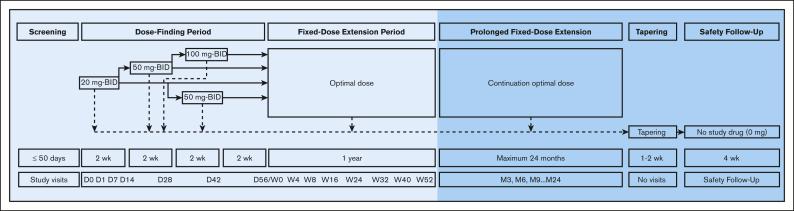
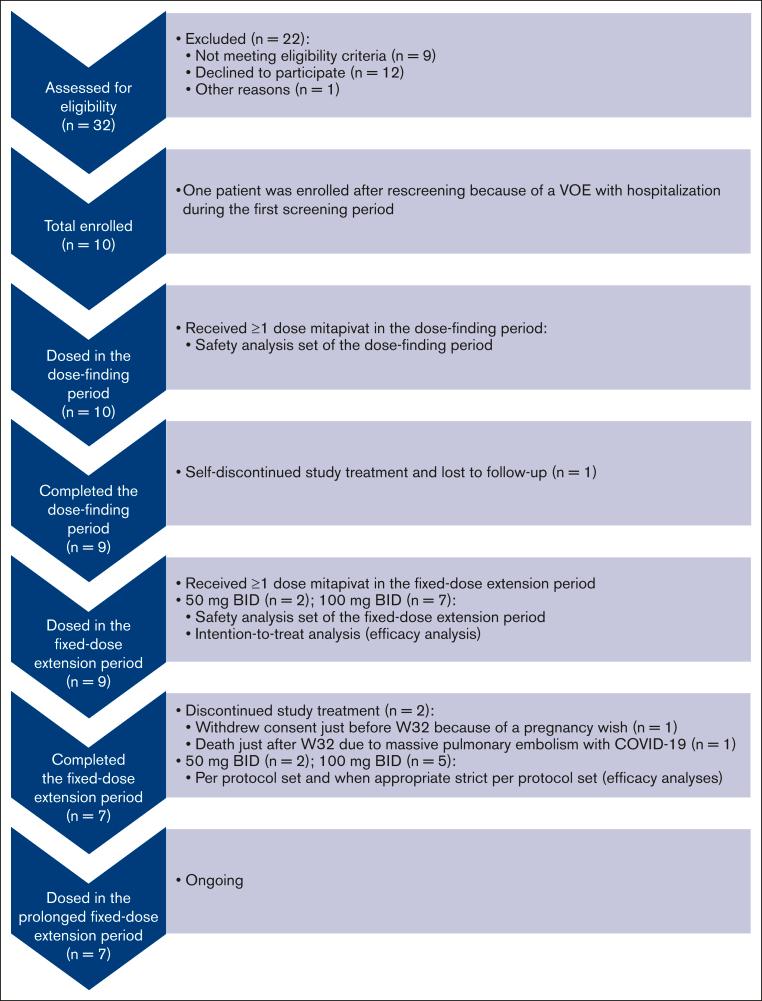
Targeting the primary pathogenic event of sickle cell disease (SCD), the polymerization of sickle hemoglobin (HbS), may prevent downstream clinical events. Mitapivat, an oral pyruvate kinase (PK) activator, has therapeutic potential by increasing adenosine triphosphate (ATP) and decreasing 2,3-diphosphoglycerate (2,3-DPG), a glycolytic red blood cell (RBC) intermediate. In the previously reported 8-week dose-finding period of this phase 2, investigator-initiated, open-label study, mitapivat was well tolerated and showed efficacy in SCD. Here, the 1-year fixed-dose extension period is reported in which 9 of 10 included patients (90%) aged ≥16 years with SCD (HbSS, HbS/β0, or HbS/β+) continued with mitapivat. Mostly mild treatment-emergent adverse events (AEs) (most commonly, transaminase increase and headache) were still reported. Apart from the reported nontreatment-related serious AE (SAE) of a urinary tract infection in the dose-finding period, 1 nontreatment-related SAE occurred in the fixed-dose extension period in a patient who died of massive pulmonary embolism due to COVID-19. Importantly, sustained improvement in Hb level (mean increase, 1.1 ± 0.7 g/dL; P = .0014) was seen, which was accompanied by decreases in markers of hemolysis. In addition, the annualized rate of vaso-occlusive events reduced significantly from a historic baseline of 1.33 ± 1.32 to 0.64 ± 0.87 (P = .0489) when combining the dose-finding period and fixed-dose extension period. Cellularly, the ATP:2,3-DPG ratio and Hb-oxygen affinity significantly increased and RBC sickling (point of sickling) nonsignificantly reduced. Overall, this study demonstrated 1-year safety and efficacy of treatment with mitapivat in SCD, supporting further evaluation in ongoing phase 2/3 study (RISE UP, NCT05031780). This trial was registered at https://www.clinicaltrialsregister.eu/ as NL8517 and EudraCT 2019-003438-18.
针对镰状细胞病(SCD)的主要致病事件——镰状血红蛋白(HbS)的聚合,可以预防下游的临床事件。米他匹韦是一种口服丙酮酸激酶(PK)激活剂,通过增加三磷酸腺苷(ATP)和降低 2,3-二磷酸甘油酸(2,3-DPG),一种糖酵解红细胞(RBC)中间产物,具有治疗潜力。在这项由研究者发起的、开放性的、2 期临床试验的之前报道的 8 周剂量发现期,米他匹韦具有良好的耐受性,并显示出对 SCD 的疗效。在这里,报告了为期 1 年的固定剂量扩展期,10 名纳入的年龄≥16 岁的 SCD 患者(HbSS、HS/β0 或 HbS/β+)中的 9 名(90%)继续使用米他匹韦。仍报告了大多数轻微的治疗后出现的不良事件(AE)(最常见的是转氨酶升高和头痛)。除了在剂量发现期报告的与治疗无关的严重 AE(SAE)——尿路感染外,在固定剂量扩展期,1 名因 COVID-19 导致的大量肺栓塞而死亡的患者发生了 1 例与治疗无关的 SAE。重要的是,观察到 Hb 水平持续改善(平均增加 1.1±0.7 g/dL;P=0.0014),同时伴有溶血标志物的降低。此外,血管阻塞性事件的年化发生率从历史基线的 1.33±1.32 显著降低至 0.64±0.87(P=0.0489),将剂量发现期和固定剂量扩展期结合在一起。细胞水平上,ATP:2,3-DPG 比值和 Hb 氧亲和力显著增加,RBC 镰变(镰变点)略有降低。总的来说,这项研究表明米他匹韦在 SCD 中的治疗具有 1 年的安全性和疗效,支持在正在进行的 2/3 期研究(RISE UP,NCT05031780)中进一步评估。这项试验在 https://www.clinicaltrialsregister.eu/ 注册为 NL8517 和 EudraCT 2019-003438-18。



 Zotero 插件