
内镜增强荧光引导微创手术可提高胶质母细胞瘤患者的生存率。
Endoscope-enhanced fluorescence-guided microsurgery increases survival in patients with glioblastoma.
机构信息
Department of Neurosurgery, University Hospital Goettingen, Goettingen, Germany.
Department of Neuroradiology, University Hospital Goettingen, Goettingen, Germany.
出版信息
Acta Neurochir (Wien). 2023 Dec;165(12):4221-4226. doi: 10.1007/s00701-023-05862-6. Epub 2023 Nov 11.
PURPOSE
Extent of resection (EOR) predicts progression-free survival (PFS) and may impact overall survival (OS) in patients with glioblastoma. We recently demonstrated that 5-aminolevulinic acid-(5-ALA)-fluorescence-enhanced endoscopic surgery increase the rate of gross total resection. However, it is hitherto unknown whether fluorescence-enhanced endoscopic resection affects survival.
METHODS
We conducted a retrospective single-center analysis of a consecutive series of patients who underwent surgery for non-eloquently located glioblastoma between 2011 and 2018. All patients underwent fluorescence-guided microscopic or fluorescence-guided combined microscopic and endoscopic resection. PFS, OS, EOR as well as clinical and demographic parameters, adjuvant treatment modalities, and molecular characteristics were compared between microscopy-only vs. endoscopy-assisted microsurgical resection.
RESULTS
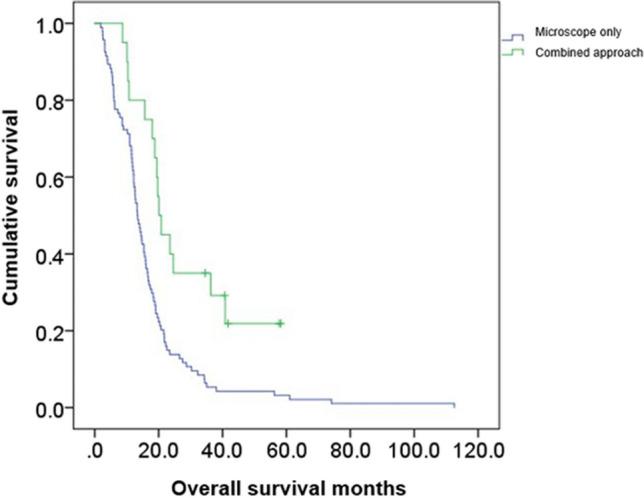
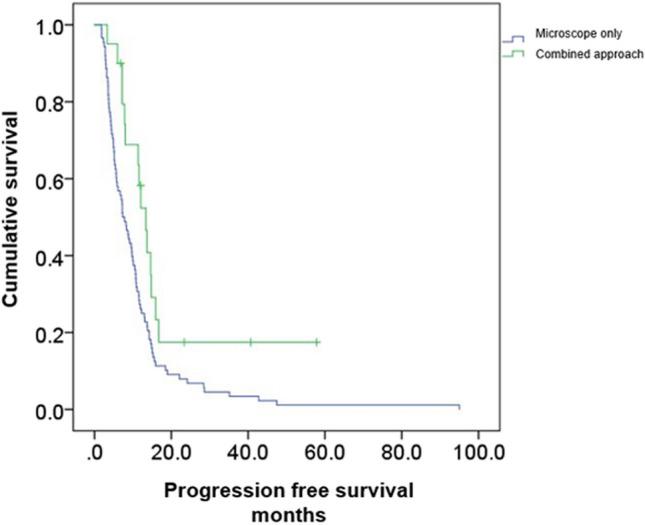
Out of 114 patients, 73 (65%) were male, and 57 (50%) were older than 65 years. Twenty patients (18%) were operated on using additional endoscopic assistance. Both cohorts were equally distributed in terms of age, performance status, lesion location, adjuvant treatment modalities, and molecular status. Gross total resection was achieved in all endoscopy-assisted patients compared to about three-quarters of microscope-only patients (100% vs. 75.9%, p=0.003). The PFS in the endoscope-assisted cohort was 19.3 months (CI95% 10.8-27.7) vs. 10.8 months (CI95% 8.2-13.4; p=0.012) in the microscope-only cohort. OS in the endoscope-assisted group was 28.9 months (CI95% 20.4-34.1) compared to 16.8 months (CI95% 14.0-20.9), in the microscope-only group (p=0.001).
CONCLUSION
Endoscope-assisted fluorescence-guided resection of glioblastoma appears to substantially enhance gross total resection and OS. The strong effect size observed herein is contrasted by the limitations in study design. Therefore, prospective validation is required before we can generalize our findings.
目的
切除范围(EOR)可预测无进展生存期(PFS),并可能影响胶质母细胞瘤患者的总生存期(OS)。我们最近证明,5-氨基酮戊酸-(5-ALA)-荧光增强内镜手术可提高大体全切除率。然而,目前尚不清楚荧光增强内镜切除是否会影响生存。
方法
我们对 2011 年至 2018 年间连续接受非语言定位胶质母细胞瘤手术的患者进行了回顾性单中心分析。所有患者均接受荧光引导显微镜或荧光引导显微镜联合内镜切除术。显微镜下单独切除与内镜辅助显微镜下联合切除比较 PFS、OS、EOR 以及临床和人口统计学参数、辅助治疗方式和分子特征。
结果
114 例患者中,73 例(65%)为男性,57 例(50%)年龄大于 65 岁。20 例(18%)患者接受了额外的内镜辅助手术。两个队列在年龄、表现状态、病变位置、辅助治疗方式和分子状态方面分布均匀。所有内镜辅助患者均达到大体全切除,而显微镜下单独切除的患者约有四分之三达到大体全切除(100%对 75.9%,p=0.003)。内镜辅助组的 PFS 为 19.3 个月(CI95%10.8-27.7),显微镜下单独切除组为 10.8 个月(CI95%8.2-13.4;p=0.012)。内镜辅助组的 OS 为 28.9 个月(CI95%20.4-34.1),而显微镜下单独切除组为 16.8 个月(CI95%14.0-20.9)(p=0.001)。
结论
内镜辅助荧光引导胶质母细胞瘤切除似乎可显著提高大体全切除率和 OS。与研究设计的局限性相比,观察到的强效应大小是相反的。因此,在推广我们的发现之前,需要进行前瞻性验证。
 Zotero 插件