
评估啮齿动物精子形态异常检测中的最佳细胞计数
Assessing Optimal Cell Counts in Sperm Shape Abnormality Assays in Rodents.
作者信息
Cardoso Elizandra, Mathias Maria da Luz, Monarca Rita I, Gabriel Sofia I
机构信息
CESAM-Centro de Estudos do Ambiente e do Mar, Departamento de Biologia Animal, Faculdade de Ciências da Universidade de Lisboa, Campo Grande, 1749-016 Lisboa, Portugal.
Departamento de Biologia da Universidade de Aveiro, Campus Universitário de Santiago, 3810-193 Aveiro, Portugal.
出版信息
Animals (Basel). 2023 Oct 26;13(21):3324. doi: 10.3390/ani13213324.
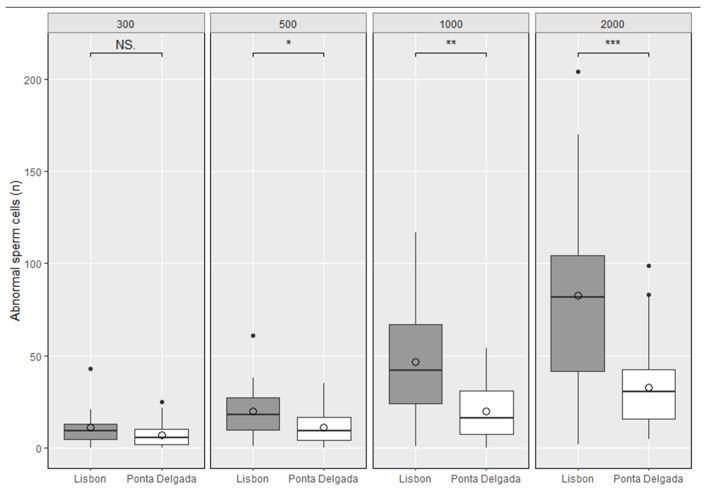
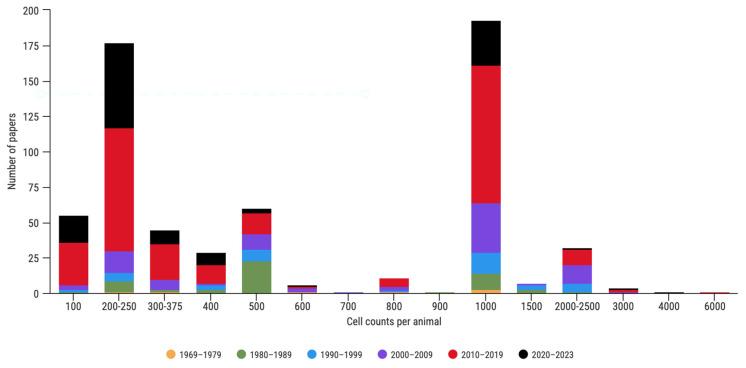
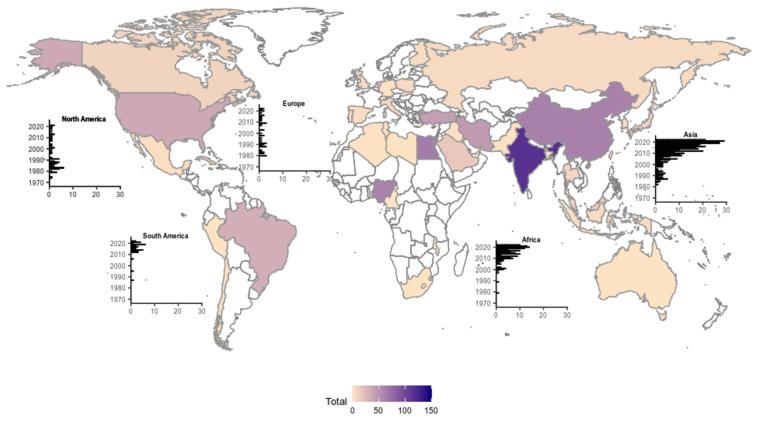
Rodents have been the preferred models for the evaluation of the toxicity of pollutants and drugs and their genotoxic effects, including sperm shape abnormalities. The scientific literature is dominated by studies conducted with model animals in laboratory conditions, but a generally accepted and standardized protocol addressing the optimal number of sperm cells to count is still lacking. In this study, we reviewed the literature regarding the number of counted sperm cells in such assessments, published from 1969 to 2023. To infer the number of counts providing the best cost/benefit regarding the robustness of the assay results, a new dataset involving the analysis of two populations of wild rodents was produced. We evaluated the frequency of sperm shape abnormalities in a total of 50 wild brown rats () captured in two port cities, aiming to detect the impact of differential sperm cell counts in the obtained results. During necropsy, the fresh epididymis tail of adult male rats was excised, and sperm cells were fixated in slides. For each animal, a total of 300, 500, 1000, and 2000 cells were sequentially counted, and head abnormalities were registered. Counting 300 sperm cells failed to detect significant differences between groups and 500 counts resulted in marginally significant differences. Only when 1000 or 2000 sperm cells were counted, significant differences emerged between groups. We propose that studies addressing sperm shape abnormalities should standardize counts to an optimal value of 1000 cells per animal, warranting robust statistical results while providing the best compromise concerning labor time.
啮齿动物一直是评估污染物和药物毒性及其遗传毒性效应(包括精子形态异常)的首选模型。科学文献主要是在实验室条件下对模式动物进行的研究,但仍然缺乏一个普遍接受的、标准化的方案来确定精子细胞的最佳计数数量。在本研究中,我们回顾了1969年至2023年发表的关于此类评估中精子细胞计数数量的文献。为了推断出在检测结果稳健性方面提供最佳成本效益的计数数量,我们生成了一个涉及分析两个野生啮齿动物种群的新数据集。我们评估了在两个港口城市捕获的总共50只野生褐家鼠(Rattus norvegicus)的精子形态异常频率,旨在检测不同精子细胞计数对所得结果的影响。在尸检过程中,切除成年雄性大鼠新鲜的附睾尾部,并将精子细胞固定在载玻片上。对每只动物依次计数总共300、500、1000和2000个细胞,并记录头部异常情况。计数300个精子细胞未能检测到组间的显著差异,计数500个时结果仅有微弱的显著差异。只有当计数1000或2000个精子细胞时,组间才出现显著差异。我们建议,针对精子形态异常的研究应将计数标准化为每只动物1000个细胞的最佳值,以保证获得稳健的统计结果,同时在劳动时间方面提供最佳的权衡。

 Zotero 插件