
用于空气中 SARS-CoV-2 检测的液滴数字 PCR 应用。
Droplet digital PCR application for the detection of SARS-CoV-2 in air sample.
机构信息
Environmental Health Research Centre, Institute for Medical Research, National Institutes of Health, Ministry of Health Malaysia, Shah Alam, Selangor, Malaysia.
Infectious Disease Research Centre, Institute for Medical Research, National Institutes of Health, Ministry of Health Malaysia, Shah Alam, Selangor, Malaysia.
出版信息
Front Public Health. 2023 Oct 27;11:1208348. doi: 10.3389/fpubh.2023.1208348. eCollection 2023.
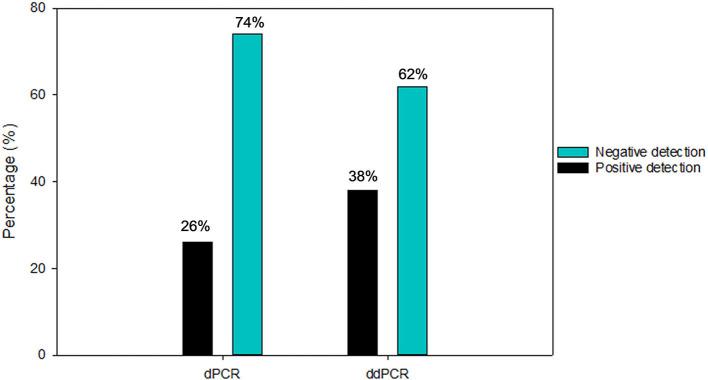
Severe Acute Respiratory Syndrome Coronavirus 2 (SARS-CoV-2) may transmit through airborne route particularly when the aerosol particles remain in enclosed spaces with inadequate ventilation. There has been no standard recommended method of determining the virus in air due to limitations in pre-analytical and technical aspects. Furthermore, the presence of low virus loads in air samples could result in false negatives. Our study aims to explore the feasibility of detecting SARS-CoV-2 ribonucleic acid (RNA) in air samples using droplet digital polymerase chain reaction (ddPCR). Active and passive air sampling was conducted between December 2021 and February 2022 with the presence of COVID-19 confirmed cases in two hospitals and a quarantine center in Klang Valley, Malaysia. SARS-CoV-2 RNA in air was detected and quantified using ddPCR and real-time reverse transcriptase-polymerase chain reaction (RT-PCR). The comparability of two different digital PCR platforms (QX200 and QIAcuity) to RT-PCR were also investigated. Additionally negative staining transmission electron microscopy was performed to visualize virus ultrastructure. Detection rates of SARS-CoV-2 in air samples using ddPCR were higher compared to RT-PCR, which were 15.2% (22/145) and 3.4% (5/145), respectively. The sensitivity and specificity of ddPCR was 100 and 87%, respectively. After excluding 17 negative samples (50%) by both QX200 and QIAcuity, 15% samples (5/34) were found to be positive both ddPCR and dPCR. There were 23.5% (8/34) samples that were detected positive by ddPCR but negative by dPCR. In contrast, there were 11.7% (4/34) samples that were detected positive by dPCR but negative by ddPCR. The SARS-CoV-2 detection method by ddPCR is precise and has a high sensitivity for viral RNA detection. It could provide advances in determining low viral titter in air samples to reduce false negative reports, which could complement detection by RT-PCR.
严重急性呼吸综合征冠状病毒 2(SARS-CoV-2)可能通过空气传播途径传播,特别是当气溶胶颗粒在通风不足的封闭空间中停留时。由于分析前和技术方面的限制,目前还没有确定空气中病毒的标准推荐方法。此外,空气中样本中的病毒载量低可能导致假阴性。我们的研究旨在探索使用液滴数字聚合酶链反应(ddPCR)检测空气中 SARS-CoV-2 核糖核酸(RNA)的可行性。2021 年 12 月至 2022 年 2 月期间,在马来西亚雪兰莪州的两家医院和一个检疫中心有 COVID-19 确诊病例的情况下,进行了主动和被动空气采样。使用 ddPCR 和实时逆转录聚合酶链反应(RT-PCR)检测和定量空气中的 SARS-CoV-2 RNA。还研究了两种不同数字 PCR 平台(QX200 和 QIAcuity)与 RT-PCR 的可比性。此外,还进行了负染色透射电子显微镜检查以观察病毒超微结构。与 RT-PCR 相比,ddPCR 检测空气中 SARS-CoV-2 的检出率更高,分别为 15.2%(22/145)和 3.4%(5/145)。ddPCR 的灵敏度和特异性分别为 100%和 87%。排除 QX200 和 QIAcuity 两种方法均为阴性的 17 个样本(50%)后,发现 ddPCR 和 dPCR 均为阳性的样本为 15%(5/34)。ddPCR 检测为阳性但 dPCR 检测为阴性的样本为 23.5%(8/34)。相反,dPCR 检测为阳性但 ddPCR 检测为阴性的样本为 11.7%(4/34)。ddPCR 用于 SARS-CoV-2 的检测方法精确,对病毒 RNA 的检测具有高灵敏度。它可以提供确定空气中低病毒滴度的方法,以减少假阴性报告,这可以补充 RT-PCR 的检测。



 Zotero 插件