
一种绿藻中细胞膜定位的 metacaspase 的热保护作用。
Thermoprotection by a cell membrane-localized metacaspase in a green alga.
机构信息
Department of Molecular Sciences, Uppsala BioCenter, Swedish University of Agricultural Sciences and Linnean Center for Plant Biology, SE-756 51 Uppsala, Sweden.
Department of Chemical Biology and Bioimaging, Wroclaw University of Science and Technology, 50-370 Wroclaw, Poland.
出版信息
Plant Cell. 2024 Feb 26;36(3):665-687. doi: 10.1093/plcell/koad289.
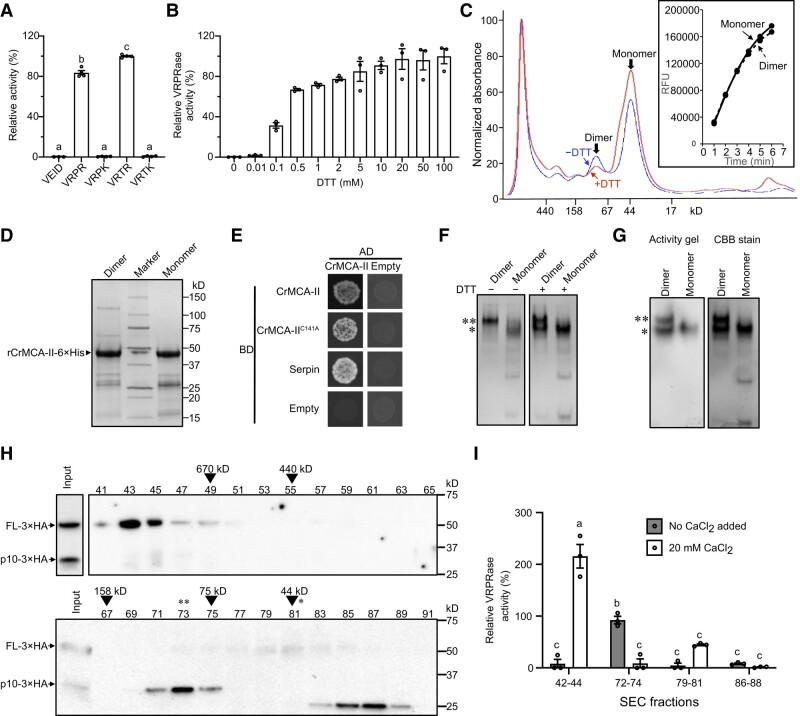
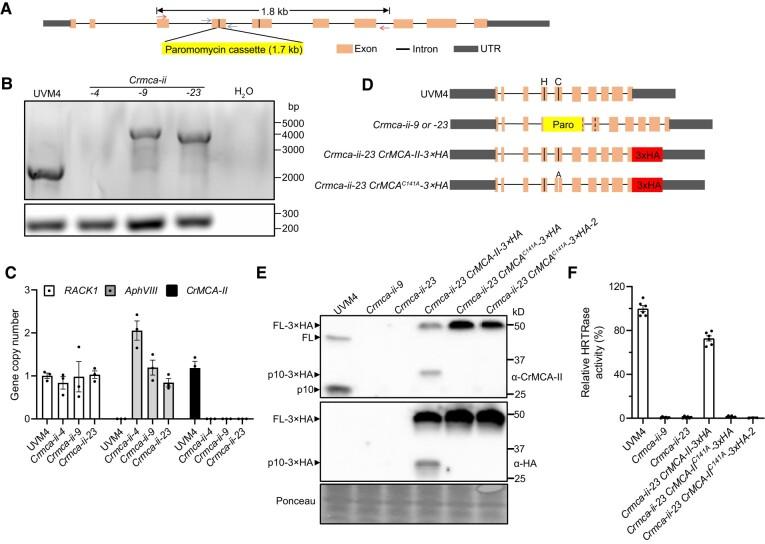
Caspases are restricted to animals, while other organisms, including plants, possess metacaspases (MCAs), a more ancient and broader class of structurally related yet biochemically distinct proteases. Our current understanding of plant MCAs is derived from studies in streptophytes, and mostly in Arabidopsis (Arabidopsis thaliana) with 9 MCAs with partially redundant activities. In contrast to streptophytes, most chlorophytes contain only 1 or 2 uncharacterized MCAs, providing an excellent platform for MCA research. Here we investigated CrMCA-II, the single type-II MCA from the model chlorophyte Chlamydomonas (Chlamydomonas reinhardtii). Surprisingly, unlike other studied MCAs and similar to caspases, CrMCA-II dimerizes both in vitro and in vivo. Furthermore, activation of CrMCA-II in vivo correlated with its dimerization. Most of CrMCA-II in the cell was present as a proenzyme (zymogen) attached to the plasma membrane (PM). Deletion of CrMCA-II by genome editing compromised thermotolerance, leading to increased cell death under heat stress. Adding back either wild-type or catalytically dead CrMCA-II restored thermoprotection, suggesting that its proteolytic activity is dispensable for this effect. Finally, we connected the non-proteolytic role of CrMCA-II in thermotolerance to the ability to modulate PM fluidity. Our study reveals an ancient, MCA-dependent thermotolerance mechanism retained by Chlamydomonas and probably lost during the evolution of multicellularity.
半胱天冬酶仅存在于动物中,而其他生物,包括植物,拥有具有更古老和更广泛结构相关但生化特性不同的蛋白酶——代谢型半胱天冬酶(MCAs)。目前我们对植物 MCAs 的了解来源于对石松类植物的研究,且主要集中在拟南芥(Arabidopsis thaliana)上,该植物拥有 9 种具有部分冗余活性的 MCAs。与石松类植物不同,大多数绿藻只含有 1 种或 2 种未被鉴定的 MCAs,为 MCA 研究提供了一个极好的平台。在这里,我们研究了模式绿藻衣藻(Chlamydomonas reinhardtii)中单一的 II 型 MCA——CrMCA-II。令人惊讶的是,与其他研究过的 MCAs 不同,CrMCA-II 与半胱天冬酶类似,在体内外均会二聚化。此外,CrMCA-II 在体内的激活与其二聚化相关。细胞中大多数 CrMCA-II 以与质膜(PM)相连的酶原形式存在。通过基因组编辑删除 CrMCA-II 会损害耐热性,导致在热应激下细胞死亡增加。添加野生型或无催化活性的 CrMCA-II 均可恢复耐热性,表明其蛋白水解活性对于这种作用是可有可无的。最后,我们将 CrMCA-II 在耐热性中的非蛋白水解作用与调节质膜流动性的能力联系起来。我们的研究揭示了一种古老的、依赖 MCA 的耐热性机制,该机制被衣藻保留下来,而在多细胞生物的进化过程中可能已经丢失。




 Zotero 插件