
前额皮质:从猴子到人。
The prefrontal cortex: from monkey to man.
机构信息
AP-HP, Groupe Hospitalier Pitié-Salpêtrière, Department of Neurology, Sorbonne Université, Institute of Memory and Alzheimer's Disease, 75013 Paris, France.
Sorbonne Université, INSERM U1127, CNRS 7225, Paris Brain Institute- ICM, 75013 Paris, France.
出版信息
Brain. 2024 Mar 1;147(3):794-815. doi: 10.1093/brain/awad389.
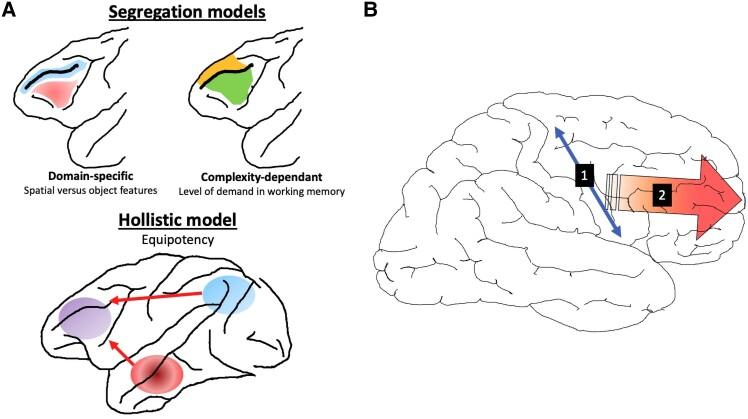
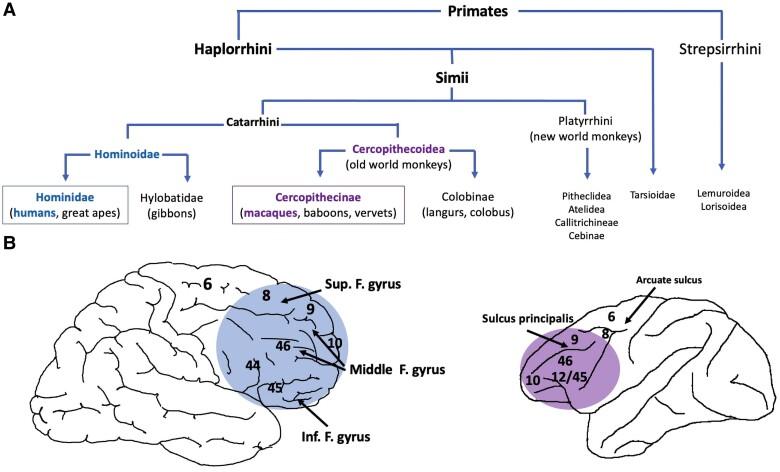
The prefrontal cortex is so important to human beings that, if deprived of it, our behaviour is reduced to action-reactions and automatisms, with no ability to make deliberate decisions. Why does the prefrontal cortex hold such importance in humans? In answer, this review draws on the proximity between humans and other primates, which enables us, through comparative anatomical-functional analysis, to understand the cognitive functions we have in common and specify those that distinguish humans from their closest cousins. First, a focus on the lateral region of the prefrontal cortex illustrates the existence of a continuum between rhesus monkeys (the most studied primates in neuroscience) and humans for most of the major cognitive functions in which this region of the brain plays a central role. This continuum involves the presence of elementary mental operations in the rhesus monkey (e.g. working memory or response inhibition) that are constitutive of 'macro-functions' such as planning, problem-solving and even language production. Second, the human prefrontal cortex has developed dramatically compared to that of other primates. This increase seems to concern the most anterior part (the frontopolar cortex). In humans, the development of the most anterior prefrontal cortex is associated with three major and interrelated cognitive changes: (i) a greater working memory capacity, allowing for greater integration of past experiences and prospective futures; (ii) a greater capacity to link discontinuous or distant data, whether temporal or semantic; and (iii) a greater capacity for abstraction, allowing humans to classify knowledge in different ways, to engage in analogical reasoning or to acquire abstract values that give rise to our beliefs and morals. Together, these new skills enable us, among other things, to develop highly sophisticated social interactions based on language, enabling us to conceive beliefs and moral judgements and to conceptualize, create and extend our vision of our environment beyond what we can physically grasp. Finally, a model of the transition of prefrontal functions between humans and non-human primates concludes this review.
前额皮质对人类至关重要,如果没有它,我们的行为就会简化为反应和自动反应,而无法做出深思熟虑的决策。为什么前额皮质对人类如此重要?在回答这个问题时,本篇综述借鉴了人类与其他灵长类动物的相似性,通过比较解剖-功能分析,我们能够理解我们共有的认知功能,并确定那些将人类与近亲区分开来的功能。首先,对前额皮质外侧区域的关注表明,在大脑的这一区域发挥核心作用的大多数主要认知功能中,猕猴(神经科学中研究最多的灵长类动物)和人类之间存在着一个连续体。这个连续体涉及到猕猴(例如工作记忆或反应抑制)中基本心理运算的存在,这些基本心理运算构成了“宏观功能”,如计划、解决问题甚至语言产生。其次,与其他灵长类动物相比,人类的前额皮质有了显著的发展。这种增加似乎与最前部(额极皮质)有关。在人类中,最前部前额皮质的发育与三个主要的、相互关联的认知变化有关:(i)更大的工作记忆能力,使过去的经验和未来的前景更能整合;(ii)更大的能力来连接不连续或遥远的数据,无论是时间上的还是语义上的;(iii)更大的抽象能力,使人类能够以不同的方式对知识进行分类,进行类比推理,或获得抽象的价值观,这些价值观产生了我们的信仰和道德。这些新技能使我们能够进行高度复杂的语言为基础的社会互动,使我们能够构想信仰和道德判断,并使我们能够将我们对环境的概念化、创造和扩展超越我们可以实际掌握的范围。最后,一个关于人类和非人类灵长类动物前额皮质功能过渡的模型总结了本综述。



 Zotero 插件