
癌症患者的预康复计划:随机对照试验的系统评价。
Prehabilitation programs for individuals with cancer: a systematic review of randomized-controlled trials.
机构信息
Division for Health Services, Norwegian Institute of Public Health, Sandakerveien 24C, Building D11, Oslo, Norway.
Facultad de Cultura Física, Deporte y Recreación. GICAEDS, Universidad Santo Tomás, Bogotá, Colombia.
出版信息
Syst Rev. 2023 Nov 17;12(1):219. doi: 10.1186/s13643-023-02373-4.
BACKGROUND
Prehabilitation programs focusing on exercise training as the main component are known as a promising alternative for improving patients' outcomes before cancer surgery. This systematic review determined the benefits and harms of prehabilitation programs compared with usual care for individuals with cancer.
METHODS
We searched CENTRAL, MEDLINE, and EMBASE from inception to June 2022, and hand searched clinical trial registries. We included randomized-controlled trials (RCTs) in adults, survivors of any type of cancer, that compared prehabilitation programs that had exercise training as the major component with usual care or other active interventions. Outcome measures were health-related quality of life (HRQL), muscular strength, postoperative complications, average length of stay (ALOS), handgrip strength, and physical activity levels. Two reviewers independently screened the studies, extracted data, and assessed the risk of bias and the certainty of the evidence.
RESULTS
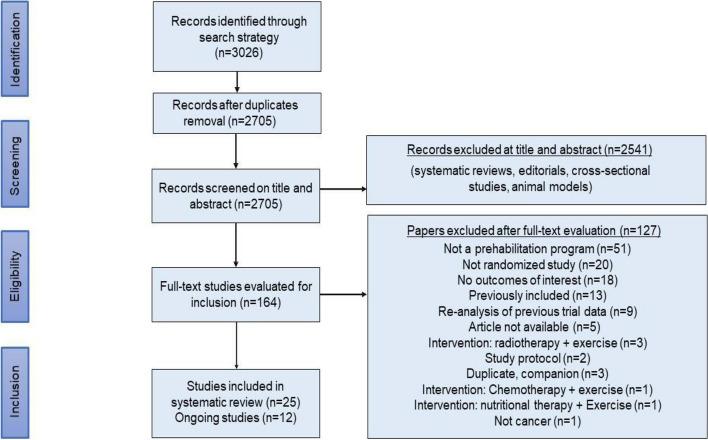
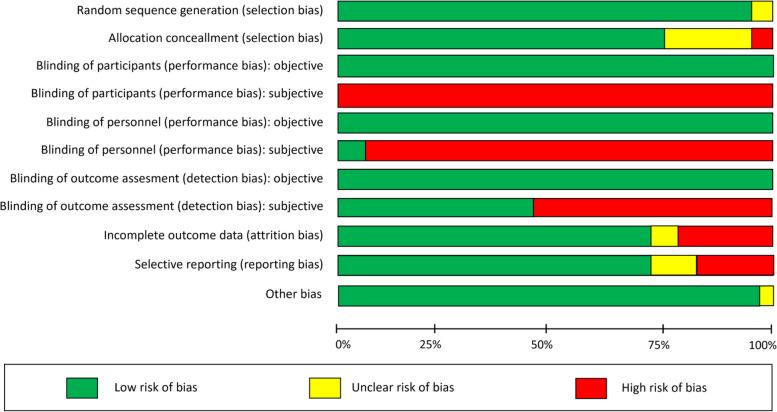
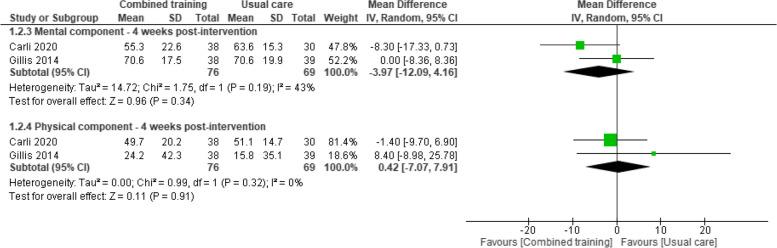
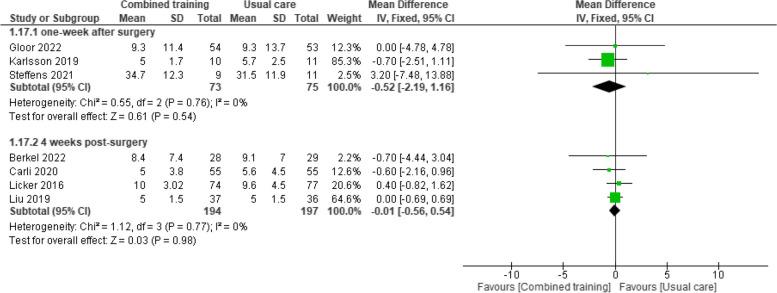
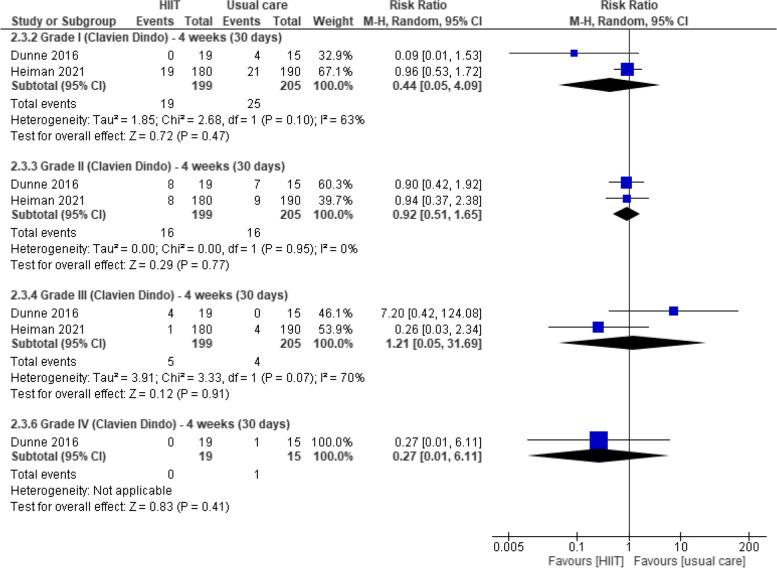
Twenty-five RCTs (2682 participants) published between 2010 and 2022 met our inclusion criteria. Colorectal and lung cancers were the most common diagnoses. The studies had methodological concerns regarding outcome measurement, selective reporting, and attrition. Five prehabilitation programs were compared to usual care (rehabilitation): combined training, aerobic training, respiratory muscle training plus aerobic training, respiratory muscle training plus resistance training, and pelvic floor training. The studies provided no clear evidence of an effect between groups. We assessed the overall certainty of the evidence as very low, downgraded due to serious study limitations and imprecision.
CONCLUSION
Prehabilitation programs focusing on exercise training may have an effect on adults with cancer, but the evidence is very uncertain. We have very little confidence in the results and the true effect is likely to be substantially different from these. Further research is needed before we can draw a more certain conclusion.
SYSTEMATIC REVIEW REGISTRATION
CRD42019125658.
背景
以运动训练为主要组成部分的预康复方案被认为是改善癌症手术前患者结局的一种很有前途的替代方法。本系统评价旨在确定与常规护理相比,预康复方案对癌症患者的益处和危害。
方法
我们从建库到 2022 年 6 月检索了 CENTRAL、MEDLINE 和 EMBASE,并对手册检索了临床试验注册库。我们纳入了成年人、各种癌症幸存者的随机对照试验(RCT),比较了以运动训练为主要组成部分的预康复方案与常规护理或其他积极干预措施的效果。结局指标包括健康相关生活质量(HRQL)、肌肉力量、术后并发症、平均住院时间(ALOS)、握力和体力活动水平。两名审查员独立筛选研究、提取数据,并评估偏倚风险和证据确定性。
结果
2010 年至 2022 年期间发表的 25 项 RCT(2682 名参与者)符合我们的纳入标准。最常见的诊断是结直肠癌和肺癌。这些研究在结局测量、选择性报告和失访方面存在方法学问题。有 5 项预康复方案与常规护理(康复)进行了比较:联合训练、有氧运动、呼吸肌训练加有氧运动、呼吸肌训练加抗阻训练和盆底训练。这些研究没有提供组间效果的明确证据。我们将证据的总体确定性评估为非常低,因研究局限性和不准确性而降级。
结论
以运动训练为重点的预康复方案可能对癌症成人患者有效,但证据非常不确定。我们对结果的信心非常有限,实际效果很可能与这些结果有很大不同。在得出更确定的结论之前,还需要进一步的研究。
系统评价注册
CRD42019125658。





 Zotero 插件