
线粒体DNA与阿尔茨海默病中的炎症
Mitochondrial DNA and Inflammation in Alzheimer's Disease.
作者信息
Galizzi Giacoma, Di Carlo Marta
机构信息
Institute for Research and Biomedical Innovation (IRIB), National Research Council (CNR), Via Ugo La Malfa, 153-90146 Palermo, Italy.
出版信息
Curr Issues Mol Biol. 2023 Oct 25;45(11):8586-8606. doi: 10.3390/cimb45110540.
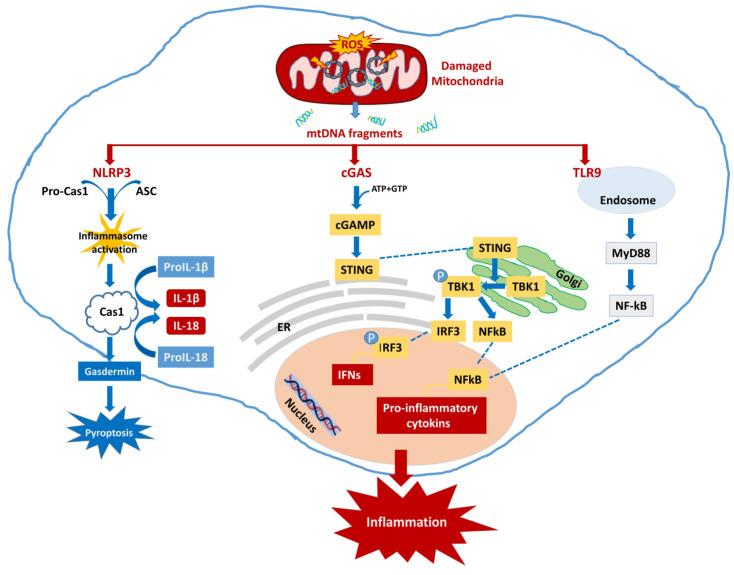
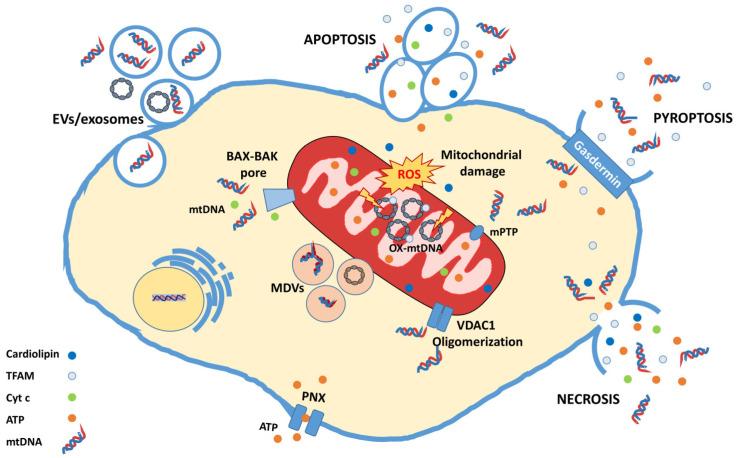
Mitochondrial dysfunction and neuroinflammation are implicated in the pathogenesis of most neurodegenerative diseases, such as Alzheimer's disease (AD). In fact, although a growing number of studies show crosstalk between these two processes, there remain numerous gaps in our knowledge of the mechanisms involved, which requires further clarification. On the one hand, mitochondrial dysfunction may lead to the release of mitochondrial damage-associated molecular patterns (mtDAMPs) which are recognized by microglial immune receptors and contribute to neuroinflammation progression. On the other hand, inflammatory molecules released by glial cells can influence and regulate mitochondrial function. A deeper understanding of these mechanisms may help identify biomarkers and molecular targets useful for the treatment of neurodegenerative diseases. This review of works published in recent years is focused on the description of the mitochondrial contribution to neuroinflammation and neurodegeneration, with particular attention to mitochondrial DNA (mtDNA) and AD.
线粒体功能障碍和神经炎症与大多数神经退行性疾病(如阿尔茨海默病,AD)的发病机制有关。事实上,尽管越来越多的研究表明这两个过程之间存在相互作用,但我们对其中涉及的机制仍知之甚少,这需要进一步阐明。一方面,线粒体功能障碍可能导致线粒体损伤相关分子模式(mtDAMPs)的释放,这些分子模式可被小胶质细胞免疫受体识别,并促进神经炎症的进展。另一方面,神经胶质细胞释放的炎症分子可影响和调节线粒体功能。对这些机制的深入理解可能有助于识别用于治疗神经退行性疾病的生物标志物和分子靶点。本综述聚焦于近年来发表的研究成果,着重描述线粒体在神经炎症和神经退行性变中的作用,尤其关注线粒体DNA(mtDNA)与AD的关系。
 Zotero 插件