
作为预测绝经前雌激素受体阳性乳腺癌患者预后的指标,乳腺密度降低:更新的 ASTRRA 研究的探索性分析。
Breast density reduction as a predictor for prognosis in premenopausal women with estrogen receptor-positive breast cancer: an exploratory analysis of the updated ASTRRA study.
机构信息
Department of Surgery, Gangnam Severance Hospital.
Institute for Breast Cancer Precision Medicine, Yonsei University College of Medicine.
出版信息
Int J Surg. 2024 Feb 1;110(2):934-942. doi: 10.1097/JS9.0000000000000907.
BACKGROUND
While the relationship between mammographic breast density reduction (MDR) and endocrine therapy efficacy has been reported in estrogen receptor (ER)-positive breast cancer, it is still unclear in premenopausal women, especially in the case of adding ovarian function suppression (OFS) to antihormone therapy. The authors investigated the impact of MDR on prognosis stratified by treatment based on the updated results of the ASTRRA trial.
MATERIALS AND METHODS
The ASTRRA trial, a randomized phase III study, showed that adding OFS to tamoxifen (TAM) improved survival in premenopausal women with estrogen receptor-positive breast cancer after chemotherapy. The authors updated survival outcomes and assessed mammography before treatment and the annual follow-up mammography for up to 5 years after treatment initiation. Mammographic density (MD) was classified into four categories based on the Breast Imaging-Reporting and Data System. MDR-positivity was defined as a downgrade in MD grade on follow-up mammography up to 2 years after randomization, with pretreatment MD grade as a reference.
RESULTS
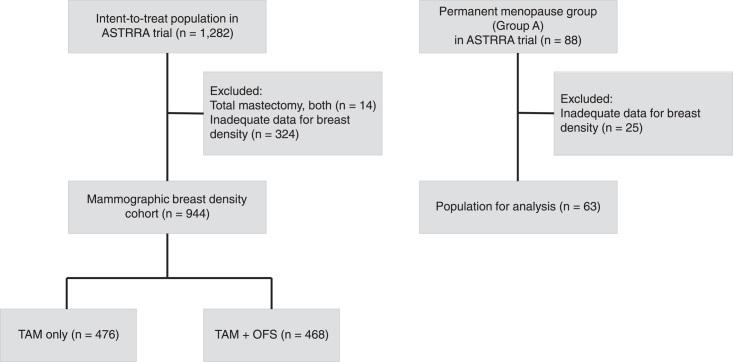
The authors evaluated MDR in 944 of the 1282 patients from the trial, and 813 (86.2%) had grade III or IV MD. There was no difference in the MDR-positivity rate between the two treatment groups [TAM-only group (106/476 (22.3%)) vs. TAM+OFS group (89/468 (19.0%)); P =0.217). MDR-positivity was significantly associated with better disease-free survival (DFS) in the TAM+OFS group (estimated 8-year DFS: 93.1% in MDR-positive vs. 82.0% in MDR-negative patients; HR: 0.37; 95% CI: 0.16-0.85; P =0.019), but not in the TAM-only group ( Pinteraction =0.039). MDR-positive patients who received TAM+OFS had a favorable DFS compared to MDR-negative patients who received only TAM (HR: 0.30; 95% CI: 0.13-0.70; P =0.005).
CONCLUSION
Although the proportion of MDR-positive patients was comparable between both treatment groups, MDR-positivity was independently associated with favorable outcomes only in the TAM+OFS group.
背景
虽然已有研究报道了乳腺密度降低(MDR)与雌激素受体(ER)阳性乳腺癌内分泌治疗疗效之间的关系,但在绝经前妇女中,这种关系仍不明确,尤其是在抗激素治疗中添加卵巢功能抑制(OFS)的情况下。作者基于 ASTRRA 试验的更新结果,研究了基于治疗的 MDR 对预后的影响。
材料和方法
ASTRRA 试验是一项随机 III 期研究,结果表明,在化疗后,对于雌激素受体阳性乳腺癌的绝经前妇女,添加 OFS 至他莫昔芬(TAM)可改善生存。作者更新了生存结果,并评估了治疗前和治疗开始后 5 年内每年的随访乳房 X 线摄影。根据乳腺影像报告和数据系统(BI-RADS)将乳腺密度(MD)分为四类。MDR 阳性定义为随机分组后 2 年内随访乳房 X 线摄影的 MD 分级下降,以治疗前 MD 分级为参考。
结果
作者评估了试验中 1282 例患者中的 944 例的 MDR,其中 813 例(86.2%)的 MD 分级为 III 级或 IV 级。两组之间的 MDR 阳性率无差异[仅 TAM 组(476 例中的 106 例[22.3%])与 TAM+OFS 组(468 例中的 89 例[19.0%]);P=0.217]。在 TAM+OFS 组中,MDR 阳性与更好的无病生存(DFS)显著相关(估计 8 年 DFS:MDR 阳性患者为 93.1%,MDR 阴性患者为 82.0%;HR:0.37;95%CI:0.16-0.85;P=0.019),但在 TAM 单药组中无相关性(P 交互=0.039)。与仅接受 TAM 的 MDR 阴性患者相比,接受 TAM+OFS 的 MDR 阳性患者的 DFS 更好(HR:0.30;95%CI:0.13-0.70;P=0.005)。
结论
尽管两组之间 MDR 阳性患者的比例相当,但 MDR 阳性仅与 TAM+OFS 组的良好结局独立相关。

 Zotero 插件