
用于预测CAR T细胞相关毒性的EASIX评分的基于人群的外部验证
Population-Based External Validation of the EASIX Scores to Predict CAR T-Cell-Related Toxicities.
作者信息
de Boer Janneke W, Keijzer Kylie, Pennings Elise R A, van Doesum Jaap A, Spanjaart Anne M, Jak Margot, Mutsaers Pim G N J, van Dorp Suzanne, Vermaat Joost S P, van der Poel Marjolein W M, van Dijk Lisanne V, Kersten Marie José, Niezink Anne G H, van Meerten Tom
机构信息
Department of Hematology, University of Groningen, University Medical Center Groningen, 9713 GZ Groningen, The Netherlands.
Department of Radiation Oncology, University of Groningen, University Medical Center Groningen, 9713 GZ Groningen, The Netherlands.
出版信息
Cancers (Basel). 2023 Nov 16;15(22):5443. doi: 10.3390/cancers15225443.
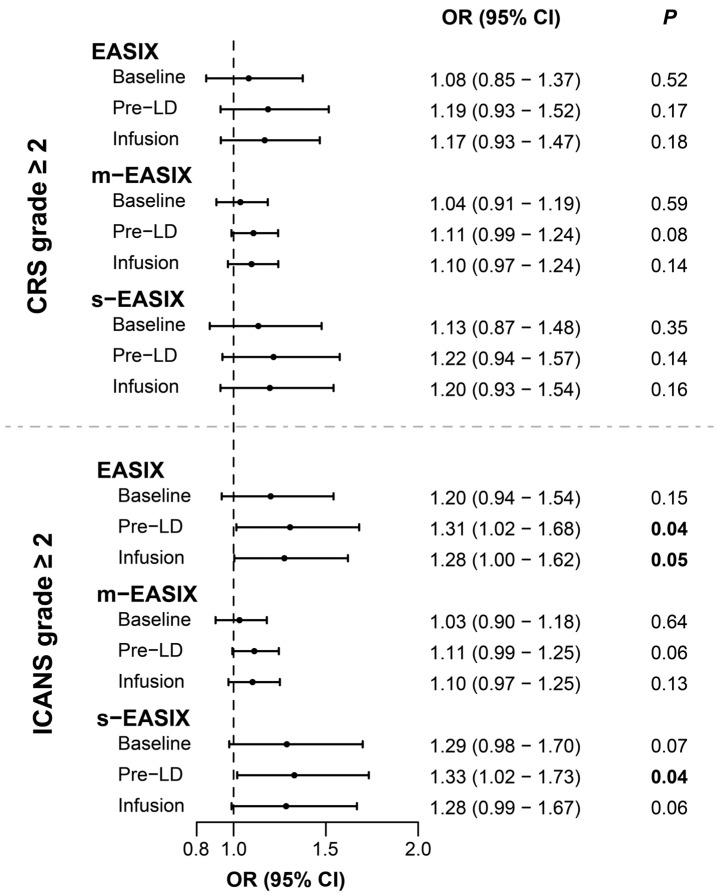
Cytokine release syndrome (CRS) and immune effector cell-associated neurotoxicity syndrome (ICANS) can hamper the clinical benefit of CAR T-cell therapy in patients with relapsed/refractory large B-cell lymphoma (r/r LBCL). To assess the risk of CRS and ICANS, the endothelial activation and stress index (EASIX), the modified EASIX (m-EASIX), simplified EASIX (s-EASIX), and EASIX with CRP/ferritin (EASIX-F(C)) were proposed. This study validates these scores in a consecutive population-based cohort. Patients with r/r LBCL treated with axicabtagene ciloleucel were included ( = 154). EASIX scores were calculated at baseline, before lymphodepletion (pre-LD) and at CAR T-cell infusion. The EASIX and the s-EASIX at pre-LD were significantly associated with ICANS grade ≥ 2 (both = 0.04), and the EASIX approached statistical significance at infusion ( = 0.05). However, the predictive performance was moderate, with area under the curves of 0.61-0.62. Validation of the EASIX-FC revealed that patients in the intermediate risk group had an increased risk of ICANS grade ≥ 2 compared to low-risk patients. No significant associations between EASIX scores and CRS/ICANS grade ≥ 3 were found. The (m-/s-) EASIX can be used to assess the risk of ICANS grade ≥ 2 in patients treated with CAR T-cell therapy. However, due to the moderate performance of the scores, further optimization needs to be performed before broad implementation as a clinical tool, directing early intervention and guiding outpatient CAR T-cell treatment.
细胞因子释放综合征(CRS)和免疫效应细胞相关神经毒性综合征(ICANS)会妨碍嵌合抗原受体(CAR)T细胞疗法对复发/难治性大B细胞淋巴瘤(r/r LBCL)患者的临床疗效。为评估CRS和ICANS的风险,人们提出了内皮激活与应激指数(EASIX)、改良EASIX(m-EASIX)、简化EASIX(s-EASIX)以及结合C反应蛋白/铁蛋白的EASIX(EASIX-F(C))。本研究在一个基于人群的连续队列中验证了这些评分系统。纳入接受阿基仑赛治疗的r/r LBCL患者(n = 154)。在基线、淋巴细胞清除前(pre-LD)以及CAR T细胞输注时计算EASIX评分。pre-LD时的EASIX和s-EASIX与≥2级ICANS显著相关(均为P = 0.04),输注时EASIX接近统计学显著性(P = 0.05)。然而,预测性能中等,曲线下面积为0.61 - 0.62。EASIX-FC的验证显示,与低风险患者相比,中风险组患者发生≥2级ICANS的风险增加。未发现EASIX评分与≥3级CRS/ICANS之间存在显著关联。(m-/s-)EASIX可用于评估接受CAR T细胞疗法患者发生≥2级ICANS的风险。然而,由于这些评分系统的性能中等,在作为临床工具广泛应用之前,需要进一步优化,以指导早期干预并指导门诊CAR T细胞治疗。


 Zotero 插件