
EACH 试验方案:一项评价avelumab(一种抗 PD-L1 药物)联合 cetuximab(西妥昔单抗)在英国作为复发/转移性头颈部鳞状细胞癌(HNSCC)患者任何线治疗的安全性和抗肿瘤活性的多中心 II 期研究。
Protocol for the EACH trial: a multicentre phase II study evaluating the safety and antitumour activity of the combination of avelumab, an anti-PD-L1 agent, and cetuximab, as any line treatment for patients with recurrent/metastatic head and neck squamous cell cancer (HNSCC) in the UK.
机构信息
Medical Oncology, University College London, London, UK.
Department of Oncology, The Christie NHS Foundation Trust, Manchester, UK.
出版信息
BMJ Open. 2023 Nov 27;13(11):e070391. doi: 10.1136/bmjopen-2022-070391.
INTRODUCTION
Head and neck cancer is the eighth most common cancer in the UK. Current standard of care treatment for patients with recurrent/metastatic squamous cell head and neck carcinoma (HNSCC) is platinum-based chemotherapy combined with the anti-epidermal growth factor receptor (anti-EGFR) monoclonal antibody, cetuximab. However, most patients will have poor median overall survival (OS) of 6-9 months despite treatment. HNSCC tumours exhibit an immune landscape poised to respond to immunotherapeutic approaches, with most tumours expressing the immunosuppressive receptor programmed death-ligand 1 (PD-L1). We undertook the current study to determine the safety and efficacy of avelumab, a monoclonal antibody targeting the interaction between PD-L1 and its receptor on cytotoxic T-cells, in combination with cetuximab.
METHODS AND ANALYSIS
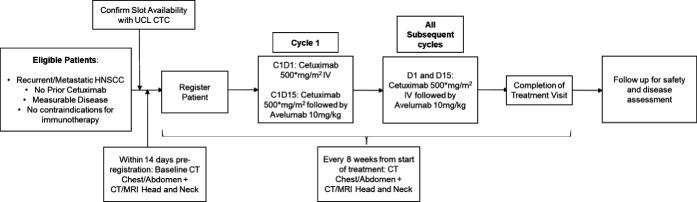
This is a multi-centre, single-arm dose de-escalation phase II safety and efficacy study of avelumab combined with cetuximab; the study was to progress to a randomised phase II trial, however, the study will now complete after the safety run-in component. Up to 16 participants with histologically/cytologically recurrent/metastatic squamous cell carcinoma (including HNSCC) who have not received cetuximab previously will be recruited. All patients will receive 10 mg/kg avelumab and cetuximab (500, 400 or 300 mg/m depending on the cohort open at time of registration) on days 1 and 15 of 4-week cycles for up to 1 year, (avelumab not given cycle 1 day 1). A modified continual reassessment method will be used to determine dose de-escalation. The primary objective is to establish the safety of the combination and to determine the optimum dose of cetuximab. Secondary objectives include assessing evidence of antitumour activity by evaluating response rates and disease control rates at 6 and 12 months as well as progression-free and OS.
ETHICS AND DISSEMINATION
Approval granted by City and East REC (18/LO/0021). Findings will be published in peer-reviewed journals and disseminated at conferences.
TRIAL REGISTRATION NUMBER
NCT03494322.
简介
头颈部癌是英国第八大常见癌症。目前,复发性/转移性鳞状细胞头颈部癌(HNSCC)患者的标准治疗方法是铂类化疗联合抗表皮生长因子受体(抗-EGFR)单克隆抗体西妥昔单抗。然而,尽管进行了治疗,大多数患者的中位总生存期(OS)仍较差,为 6-9 个月。HNSCC 肿瘤表现出对免疫治疗方法有反应的免疫景观,大多数肿瘤表达免疫抑制受体程序性死亡配体 1(PD-L1)。我们进行了这项研究,以确定avelumab(一种针对 PD-L1 与其在细胞毒性 T 细胞上的受体之间相互作用的单克隆抗体)联合西妥昔单抗的安全性和有效性。
方法和分析
这是一项多中心、单臂、剂量递减的 II 期 avelumab 联合西妥昔单抗安全性和疗效研究;该研究计划进展为随机 II 期试验,但现在在安全入组部分完成后将结束。将招募多达 16 名接受过组织学/细胞学复发性/转移性鳞状细胞癌(包括 HNSCC)且以前未接受过西妥昔单抗治疗的患者。所有患者将在 4 周周期的第 1 天和第 15 天接受 10mg/kg 的avelumab 和西妥昔单抗(根据登记时开放的队列,分别为 500、400 或 300mg/m),持续 1 年(avelumab 在第 1 周期第 1 天不给予)。将使用改良连续评估方法确定剂量递减。主要目标是确定该组合的安全性并确定西妥昔单抗的最佳剂量。次要目标包括通过评估 6 个月和 12 个月时的反应率和疾病控制率以及无进展生存期和总生存期来评估抗肿瘤活性的证据。
伦理和传播
东伦敦和城市地区伦理委员会批准(18/LO/0021)。研究结果将发表在同行评议的期刊上,并在会议上传播。
试验注册编号
NCT03494322。
 Zotero 插件