
奥希替尼治疗 T790M 阳性 EGFR 突变型 NSCLC 患者中循环肿瘤 DNA 的预测意义。
Predictive significance of circulating tumor DNA against patients with T790M-positive EGFR-mutant NSCLC receiving osimertinib.
机构信息
Department of Respiratory Medicine, International Medical Center, Comprehensive Cancer Center, Saitama Medical University, 1397-1 Yamane, Hidaka-City, Saitama, 350-1298, Japan.
Innovative Medical Research Center, Gunma University Hospital, 3-39-15, Showa-machi, Maebashi, Gunma, 371-8511, Japan.
出版信息
Sci Rep. 2023 Nov 27;13(1):20848. doi: 10.1038/s41598-023-48210-5.
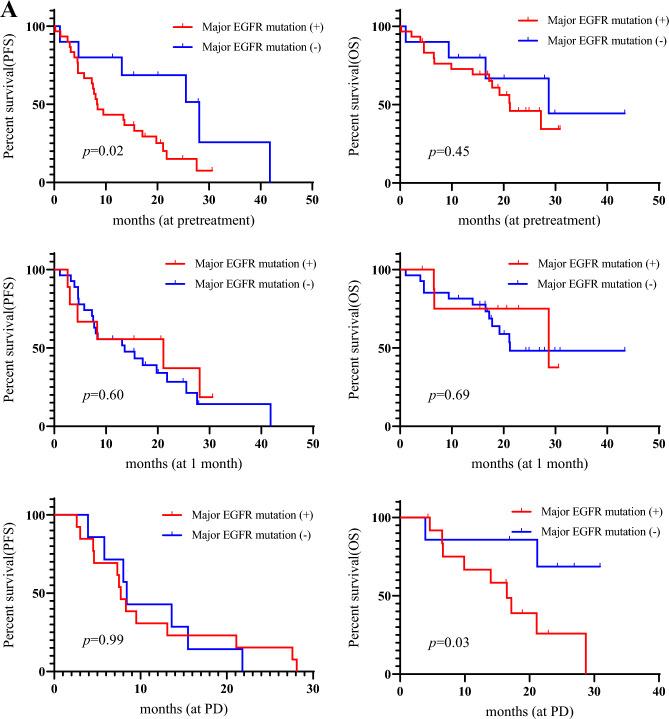
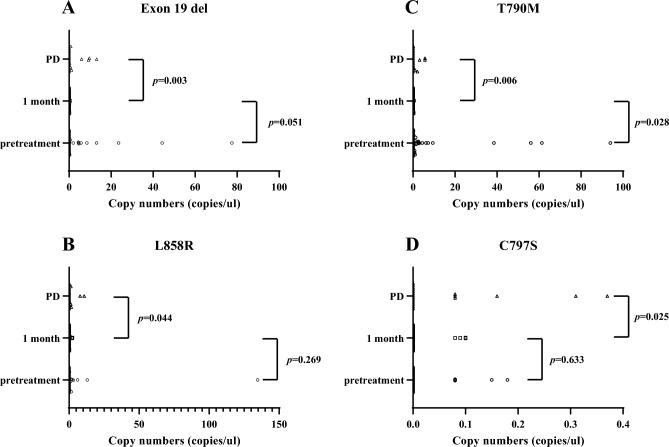
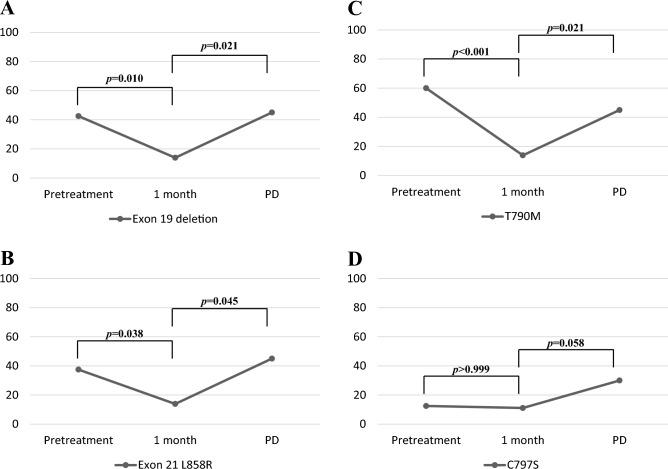
Circulating tumor DNA (ctDNA) provides molecular information on tumor heterogeneity. The prognostic usefulness of ctDNA after first-line epidermal growth factor receptor (EGFR) tyrosine kinase inhibitors (TKIs) are limited. Therefore, the present study evaluated ctDNA during osimertinib administration as a second-line or more setting to identify the relationship between EGFR mutation levels and outcomes in patients with advanced non-small cell lung cancer (NSCLC). Forty patients with EGFR T790M-positive NSCLC receiving osimertinib after prior EGFR-TKI treatment were registered. Plasma samples were collected at osimertinib pretreatment, after 1 month of treatment, and at the time of progressive disease (PD). ctDNA analysis was performed by digital polymerase chain reaction. The detection rate of copy numbers of exon 19 deletion, L858R, and T790M in plasma samples was significantly lower 1 month after osimertinib than at pretreatment, and significantly higher at PD than at 1 month, whereas that of C797S was significantly higher at PD than at 1 month. No statistically significant difference was observed in the copy numbers of exon 19 deletion, L858R, T790M, and C797S between complete response or partial response and stable disease or PD. The detection of T790M at PD after osimertinib initiation was a significant independent prognostic factor for predicting shorter prognosis, and the presence of major EGFR mutations at pretreatment and PD was closely linked to worse survival after osimertinib initiation. Molecular testing based on ctDNA is helpful for predicting outcomes of osimertinib treatment in T790M-positive NSCLC after previous EGFR-TKI treatment.
循环肿瘤 DNA(ctDNA)提供了肿瘤异质性的分子信息。一线表皮生长因子受体(EGFR)酪氨酸激酶抑制剂(TKI)治疗后 ctDNA 的预后作用有限。因此,本研究评估了奥希替尼治疗期间的 ctDNA 作为二线或更后的治疗方案,以确定晚期非小细胞肺癌(NSCLC)患者中 EGFR 突变水平与结局之间的关系。本研究共登记了 40 例接受奥希替尼治疗的 EGFR T790M 阳性 NSCLC 患者,这些患者在接受 EGFR-TKI 治疗后。在奥希替尼预处理、治疗 1 个月后和疾病进展(PD)时采集血浆样本。通过数字聚合酶链反应进行 ctDNA 分析。血浆样本中外显子 19 缺失、L858R 和 T790M 的拷贝数检测率在奥希替尼治疗 1 个月后显著低于预处理时,在 PD 时显著高于 1 个月时,而 C797S 的检测率在 PD 时显著高于 1 个月时。完全缓解或部分缓解与稳定疾病或 PD 之间,外显子 19 缺失、L858R、T790M 和 C797S 的拷贝数无统计学差异。奥希替尼治疗后 PD 时 T790M 的检测是预测预后更差的独立预后因素,预处理和 PD 时主要 EGFR 突变的存在与奥希替尼治疗后生存更差密切相关。基于 ctDNA 的分子检测有助于预测先前接受 EGFR-TKI 治疗的 T790M 阳性 NSCLC 患者接受奥希替尼治疗的结局。
 Zotero 插件