
放射学与区块链及智能合约的交叉融合:一种视角
The Intersection of Radiology With Blockchain and Smart Contracts: A Perspective.
作者信息
Ghorashi Nima S, Rahimi Murwarit, Sirous Reza, Javan Ramin
机构信息
Department of Radiology, The George Washington University School of Medicine and Health Sciences, Washington, D.C., USA.
Department of Radiology and Biomedical Imaging, University of California San Francisco, San Francisco, USA.
出版信息
Cureus. 2023 Oct 13;15(10):e46941. doi: 10.7759/cureus.46941. eCollection 2023 Oct.
INTRODUCTION
Although blockchain technology and smart contracts are garnering attention in various sectors, their applications and familiarity within the realm of radiology remain largely unexplored. Blockchain, a decentralized digital ledger technology, offers secure, transparent, and resilient data management by distributing the verification process across a network of independent entities. This decentralized technology presents a possible solution for a range of healthcare challenges, from secure data transfer to automated verification processes. To address such challenges in the context of medical imaging, blockchain could provide different approaches, including smart contracts, machine learning algorithms, and the secure dissemination of large files among key stakeholders such as patients, healthcare providers, and institutions. This manuscript aims to explore the current attitudes and perspectives of trainees and radiologists to the utilization of blockchain technology and smart contracts in clinical radiology. Additionally, the study provides an in-depth analysis of the potential applications for incorporating blockchain into radiology.
METHODS
After obtaining The George Washington University Committee on Human Research Institutional Review Board (IRB) approval, we conducted a 10-question survey among radiologists and trainees at several institutions and private practices. Surveys were created via the Google Forms application and were emailed to potential participants. Participants were asked about their current academic level (medical student, resident/fellow, academic radiologist, private practice radiologist, others), their knowledge level about the field of imaging informatics and blockchain and smart contract technologies, their level of interest in learning more about blockchain and smart contracts, and their opinion about possible applications of blockchain and smart contract in the future of medical imaging.
RESULTS
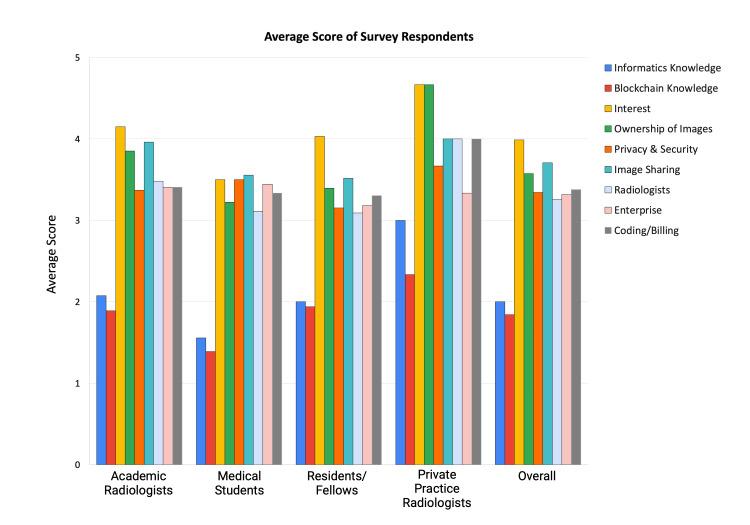
A total of 118 survey requests were distributed; 83 were returned, reflecting a 70.3% overall response rate. Of these, 19 were sent to private practices with a 15.8% response rate (3/19), and 99 to academic centers, yielding an 80.8% response rate (80/99). The survey respondents demonstrated a strong interest and need to further understand these technologies among radiologists and trainees. This study focuses on key components of this technology as it relates to healthcare and the practice of radiology, including data storage, patient care, secure communication, and automation, as well as strengths, weaknesses, opportunities, and threats (SWOT) analysis.
DISCUSSION
To our knowledge, this is the first study to investigate and establish a baseline for the current perspectives on the application of blockchain technology and smart contracts in clinical radiology amongst trainees and radiologists across academic and private settings. Incorporating blockchain and smart contracts technologies into the field of radiology has the potential to achieve greater efficiency, security, and patient empowerment. However, the adoption of this technology comes with challenges, such as infrastructure, interoperability, scalability, and regulatory compliance. Collaboration between radiologists, hospital administration, policymakers, technology developers, and patient advocacy organizations will help guide and advance our understanding of the potential applications of blockchain and smart contracts in radiology and healthcare.
引言
尽管区块链技术和智能合约在各个领域都备受关注,但它们在放射学领域的应用及人们对其的熟悉程度在很大程度上仍未得到探索。区块链是一种去中心化的数字账本技术,通过在独立实体网络中分布验证过程,提供安全、透明且有弹性的数据管理。这种去中心化技术为一系列医疗保健挑战提供了可能的解决方案,从安全的数据传输到自动化验证过程。为了在医学成像背景下应对此类挑战,区块链可以提供不同的方法,包括智能合约、机器学习算法,以及在患者、医疗保健提供者和机构等关键利益相关者之间安全地传播大文件。本手稿旨在探讨实习生和放射科医生对在临床放射学中利用区块链技术和智能合约的当前态度和观点。此外,该研究还对将区块链纳入放射学的潜在应用进行了深入分析。
方法
在获得乔治华盛顿大学人类研究机构审查委员会(IRB)批准后,我们在几家机构和私人诊所对放射科医生和实习生进行了一项包含10个问题的调查。调查问卷通过谷歌表单应用程序创建,并通过电子邮件发送给潜在参与者。参与者被问及他们当前的学术水平(医学生、住院医师/研究员、学术放射科医生、私人执业放射科医生、其他)、他们对成像信息学以及区块链和智能合约技术领域的知识水平、他们对进一步了解区块链和智能合约的兴趣程度,以及他们对区块链和智能合约在医学成像未来可能应用的看法。
结果
共分发了118份调查问卷;83份被收回,总体回复率为70.3%。其中,19份发送给私人诊所,回复率为15.8%(3/19),99份发送给学术中心,回复率为80.8%(80/99)。调查对象表明放射科医生和实习生对进一步了解这些技术有着浓厚的兴趣和需求。本研究关注该技术与医疗保健及放射学实践相关的关键组成部分,包括数据存储、患者护理、安全通信和自动化,以及优势、劣势、机会和威胁(SWOT)分析。
讨论
据我们所知,这是第一项调查并建立关于实习生和放射科医生在学术和私人环境中对区块链技术和智能合约在临床放射学中应用的当前观点基线的研究。将区块链和智能合约技术纳入放射学领域有潜力实现更高的效率、安全性和患者赋权。然而,采用这项技术面临着基础设施、互操作性、可扩展性和法规遵从性等挑战。放射科医生、医院管理部门、政策制定者、技术开发者和患者权益倡导组织之间的合作将有助于指导和推进我们对区块链和智能合约在放射学和医疗保健中潜在应用的理解。

 Zotero 插件