
身体活动、久坐行为和睡眠之间的时间重新分配与腰痛有关吗?一项成分数据分析。
Are reallocations of time between physical activity, sedentary behaviour and sleep associated with low back pain? A compositional data analysis.
作者信息
Kastelic Kaja, Šarabon Nejc, Stanford Ty, Dumuid Dorothea, Pedišić Željko
机构信息
Department of Health Studies, Andrej Marušič Institute, University of Primorska, Koper, Slovenia.
InnoRenew CoE, Izola, Slovenia.
出版信息
BMJ Open Sport Exerc Med. 2023 Nov 24;9(4):e001701. doi: 10.1136/bmjsem-2023-001701. eCollection 2023.
OBJECTIVES
The aim of this cross-sectional study was to explore the associations of reallocating time between moderate- to vigorous-intensity physical activity (MVPA), light-intensity physical activity (LPA), sedentary behaviour (SB) and sleep with occurrence, frequency and intensity of low back pain (LBP) among adults using compositional isotemporal substitution analysis.
METHODS
A total of 2333 participants from the general adult population completed the Daily Activity Behaviours Questionnaire asking about their time-use composition consisting of sleep, SB, LPA and MVPA, and they self-reported their frequency and intensity of LBP in the past year.
RESULTS
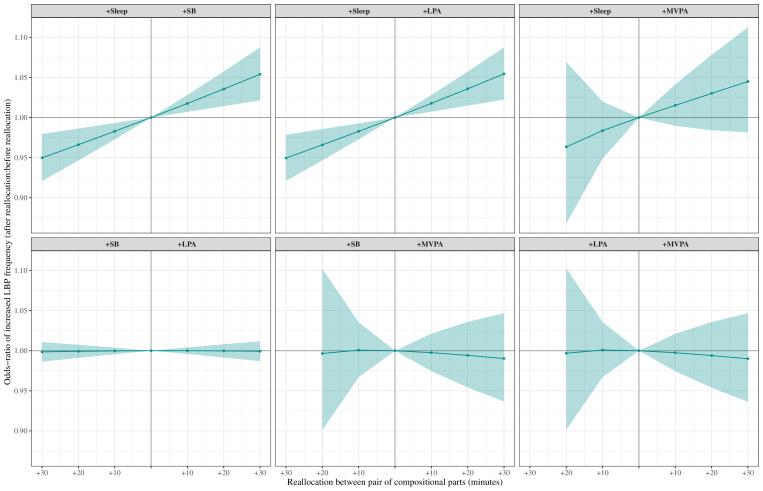
Regression analyses adjusted for age, sex, body mass index, smoking, stress, education and socioeconomic status found that the time-use composition is associated with the frequency (p=0.009) and intensity of LBP (p<0.001). Reallocating time from SB or LPA to sleep was associated with lower frequency and intensity of LBP (p<0.05). Reallocating time from MVPA to sleep, SB or LPA and from SB to LPA was associated with a lower intensity of LBP (p<0.05). For example, reallocating 30 min/day from SB to sleep was associated with 5% lower odds (95% CI: 2% to 8%, p=0.001) of experiencing LBP more frequently, and 2% lower LBP intensity (95% CI: 1% to 3%, p<0.001).
CONCLUSION
LBP sufferers may benefit from getting additional sleep and spending more time in LPA, while engaging less in SB and MVPA. These reallocations of time may be meaningful from clinical and public health perspectives.
目的
这项横断面研究的目的是通过成分等时替代分析,探讨成年人在中等至剧烈强度身体活动(MVPA)、轻度强度身体活动(LPA)、久坐行为(SB)和睡眠之间重新分配时间与腰痛(LBP)的发生、频率和强度之间的关联。
方法
共有2333名来自普通成年人群的参与者完成了日常活动行为问卷,该问卷询问了他们由睡眠、SB、LPA和MVPA组成的时间使用构成情况,并且他们自我报告了过去一年中LBP的频率和强度。
结果
在对年龄、性别、体重指数、吸烟、压力、教育程度和社会经济地位进行调整的回归分析中发现,时间使用构成与LBP的频率(p = 0.009)和强度(p < 0.001)相关。将时间从SB或LPA重新分配到睡眠与LBP的较低频率和强度相关(p < 0.05)。将时间从MVPA重新分配到睡眠、SB或LPA以及从SB重新分配到LPA与较低的LBP强度相关(p < 0.05)。例如,将每天30分钟的时间从SB重新分配到睡眠与LBP更频繁发生的几率降低5%(95%CI:2%至8%,p = 0.001)以及LBP强度降低2%(95%CI:1%至3%,p < 0.001)相关。
结论
LBP患者可能会从增加睡眠和增加LPA时间中受益,同时减少SB和MVPA的时间。从临床和公共卫生角度来看,这些时间的重新分配可能是有意义的。

 Zotero 插件