
从胆道感染分离出的菌株与尿路致病性菌株之间的系统发育和毒力因子比较。
Comparison of phylogenetic and virulence factors between isolated from biliary tract infections and uropathogenic .
作者信息
Ikeda Mahoko, Kobayashi Tatsuya, Okugawa Shu, Fujimoto Fumie, Okada Yuta, Tatsuno Keita, Higurashi Yoshimi, Tsutsumi Takeya, Moriya Kyoji
机构信息
Department of Infectious diseases, The University of Tokyo Hospital, 7-3-1, Hongo, Bunkyo-ku, Tokyo, Japan.
Department of Infection Control and Prevention, The University of Tokyo Hospital, 7-3-1, Hongo, Bunkyo-ku, Tokyo, Japan.
出版信息
Heliyon. 2023 Oct 29;9(11):e21748. doi: 10.1016/j.heliyon.2023.e21748. eCollection 2023 Nov.
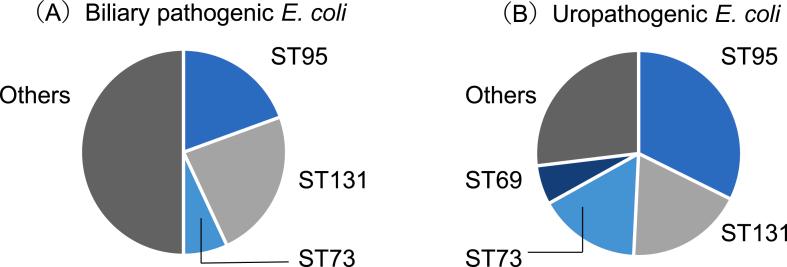
is a gram-negative intestinal commensal that can also cause various infections, including urinary tract infections, biliary tract infections, neonatal meningitis, and septicemia. Although the characteristics of uropathogenic and the mechanisms of urinary tract infection have been well studied, the genetic distinctions among isolates from different types of infections have not yet been determined. This study compared the phylogenetic and virulence factors of isolates from bacteremic biliary tract infections with those from bacteremic urinary tract infections. The phylogenetic B2 group was the most prevalent in both pathogenic groups (68 % in biliary pathogenic isolates and 85 % in uropathogenic isolates), but the frequency pattern of the phylogenetic group was different. Half of the uropathogenic isolates belonged to ST95 and ST131 (51 %). Among the biliary pathogenic isolates, ST131 was the most prevalent, while the remaining half belonged to other STs outside the four major STs. The frequency of some virulence factors, such as , , , , , , , and was lower in the biliary pathogenic isolates than in the uropathogenic isolates. The frequency of phylogenetic groups and STs in MLST differed between isolates from bacteremic biliary tract infections and urinary tract infections. Additionally, some virulence factors, including adhesion and toxin gene groups, showed lower frequencies in the biliary pathogenic group than in the uropathogenic group. Studying the differences in pathovars from different infection sites is important for developing pathovar-specific targeted therapies such as vaccine therapy.
是一种革兰氏阴性肠道共生菌,也可引起各种感染,包括尿路感染、胆道感染、新生儿脑膜炎和败血症。尽管尿路致病性的特征以及尿路感染的机制已得到充分研究,但来自不同类型感染的分离株之间的遗传差异尚未确定。本研究比较了来自菌血症性胆道感染的分离株与来自菌血症性尿路感染的分离株的系统发育和毒力因子。系统发育B2组在两个致病组中最为普遍(胆道致病分离株中占68%,尿路致病分离株中占85%),但系统发育组的频率模式不同。一半的尿路致病分离株属于ST95和ST131(51%)。在胆道致病分离株中,ST131最为普遍,而其余一半属于四大ST之外的其他ST。一些毒力因子,如、、、、、、和在胆道致病分离株中的频率低于尿路致病分离株。来自菌血症性胆道感染和尿路感染的分离株在多位点序列分型中的系统发育组和ST频率不同。此外,一些毒力因子,包括黏附素和毒素基因组,在胆道致病组中的频率低于尿路致病组。研究来自不同感染部位的致病型差异对于开发致病型特异性靶向治疗方法(如疫苗治疗)很重要。
 Zotero 插件