
高强度聚焦超声消融联合系统治疗不可切除结直肠癌肝转移:倾向评分匹配分析。
High-intensity focused ultrasound ablation combined with systemic therapy for unresectable colorectal cancer liver metastasis: A propensity score-matched analysis.
机构信息
Department of Cancer Center, Second Affiliated Hospital, Chongqing Medical University, Chongqing, China.
Department of Medical Oncology, Guizhou Province People's Hospital, Guiyang, China.
出版信息
Cancer Med. 2023 Dec;12(24):21985-21995. doi: 10.1002/cam4.6774. Epub 2023 Nov 30.
OBJECTIVE
Unresectable colorectal cancer liver metastasis (CRLM) remains a challenging obstacle that often prevents curative treatment. In this study, we retrospectively analyzed the efficacy and safety of high-intensity focused ultrasound (HIFU) as a local adjuvant therapy for systemic chemotherapy for patients with unresectable CRLM. HIFU is a noninvasive method previously demonstrated as efficacious for various solid malignancies.
METHODS
Propensity score matching was used for the combination therapy group (HIFU group, n = 59) and the observation group receiving systemic therapy only (No-HIFU group, n = 59). In addition, the survival benefit, adverse effects, and factors affecting prognosis following HIFU were evaluated.
RESULTS
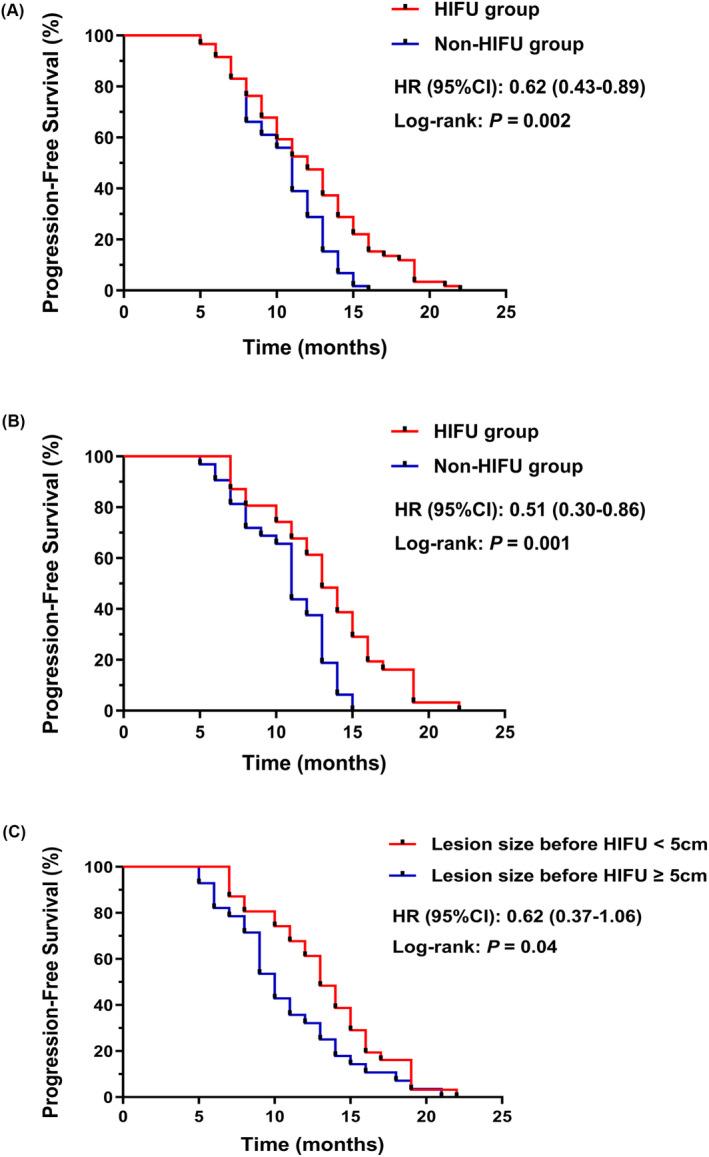
The disease control rate was 77.9% and 62.7%, and the objective remission rate was 18.9% and 6.8% in the HIFU and non-HIFU groups, respectively. The survival analysis showed that median progression-free survival (mPFS) was 12.0 months and 11.0 months for the HIFU and non-HIFU groups, respectively (p = 0.002). The univariate and multivariate analysis showed that pre-treatment colorectal cancer liver metastasis lesion size was significantly associated with mPFS. In addition, patients that received a combination treatment for CRLM lesions <5.0 cm had a longer mPFS when compared to those receiving systemic therapy alone (13.0 months vs. 11.0 months, p = 0.001). In the HIFU group, patients with lesions <5.0 cm had a longer mPFS than patients with lesions ≥5.0 cm (13.0 months vs. 10.0 months, p = 0.04) (Figure 3B,C). Most treatment-related adverse events observed in both groups were grade 1-2. Only four cases (6.8%) of grade 1-2 skin burns were observed in patients in the HIFU group; no other statistically significant adverse events were observed.
CONCLUSIONS
Our study showed that HIFU ablation targeting unresectable CRLM alongside systemic therapy safely and significantly improved local control rates and prolonged mPFS, especially for lesions smaller than 5.0 cm.
目的
不可切除的结直肠癌肝转移(CRLM)仍然是一个具有挑战性的障碍,常常阻止了治愈性治疗。在这项研究中,我们回顾性分析了高强度聚焦超声(HIFU)作为不可切除的 CRLM 全身化疗的局部辅助治疗的疗效和安全性。HIFU 是一种先前被证明对各种实体恶性肿瘤有效的非侵入性方法。
方法
采用倾向评分匹配,将联合治疗组(HIFU 组,n=59)和仅接受全身治疗的观察组(非 HIFU 组,n=59)进行组合。此外,还评估了 HIFU 后的生存获益、不良反应以及影响预后的因素。
结果
HIFU 组和非 HIFU 组的疾病控制率分别为 77.9%和 62.7%,客观缓解率分别为 18.9%和 6.8%。生存分析显示,HIFU 组和非 HIFU 组的中位无进展生存期(mPFS)分别为 12.0 个月和 11.0 个月(p=0.002)。单因素和多因素分析显示,治疗前结直肠癌肝转移病灶大小与 mPFS 显著相关。此外,对于接受 <5.0cm CRLM 病灶联合治疗的患者,mPFS 明显长于单独接受全身治疗的患者(13.0 个月 vs. 11.0 个月,p=0.001)。在 HIFU 组中,病灶 <5.0cm 的患者 mPFS 长于病灶≥5.0cm 的患者(13.0 个月 vs. 10.0 个月,p=0.04)(图 3B,C)。两组观察到的大多数治疗相关不良事件均为 1-2 级。HIFU 组仅观察到 4 例(6.8%)1-2 级皮肤灼伤病例,无其他统计学意义的不良事件。
结论
我们的研究表明,HIFU 消融联合全身治疗靶向不可切除的 CRLM 安全且显著提高了局部控制率,并延长了 mPFS,特别是对于病灶小于 5.0cm 的患者。


 Zotero 插件