
在真实世界中使用埃洛昔巴特治疗慢性便秘:一项使用日本电子病历数据库的回顾性队列研究
Treatment of Chronic Constipation using Elobixibat in a Real-World Setting: A Retrospective Cohort Study using an Electronic Medical Records Database in Japan.
作者信息
Masaki Hisanori, Shimamoto Koji, Inokuchi Shoichiro, Ishizaki Sonoko
机构信息
Medical Department, Medical Science Group, EA Pharma Co, Ltd, Tokyo, Japan.
Research and Analytics Department, Real World Data Co, Ltd, Kyoto, Japan.
出版信息
Curr Ther Res Clin Exp. 2023 Oct 28;99:100724. doi: 10.1016/j.curtheres.2023.100724. eCollection 2023.
BACKGROUND
Chronic constipation is a common condition affecting people of all ages; therefore, the socioeconomic burden of chronic constipation is nonnegligible. Elobixibat (ELO), an ileal bail acid transport inhibitor, was launched in Japan in 2018. However, evidence of its use in diverse populations is limited.
OBJECTIVES
This study aimed to evaluate the prescription of ELO, risk factors associated with ELO discontinuation, and the continuation of stimulants or saline laxatives during ELO treatment in a real-world setting using an extensive electronic medical records database that primarily includes data from acute-care hospitals.
METHODS
Data of patients prescribed for ELO from April 1, 2018, to March 31, 2022, were extracted from the database. The discontinuation of ELO and stimulant or saline laxatives during ELO treatment was evaluated using the Kaplan-Meier method. The Cox proportional hazards model evaluated risk factors associated with laxative discontinuation.
RESULTS
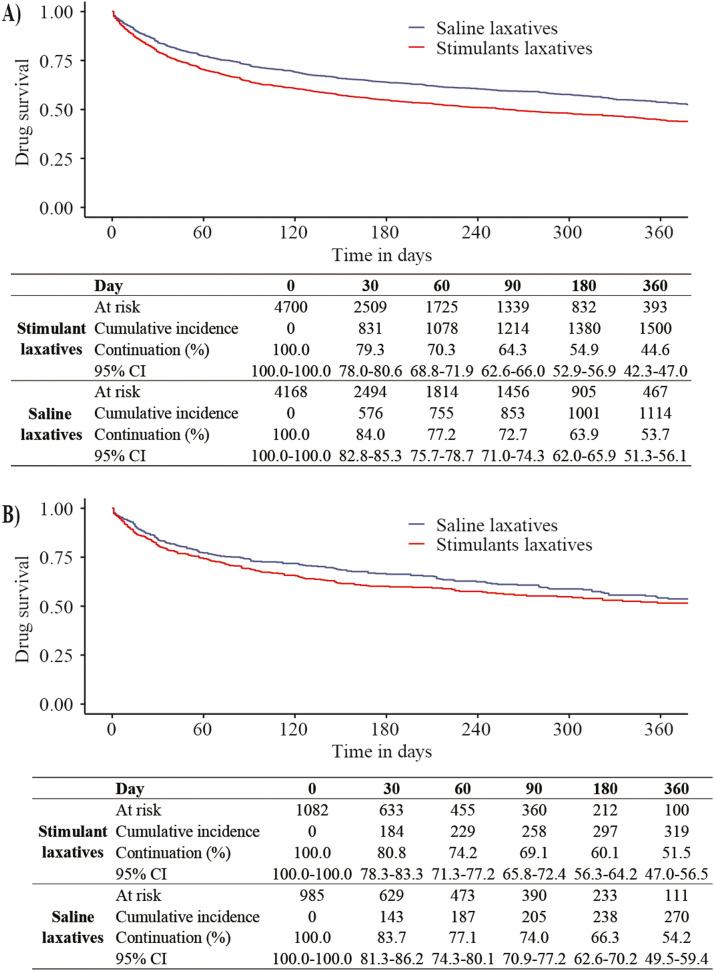
In total, 11,062 patients were evaluated. The rate of ELO discontinuation within 360 days of initiation was 78.7%. Hospitalized at the ELO initiation, stage 5 chronic kidney disease, and diagnosis of constipation by departments of obstetrics and gynecology or by departments of malignant neoplasm were identified as risk factors for discontinuation. Diagnosis of constipation, diabetes mellitus, Parkinson's disease, and previous laxative treatment was associated with a lower risk of ELO discontinuation. The prescription rate of stimulants and saline laxatives markedly decreased after ELO initiation; furthermore, nearly half of patients who were continuously prescribed ELO discontinued these laxatives within 360 days.
CONCLUSIONS
The discontinuation of ELO was associated with various factors and using ELO may be beneficial in the withdrawal of concurrent stimulants and saline laxatives. These findings may help effectively manage chronic constipation.
背景
慢性便秘是一种影响各年龄段人群的常见病症;因此,慢性便秘的社会经济负担不可忽视。依洛比昔巴特(ELO)是一种回肠胆汁酸转运抑制剂,于2018年在日本上市。然而,其在不同人群中使用的证据有限。
目的
本研究旨在利用一个广泛的电子病历数据库(主要包括来自急症医院的数据),在真实世界环境中评估ELO的处方情况、与ELO停药相关的危险因素以及ELO治疗期间刺激性泻药或盐类泻药的持续使用情况。
方法
从数据库中提取2018年4月1日至2022年3月31日期间开具ELO处方的患者数据。使用Kaplan-Meier方法评估ELO治疗期间ELO以及刺激性泻药或盐类泻药的停药情况。Cox比例风险模型评估与泻药停药相关的危险因素。
结果
总共评估了11062例患者。开始使用ELO后360天内的停药率为78.7%。开始使用ELO时住院、5期慢性肾脏病以及由妇产科或恶性肿瘤科室诊断为便秘被确定为停药的危险因素。便秘诊断、糖尿病、帕金森病以及既往泻药治疗与ELO停药风险较低相关。开始使用ELO后,刺激性泻药和盐类泻药的处方率显著下降;此外,近一半持续开具ELO处方的患者在360天内停用了这些泻药。
结论
ELO的停药与多种因素相关,使用ELO可能有助于停用同时使用的刺激性泻药和盐类泻药。这些发现可能有助于有效管理慢性便秘。


 Zotero 插件