
儿童感染 SARS-CoV-2 或接种疫苗后对奥密克戎 BQ.1、BQ.1.1 和 XBB.1 变异株的中和作用。
Neutralization of SARS-CoV-2 Omicron BQ.1, BQ.1.1 and XBB.1 variants following SARS-CoV-2 infection or vaccination in children.
机构信息
Division of Viral Products, Center for Biologics Evaluation and Research (CBER), FDA, Silver Spring, MD, 20993, USA.
Mucosal Immunology and Biology Research Center, Massachusetts General Hospital for Children, Harvard Medical School, Boston, MA, 02114, USA.
出版信息
Nat Commun. 2023 Dec 1;14(1):7952. doi: 10.1038/s41467-023-43152-y.
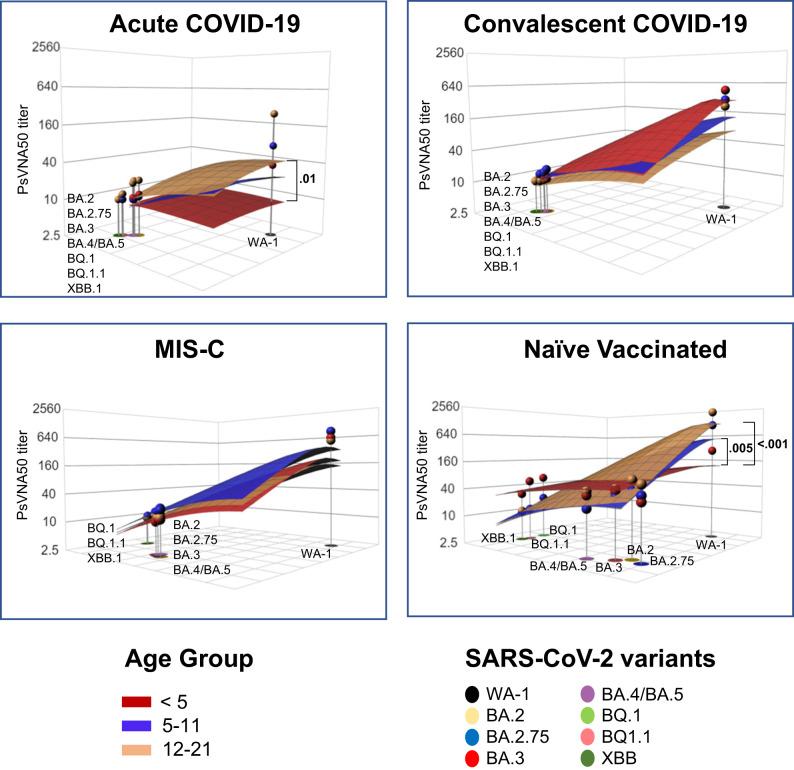
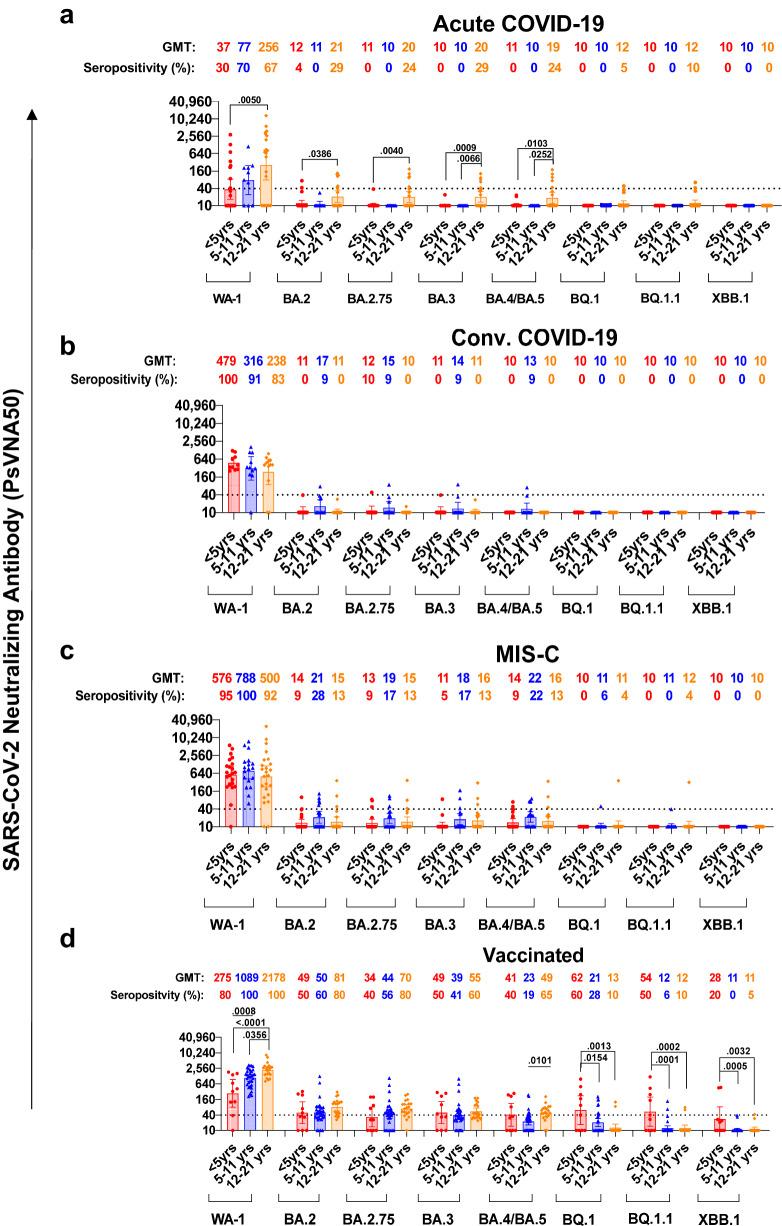
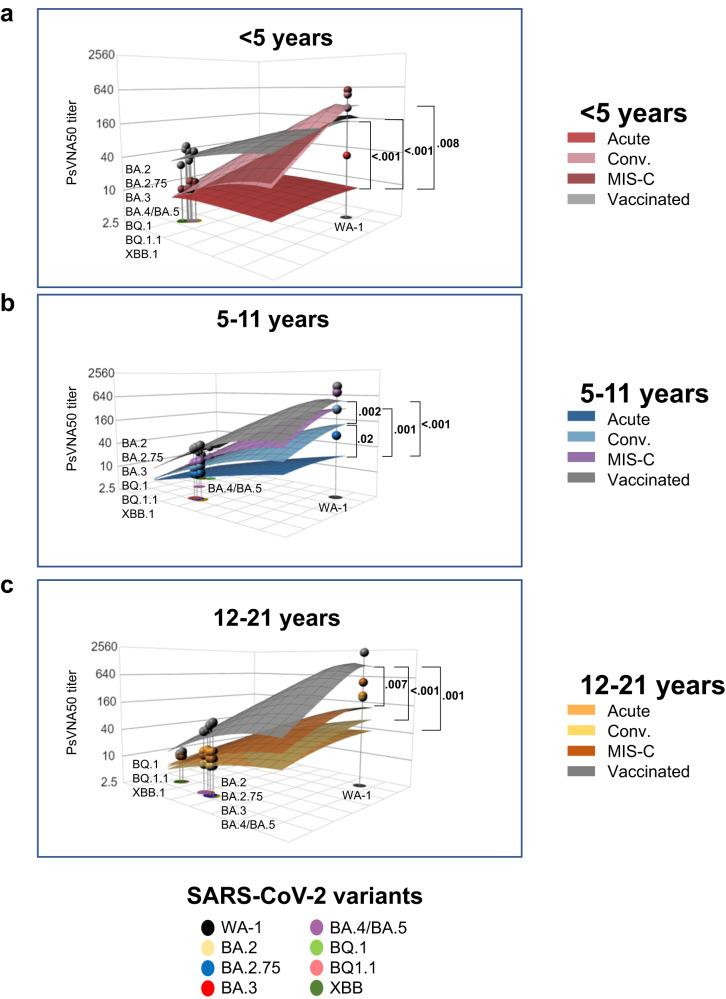
Emergence of highly transmissible Omicron subvariants led to increased SARS-CoV-2 infection and disease in children. However, minimal knowledge exists regarding the neutralization capacity against circulating Omicron BA.4/BA.5, BA.2.75, BQ.1, BQ.1.1 and XBB.1 subvariants following SARS-CoV-2 vaccination in children versus during acute or convalescent COVID-19, or versus multisystem inflammatory syndrome (MIS-C). Here, we evaluate virus-neutralizing capacity against SARS-CoV-2 variants in 151 age-stratified children ( <5, 5-11, 12-21 years old) hospitalized with acute severe COVID-19 or MIS-C or convalescent mild (outpatient) infection compared with 62 age-stratified vaccinated children. An age-associated effect on neutralizing antibodies is observed against SARS-CoV-2 following acute COVID-19 or vaccination. The primary series BNT162b2 mRNA vaccinated adolescents show higher vaccine-homologous WA-1 neutralizing titers compared with <12 years vaccinated children. Post-infection antibodies did not neutralize BQ.1, BQ.1.1 and XBB.1 subvariants. In contrast, monovalent mRNA vaccination induces more cross-neutralizing antibodies in young children <5 years against BQ.1, BQ.1.1 and XBB.1 variants compared with ≥5 years old children. Our study demonstrates that in children, infection and monovalent vaccination-induced neutralization activity is low against BQ.1, BQ.1.1 and XBB.1 variants. These findings suggest a need for improved SARS-CoV-2 vaccines to induce durable, more cross-reactive neutralizing antibodies to provide effective protection against emerging variants in children.
高度传播的奥密克戎亚变种的出现导致儿童中 SARS-CoV-2 感染和疾病增加。然而,关于儿童接种 SARS-CoV-2 疫苗后与急性或恢复期 COVID-19 期间或与多系统炎症综合征(MIS-C)期间针对循环的奥密克戎 BA.4/BA.5、BA.2.75、BQ.1、BQ.1.1 和 XBB.1 亚变种的中和能力知之甚少。在这里,我们评估了 151 名年龄分层的儿童(<5 岁、5-11 岁、12-21 岁)与 62 名年龄分层的接种疫苗儿童在因急性严重 COVID-19 或 MIS-C 住院或因轻度(门诊)感染而康复时针对 SARS-CoV-2 变体的病毒中和能力。在急性 COVID-19 或接种疫苗后,观察到针对 SARS-CoV-2 的中和抗体随年龄的变化。与<12 岁接种疫苗的儿童相比,接种 BNT162b2 mRNA 的青少年初级系列显示出更高的与 WA-1 同源的疫苗中和效价。感染后抗体不能中和 BQ.1、BQ.1.1 和 XBB.1 亚变种。相比之下,单价 mRNA 疫苗在<5 岁的幼儿中诱导出针对 BQ.1、BQ.1.1 和 XBB.1 变体的更多交叉中和抗体,而在≥5 岁的儿童中则诱导出更少的交叉中和抗体。我们的研究表明,在儿童中,感染和单价疫苗诱导的中和活性对 BQ.1、BQ.1.1 和 XBB.1 变体较低。这些发现表明需要改进 SARS-CoV-2 疫苗,以诱导持久的、更具交叉反应性的中和抗体,为儿童提供针对新出现变体的有效保护。



 Zotero 插件