
立体定向体部放疗治疗肾上腺转移瘤局部控制的危险因素——一项系统综述和荟萃分析
Risk factors of local control in adrenal metastases treated by stereotactic body radiation therapy - a systematic review and meta-analysis.
作者信息
Liao Xuehong, Kishi Kazushi, Du Kaixin, Komaki Ritsuko, Mizoe Junetsu, Aikawa Gosuke, Zheng Wei, Pan Chao
机构信息
Department of Pathology, Zhongshan Hospital, Xiamen University, Xiamen, China.
Department of Pathology, School of Medicine, Sapporo Medical University, Sapporo, Japan.
出版信息
Front Oncol. 2023 Nov 17;13:1193574. doi: 10.3389/fonc.2023.1193574. eCollection 2023.
PURPOSE
This study is aimed to explore risk factors affect the therapy outcomes of adrenal metastases (AM) for stereotactic body radiation therapy (SBRT) and guide clinical dose selection.
METHODS AND MATERIALS
PubMed, Embase and Web of Science were searched in September 22, 2022 in accordance with Preferred Reporting Items for Systematic Reviews and Meta-Analyses guidelines (PRISMA). Subgroup analysis and meta-regression were used to search for sources of heterogeneity and identify risky outcomes factors. Publication bias test and sensitivity analysis were also conducted.
RESULTS
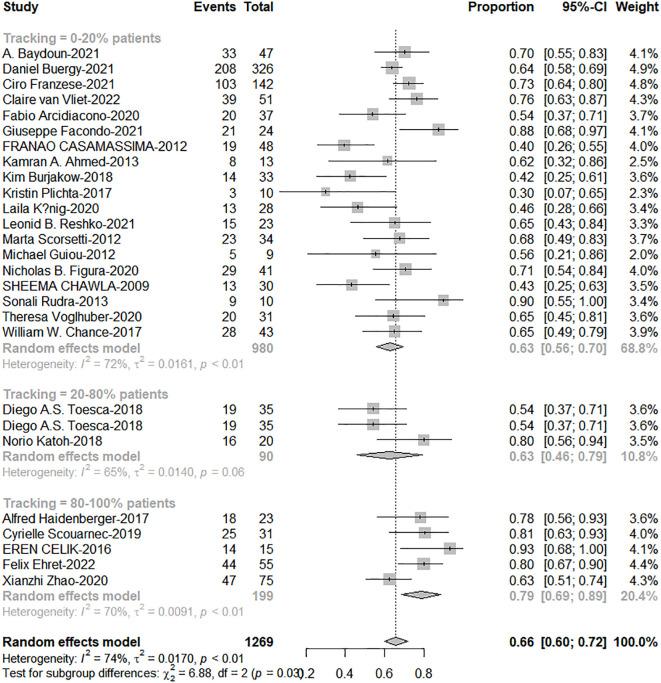
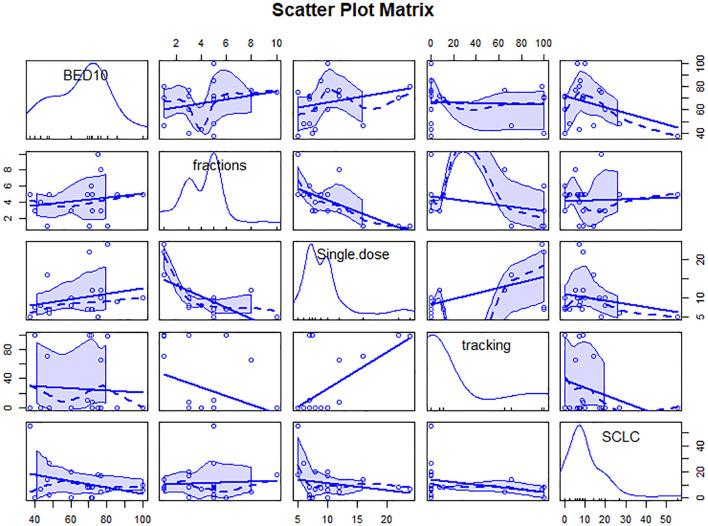
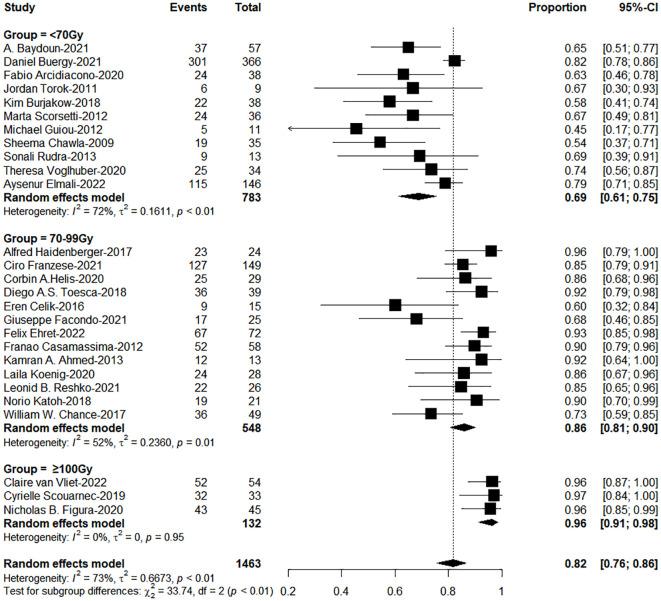
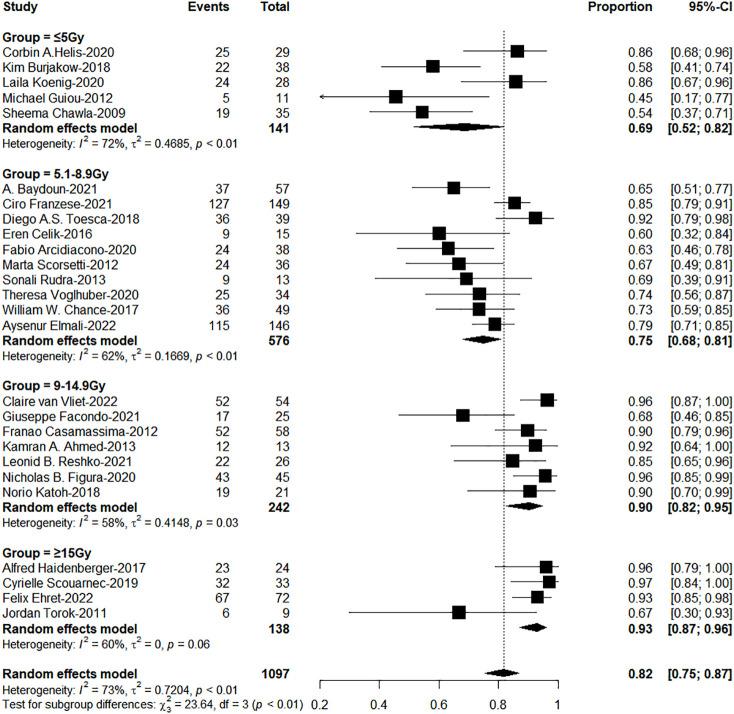
Thirty-three studies with full text from 2009 to 2022 about AM with SBRT on 1483 patients were included. Pooled 1- and 2-year local control (LC) and overall survival(OS) were 81.7% (95% confidence interval [CI], 75.6%-86.5%), 62.8% (95% CI, 53.8%-71.8%), 67.4% (95%CI, 61.8%-73.1%) and 46.5% (95%CI, 40.4%-52.6%), respectively. Biological effective dose (BED, =10Gy) and dose per fraction affected 1-year LC (Qm=23.89, 15.10; <0.0001, 0.0001). In the range of 60-80Gy (BED), the group of dose per fraction ≥ 9Gy achieved the excellent 1-year LC (< 9Gy: ≥ 9Gy =78%, 91%; χ10.16, = 0.001). Tracking technology significantly affected 1- and 2-year OS (Qm = 5.73, 8.75; = 0.017, 0.003) and high tracking adoption group showed excellent 1- and 2- year OS (78.7% [95%CI, 68.6%- 88.9%]; and 62.9% [95%CI, 53.1%-72.7%]).
CONCLUSION
Increasing the dose per fraction appropriately may help control locally AM lesious. Tracking technology might contribute to improve survival of advanced patients with AM. But these results need prospective studies to verify them.
目的
本研究旨在探讨影响肾上腺转移瘤(AM)立体定向体部放射治疗(SBRT)疗效的危险因素,并指导临床剂量选择。
方法和材料
按照系统评价和Meta分析的首选报告项目(PRISMA)指南,于2022年9月22日检索了PubMed、Embase和Web of Science。采用亚组分析和Meta回归来寻找异质性来源并确定风险结局因素。还进行了发表偏倚检验和敏感性分析。
结果
纳入了2009年至2022年关于1483例接受SBRT治疗的AM的33项全文研究。1年和2年的局部控制(LC)及总生存(OS)的合并率分别为81.7%(95%置信区间[CI],75.6%-86.5%)、62.8%(95%CI,53.8%-71.8%)、67.4%(95%CI,61.8%-73.1%)和46.5%(95%CI,40.4%-52.6%)。生物等效剂量(BED,=10Gy)和分次剂量影响1年LC(Qm=23.89,15.10;<0.0001,0.0001)。在60-80Gy(BED)范围内,分次剂量≥9Gy组的1年LC效果优异(<9Gy组:≥9Gy组=78%,91%;χ²=10.16,P=0.001)。追踪技术显著影响1年和2年OS(Qm=5.73,8.75;P=0.017,0.003),高追踪采用组的1年和2年OS表现优异(78.7%[95%CI,68.6%-88.9%];62.9%[95%CI,53.1%-72.7%])。
结论
适当增加分次剂量可能有助于局部控制AM病灶。追踪技术可能有助于提高晚期AM患者的生存率。但这些结果需要前瞻性研究来验证。


 Zotero 插件