
闪光同步对视效物体联结的影响——人工视觉模拟研究
The Influence of Phosphene Synchrony in Driving Object Binding in a Simulation of Artificial Vision.
机构信息
Department of Neurosurgery, Massachusetts General Hospital, Boston, Massachusetts, United States.
Department of Neurosurgery, Harvard Medical School, Boston, Massachusetts, United States.
出版信息
Invest Ophthalmol Vis Sci. 2023 Dec 1;64(15):5. doi: 10.1167/iovs.64.15.5.
PURPOSE
Electrical microstimulation techniques used in visual prostheses are designed to restore visual function following acquired blindness. Patterns of induced focal percepts, known as phosphenes, are achieved by applying localized electrical pulses to the visual pathway to bypass the impaired site in order to convey images from the external world. Here, we use a simulation of artificial vision to manipulate relationships between individual phosphenes to observe the effects on object binding and perception. We hypothesize that synchronous phosphene presentation will facilitate object perception as compared to asynchronous presentation.
METHODS
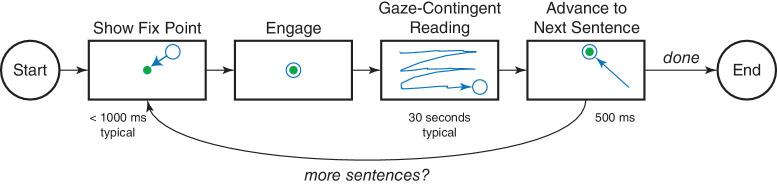
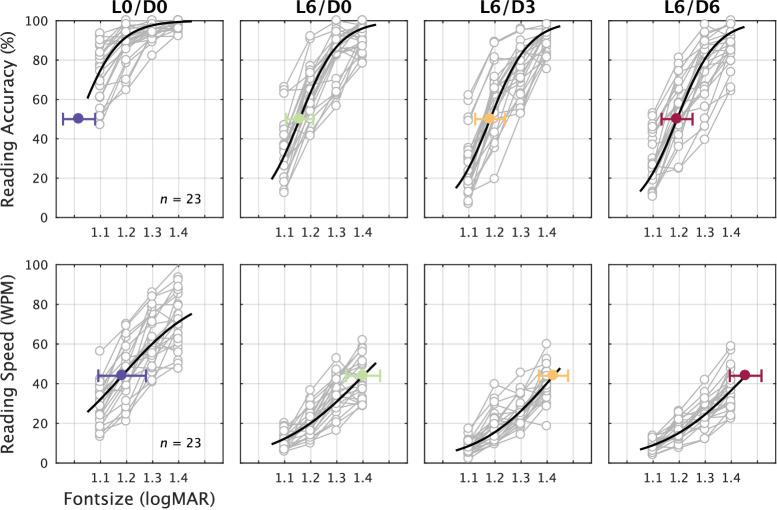
A model system that tracks gaze position of normal, sighted participants to present patterns of phosphenes on a computer screen was used to simulate prosthetic vision. Participants performed a reading task at varying font sizes (1.1-1.4 logMAR) and under varying levels of phosphene temporal noise while reading accuracy and speed were measured.
RESULTS
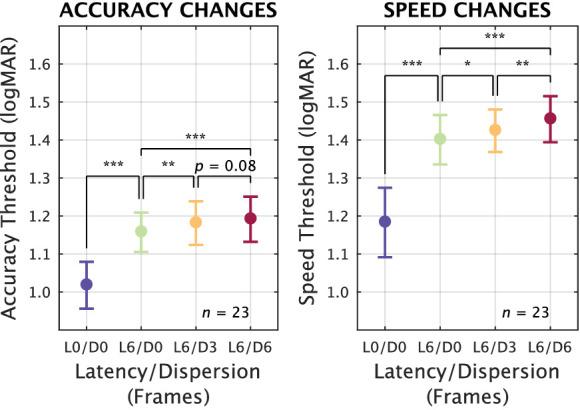
Reading performance was significantly affected by temporal noise in phosphene presentation, with increasing desynchronization leading to lower reading scores. A drop in performance was also observed when the total latency between the gaze position and phosphene update was increased without adding temporal noise.
CONCLUSIONS
Object perception (here, text perception) is enhanced with synchronously presented phosphenes as compared to asynchronously presented ones. These results are fundamental for developing an efficient temporal pattern of stimulation and for the creation of high-fidelity prosthetic vision.
目的
用于视觉假体的电微刺激技术旨在恢复后天失明后的视觉功能。通过向视觉通路施加局部电脉冲来绕过受损部位,从而产生诱导的焦点感知模式,即光幻视,以传递来自外部世界的图像。在这里,我们使用人工视觉模拟来操纵单个光幻视之间的关系,以观察对物体绑定和感知的影响。我们假设同步光幻视呈现将比异步呈现更有利于物体感知。
方法
使用跟踪正常、有视力的参与者注视位置的模型系统,在计算机屏幕上呈现光幻视图案,模拟假体视觉。参与者在不同的字体大小(1.1-1.4 logMAR)和不同的光幻视时间噪声水平下执行阅读任务,同时测量阅读准确性和速度。
结果
光幻视呈现的时间噪声对阅读性能有显著影响,随着去同步化的增加,阅读得分降低。当增加总注视位置和光幻视更新之间的延迟而不添加时间噪声时,也观察到性能下降。
结论
与异步呈现相比,同步呈现的光幻视可增强物体感知(这里是文本感知)。这些结果对于开发有效的刺激时间模式和创建高保真假体视觉至关重要。



 Zotero 插件